Prelims: Current events of national and international importance | Economy
Why in News?
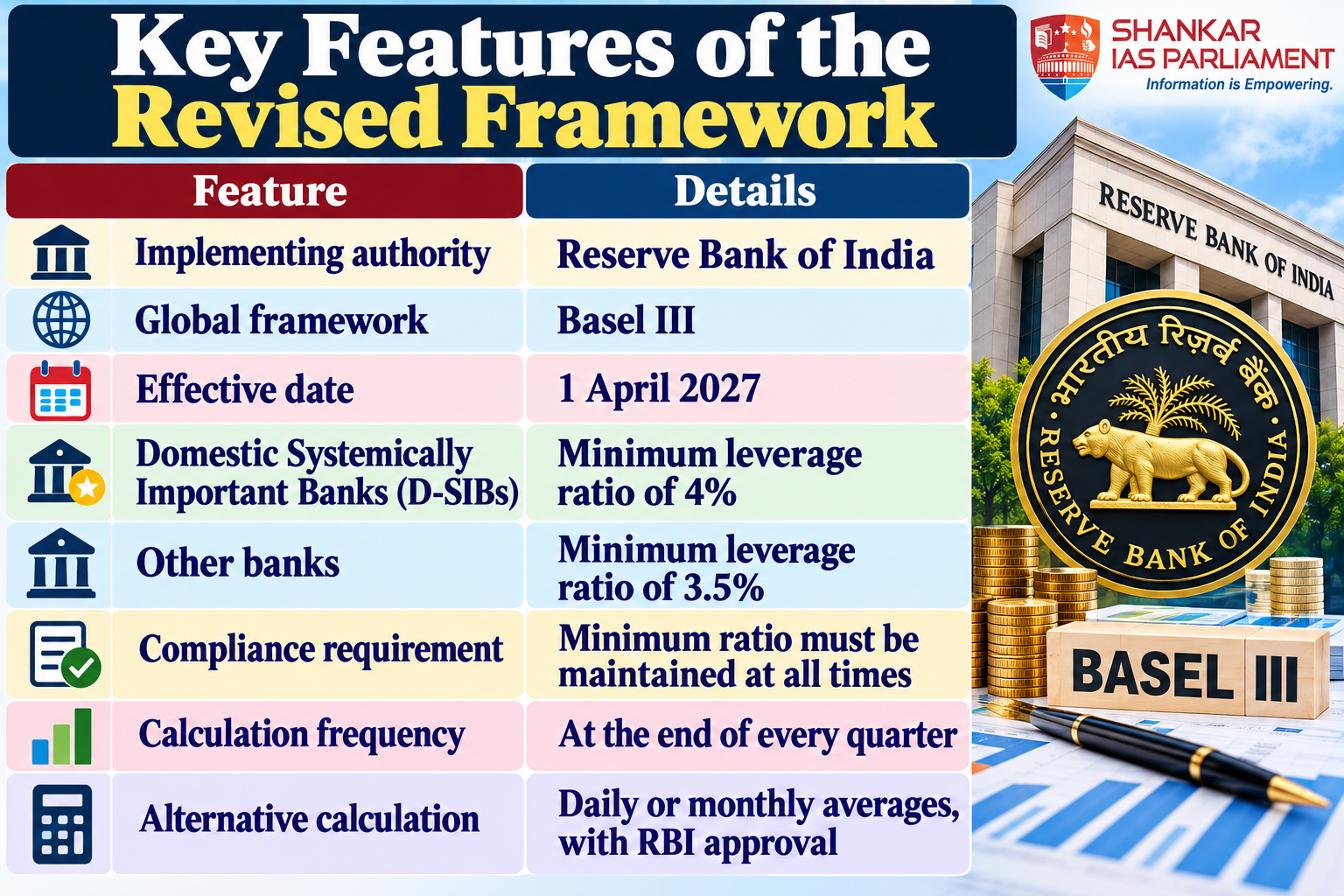
Recently, the RBI has revised its capital adequacy framework to align with the global standards established by the Basel Committee on Banking Supervision (BCBS).
- The revised leverage ratio norms are scheduled to take effect on 1 April 2027.
- The RBI declined requests from banks to extend the implementation timeline.
- Objective – To strengthen banks’ balance sheets and enhance their capacity to absorb financial losses.
Leverage Ratio
- The leverage ratio quantifies a bank’s capital in relation to its total exposure, without adjusting for the risk profile of individual exposures.
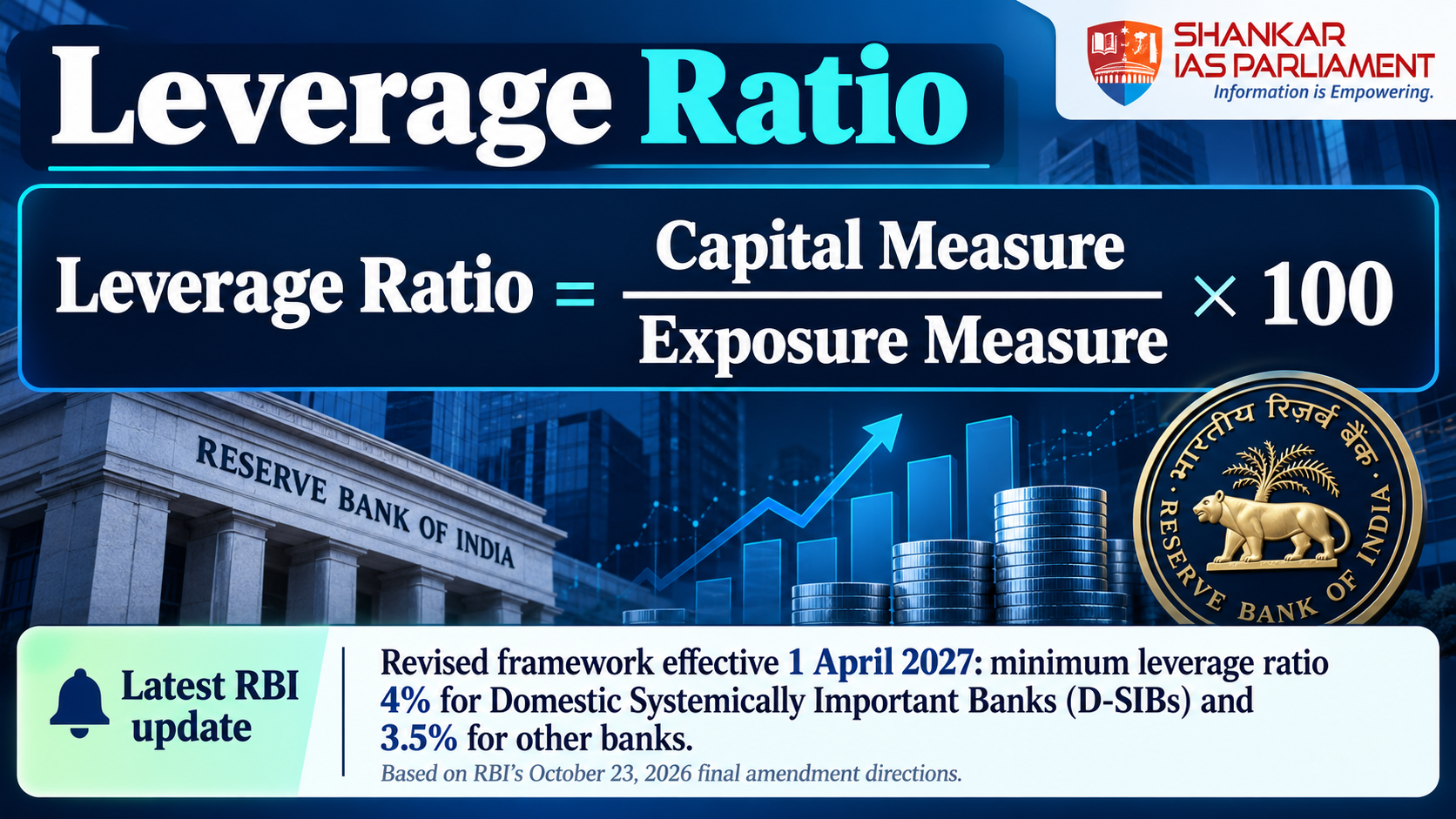
- Capital measure – It refers to the eligible capital recognized under the relevant Basel III framework.
- Exposure measure – It denotes the bank’s total exposure, encompassing both on-balance-sheet and off-balance-sheet items.
- For example, if a bank possesses eligible capital of Rs.4 crore and a total exposure of Rs.100 crore, its leverage ratio would be 4%.
- A higher leverage ratio typically reflects a more robust capital buffer relative to the bank’s total exposure.
Leverage Ratio vs Risk-Weighted Capital Adequacy Ratio
|
Basis
|
Leverage ratio
|
Risk-weighted capital ratio
|
|
Nature
|
Non-risk-based
|
Risk-based
|
|
Calculation
|
Capital ÷ total exposure
|
Eligible capital ÷ risk-weighted assets
|
|
Treatment of assets
|
Generally, does not differentiate by risk weight
|
Assigns different risk weights to exposures
|
|
Purpose
|
Limits excessive leverage
|
Ensures capital is proportionate to assessed risks
|
|
Role
|
Acts as a backstop to risk-based requirements
|
Main framework for measuring risk-based capital adequacy
|
Components of Total Exposure
The revised framework encompasses multiple categories of banking exposure.
- On-balance-sheet assets – It includes loans, investments, and other recognised assets.
- Derivatives – It refers to exposures that arise from financial contracts.
- Securities financing transactions – It includes activities such as repurchase agreements (repos) and securities lending.
- Off-balance-sheet commitments – It comprises relevant guarantees, credit commitments, and other contingent exposures.
Treatment of Collateral and Guarantees
- Banks are not permitted to reduce the leverage exposure measure by using physical or financial collateral.
- Guarantees and credit-risk mitigation techniques are not permitted to reduce reported exposure.
- Assets and liabilities may only be netted when explicitly permitted by the framework.
Rationale for the RBI’s Tightening of Regulatory Norms
- Enhancement of financial stability – Strengthens banks’ capacity to absorb unexpected losses.
- Limitation of excessive borrowing – Prevents banks from expanding their balance sheets disproportionately relative to their capital.
- Alignment with Basel III – Reinforces the prudential framework for banking supervision.
- Addressing measurement gaps – Discourages transactions or structures that may understate leverage.
- Protection of depositors – Reduces the likelihood that excessive leverage will threaten bank solvency.
- Systemic risk management – Imposes a higher minimum leverage ratio on domestic systemically important banks.
Special Powers of the RBI
- The RBI may undertake supervisory action if a bank employs transactions or structures that inadequately capture its sources of leverage.
- The RBI may, at its discretion, temporarily exempt central bank reserves from the exposure measure.
- The RBI may increase the minimum leverage ratio calibration when necessary to support the transmission of monetary policy.
- These provisions provide the RBI with flexibility to address emerging risks and specific monetary policy considerations.
Reference
Mint | RBI Revises Leverage Ratio Framework for Banks



