Why in News?
Recently the Centre amended the Census Rules, 1990, to explicitly include private-school teachers and private-sector employees as Census enumerators. The amendment follows legal challenges questioning the government’s authority under the Census Act, 1948.
What Is the Significance of the Amendment to Census Rules?
- Clarification of eligibility – The earlier rules already allowed the appointment of “Teachers, Clerks or any official or any person”.
- The amendment explicitly identifies private-school teachers and private-sector employees to remove ambiguity.
- Legal controversy – The Court have questioned the compulsory deployment of private-school teachers and employees, raising concerns about whether the rules exceed the powers granted by the parent Act.
- Government’s rationale – The amendment aims to ensure the availability of sufficient enumerators and smooth conduct of Census 2027.
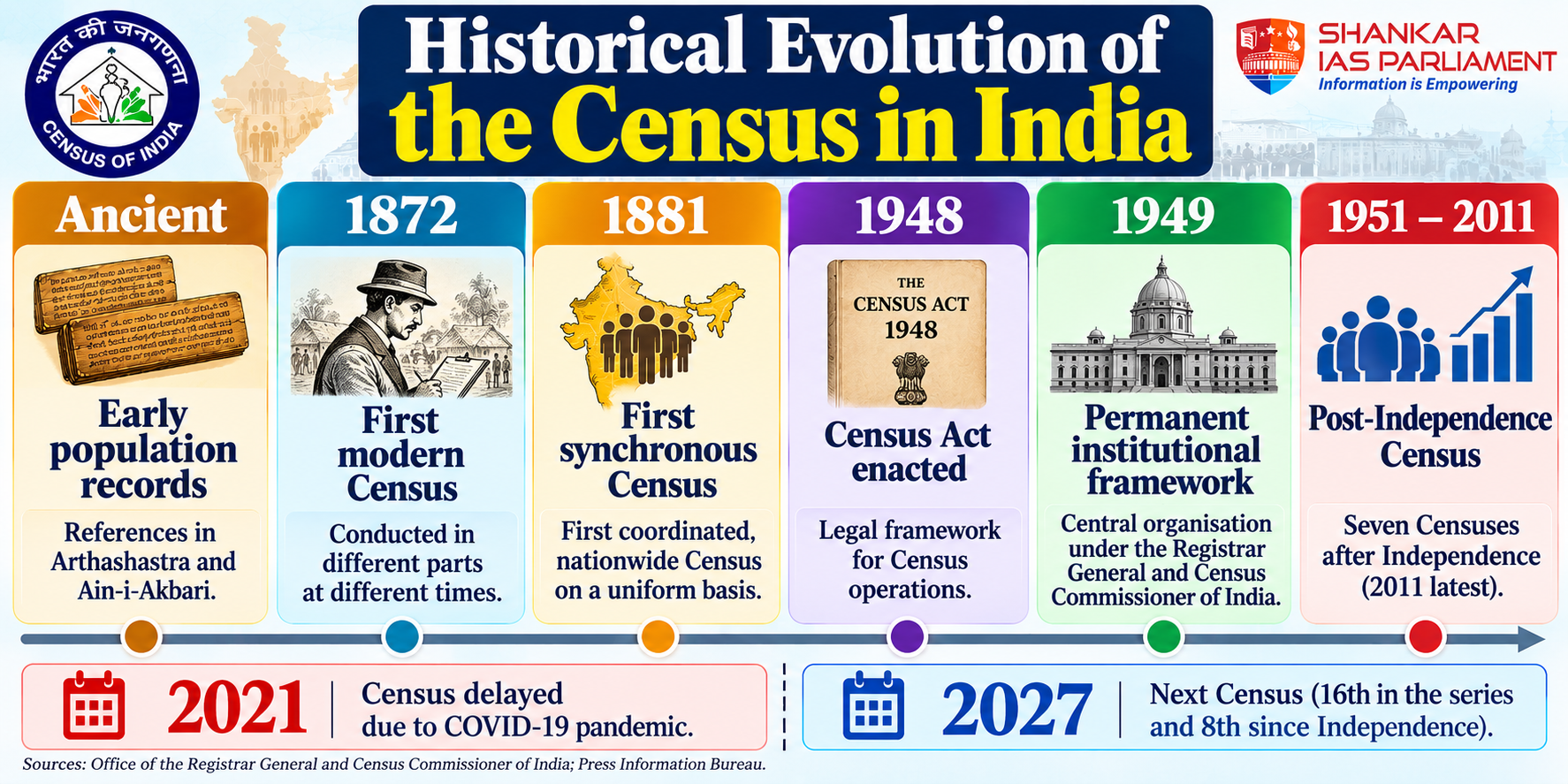
What Does the Census Act, 1948, Provide?
- Section 4(2) – Empowers state governments to appoint persons as Census officers and requires them to perform the assigned duties once appointed.
- Section 4A – Requires local authorities to provide necessary staff for Census operations when directed by the Centre.
- Sections 6 and 7 – Provide for assistance from private establishments and their personnel in specified circumstances, particularly for counting people under their charge or present on their premises.
- Legal ambiguity – While Section 4(2) uses the broad term “persons”, Sections 6 and 7 impose more specific limits on requisitioning private employees.
- It creating uncertainty over their compulsory deployment as general door-to-door enumerators.
What Have Courts Ruled on Compulsory Census Duty?
- Punjab and Haryana High Court (2010) – Quashed orders requiring LIC to provide employees for Census work, holding that Section 7(c) did not authorise their general deployment.
- However, it left the government free to invoke Section 4(2).
- Gujarat High Court (2019) – Similarly held that Section 7 did not empower authorities to requisition LIC employees for general Census duties.
- Bombay High Court (2026) – Granted interim protection against compulsory deployment of private staff, observing that subordinate legislation cannot exceed the parent Act.
- Punjab and Haryana High Court (October 2026) – Stayed Haryana government communications seeking details of private unaided-school teachers for Census duty.
- Census 2011 precedent – The Bombay High Court permitted deployment of private-school teachers subject to safeguards, with exemption of Classes X and XII teachers, and protection against disruption of academic activities.
Does the Constitution Permit Compulsory Public Service?
- Article 23(1) – Prohibits begar and other forms of forced labour.
- Article 23(2) – Allows the State to impose compulsory service for public purposes, provided it does not discriminate on grounds of religion, race, caste or class, or any combination of them.
- Judicial precedent – In Dulal Samanta v. District Magistrate, Howrah (1958), the Calcutta High Court treated compulsory appointment of special police officers under specified circumstances as public service permissible under Article 23(2).
- National Service Act, 1972 – Enabled compulsory national service for specified doctors and engineers, with safeguards for notice, hardship, remuneration and job security.
- Key distinction – Constitutional permission for compulsory public service does not automatically empower Census authorities to compel private individuals; such action must be supported by the relevant statute.
Why Does Census 2027 Require a Large Workforce?
- Scale of operations – The government estimated a requirement of around 34 lakh enumerators and supervisors in June 2025, while more recent operational figures indicate around 31 lakh personnel being trained.
- Uneven availability – Although India has more than 50 lakh government teachers, their availability varies across regions, with remote and tribal areas often facing shortages.
- Administrative challenges – Exemptions and reluctance to undertake Census duty can reduce the available workforce, while digitalisation has not eliminated the need for extensive field-level enumeration.
- Alternative approach – Adequate honoraria and better working arrangements could encourage voluntary participation and reduce the need for compulsory deployment.
What Are the Major Issues Involved?
- Statutory interpretation – Whether the broad wording of Section 4(2) permits compulsory appointment of private individuals or must be read alongside the specific limitations in Sections 6 and 7.
- Fundamental rights – Balancing compulsory public service under Article 23(2) with protection against forced labour under Article 23(1).
- Education and employment – Ensuring that Census duties do not disrupt school functioning or impose unreasonable burdens on private employees.
- Administrative efficiency – Meeting Census staffing requirements without unnecessary litigation or coercive deployment.
What Could be done?
- Provide Legal clarity – Parliament or the government should ensure that the legal basis, scope and limits of compulsory Census appointments are clearly established.
- Ensure Proportionate deployment – Prioritise government and local-authority personnel, voluntary participation and suitable honoraria, while protecting essential services.
- Ensure Safeguards – Provide reasonable notice, exemptions for genuine hardship, appropriate remuneration and safeguards against disruption of regular employment.
- Provide Judicial certainty – The courts should clarify the relationship between Section 4(2) and the specific provisions governing assistance from private establishments.
What lies ahead?
- The Census Rules amendment explicitly includes private teachers and private-sector employees, but it does not by itself settle whether they can legally be compelled to serve as general enumerators.
- The constitutional validity of compulsory public service and the statutory authority to impose it are separate questions; the latter remains central to the ongoing legal debate.
Reference
The Indian Express| Census 2027: Can private teachers or citizens be forced to do Census duty?



