Prelims: Current events of national and international importance | Environment
Why in News?
Ladakh has been designated as India’s first fully organic Union Territory, following a phased transition to organic agriculture throughout Leh and Kargil.
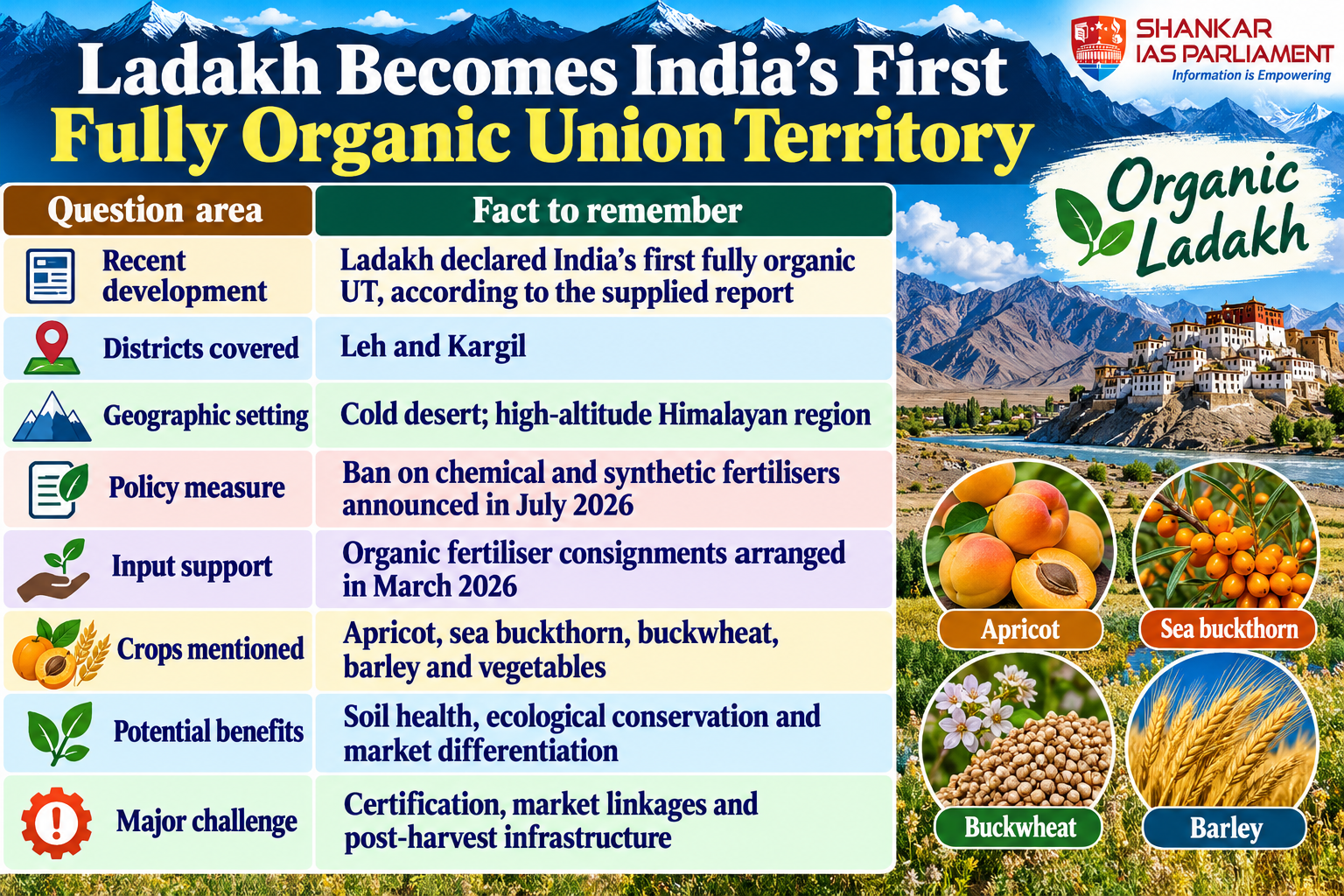
- Aim – To advance chemical-free agriculture, preserve the sensitive Himalayan ecosystem, and enhance the livelihoods of farmers.
- The administration has facilitated the transition by imposing restrictions on chemical and synthetic fertilisers, providing organic fertiliser supplies, and implementing certification measures.
|
Organic Farming
|
- Organic farming is an agricultural system that emphasises natural processes and biological inputs, while excluding synthetic fertilisers and chemical pesticides as mandated by organic production standards.
- It promotes soil health, ecological balance, biodiversity, and the sustainable use of resources.
- Key Characteristics
- Application of organic manures and compost.
- Implementation of crop rotation and additional ecological farming practices.
- Utilisation of biological methods for pest management.
- Conservation of soil and water resources is prioritised.
- Certification and traceability to establish the organic status of produce.
|
Importance of Organic Farming in Ladakh
- Ladakh is a cold desert region characterised by high altitude, limited water resources, shallow soils, and a brief agricultural growing season.
- Soil conservation helps maintain soil health and reduces dependence on synthetic inputs.
- Water protection reduces risks associated with chemical runoff.
- Ecological sustainability supports farming practices appropriate for fragile mountain ecosystems.
- Certified organic produce may command premium prices, thereby increasing farmers’ income.
- Market differentiation helps establish a distinct identity for Ladakh’s agricultural products.
- Sustainable livelihoods can create opportunities in processing, packaging, and specialised agricultural markets.
Major Steps Taken by the Administration
- Ban on Chemical Fertilisers (July 2026) – Prohibited procurement, sale and use of chemical/synthetic fertilisers across Ladakh.
- Organic Input Supply (March 2026) – Distributed organic fertilisers to villages before the sowing season.
- Phased Organic Transition – Shifted farming in Leh and Kargil towards organic cultivation with certification and monitoring support.
- Policy Promotion – Advanced chemical-free farming to support environmental conservation and sustainable livelihoods.
Challenges in Organic Agriculture
- Certification & Quality Assurance – Ensuring continuous compliance, traceability, and credible certification.
- Market & Price Constraints – High transport costs, limited market access, and uncertain premium prices for farmers.
- Infrastructure & Input Gaps – Need for better storage, processing facilities, and reliable organic input supplies.
Reference
ET | Ladakh Becomes India’s First Fully Organic Union Territory



