Mains: GS – II – Polity & Governance | Issues relating to development and management of Social Sector and Resources.
Why in news?
India has achieved a major milestone under the Jal Jeevan Mission (Har Ghar Jal), with over 81 % of rural households having access to clean tap water, marking a significant step towards universal water security in rural India.
What is jal jeevan mission?
- Aim - To provide Functional Household Tap Connections (FHTC) to provide 55 lpcd (litre per capita per day) drinking water to all rural households in the country by 2024.
- 75% of the target achieved over 5 years, so extended till 2028.
- Launched in – August 2019.
- Nodal Ministry – Ministry of Jal Shakti.
- Funding – Centrally Sponsored Scheme.
- Objective –
- Ensure universal FHTC in rural India, prioritizing water-scarce and vulnerable areas.
- Emphasizes institutional access, regular monitoring, and community ownership through voluntary contributions.
- Sustainability is supported via infrastructure, source protection, and O&M funding.
- Capacity building and awareness campaigns foster long-term engagement and safe water practices.
What are the key components of JJM?
- In-Village Piped Water Supply Infrastructure – Development of piped water systems within villages to ensure tap water connections to every rural household.
- Sustainable Drinking Water Sources – Development of reliable drinking water sources and/ or augmentation of existing sources to provide long-term sustainability to water supply system.
- Bulk Water Transfer & Distribution – Establishment of bulk water transfer systems, treatment plants, and distribution networks.
- Technological Interventions for Water Quality – Implementation of technologies to remove contaminants where water quality is an issue.
- Retrofitting of Existing Schemes – Upgrading completed and ongoing schemes to provide FHTCs at a minimum service level of 55 lpcd.
- Grey Water Management – Treatment and reuse of grey water to promote water conservation.
- Community Capacity Building – Support activities aimed at building the capacities of communities for sustainable water management.
- Contingency Funds – Provision of funds to address unforeseen challenges or issues arising from natural disasters or calamities.
What are the progress under the Jal Jeevan Mission?
- Ensuring safety – The JJM continues to make steady progress towards ensuring safe and adequate drinking water for every rural household in India.
- States/UTs with 100% Coverage – 11 States & Union Territories - achieved full tap water connectivity for all rural households.
- UTs – Goa, Andaman & Nicobar Islands, Dadra & Nagar Haveli & Daman & Diu.
- States – Haryana, Telangana, Puducherry, Gujarat, Himachal Pradesh, Punjab, Mizoram, and Arunachal Pradesh.
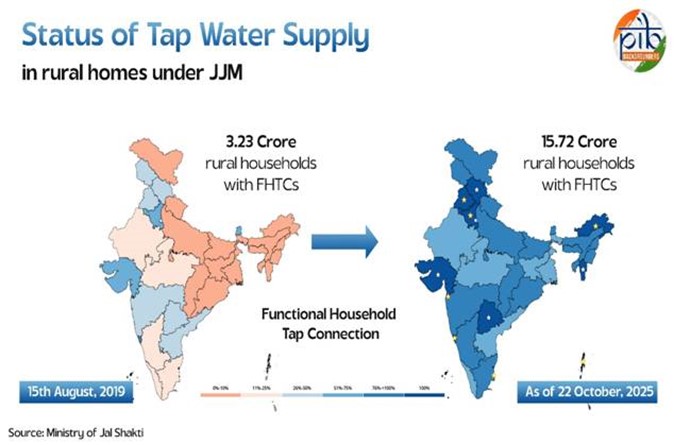
- In 2019, when the Mission was launched, only 3.23 crore households (16.71 %) had access to tap water.
- Since then, 12.48 crore additional households have been connected, marking one of the fastest expansions of basic infrastructure in rural India.
|
Quality Assurance and Monitoring (QA&M) system under JJM
|
- It is a multi-tiered, community-driven framework designed to ensure that rural households receive safe, potable tap water.
- It combines on-site testing with a robust network of laboratories and uses a digital information system for tracking and reporting.
- As of 21 October 2025, a total of 2,843 laboratories tested 38.78 lakh water samples across 4,49,961 villages in the country.
- 24.80 lakh women have been trained to test water quality using Field Testing Kits (FTKs) in 5.07 lakh villages.
|
What are the digital innovations that help in transforming rural water supply?
- RPWSS module – It is a digital registry for rural water projects, aims to enhance transparency, accountability, and efficiency in the management of rural water infrastructure.
- The module assigns a unique ID to every rural piped water supply scheme to improve transparency, accountability, and efficiency.
- Integrated with GIS mapping & PM Gati Shakti – Offers real-time dashboards, predictive analytics, and tools for efficient operation and maintenance.
- JJM Dashboard – Provides real-time tracking of mission progress across states, districts, and villages and promotes transparency, accountability, healthy competition among regions to achieve universal tap water coverage.
- Digital training platforms – JJM Digital Academy uses technology to train professionals and community members on sustainable water management, operations, and maintenance.
What are the impacts of JJM?
- Reduce burden for women – WHO estimates that by providing tap connection to every rural household will save over 5.5 crore hours daily, primarily for women.
- Health & economic benefit – Ensuring universal access to safely managed drinking water across all Indian households could:
- Prevent nearly 4 lakh deaths from diarrheal diseases
- Avert around 14 million DALYs (Disability Adjusted Life Years)
- Save up to rupees 8.2 lakh crore in health-related costs.
- Empowering women – 8.3%-point drop in household fetching water from outside, resulting in 9 crore women no longer need to fetch water – led to 7.4%-point rise in women's participation in agriculture & allied activities (SBI research).
- Reduction in mortality rate – Safe water coverage could reduce mortality among children under 5 by nearly 30%, potentially saving more than 1,00,000 lives annually (Nobel laureate Prof. Michael Kremer’s research).
- Employment generation – JJM has potential to generate nearly 3 crore person-years of employment during its build-out, with nearly 25 lakh women being trained to use Field Testing Kits (IIM-Bangalore + ILO).
What are the successful initiatives driven by communities & supported by technology?
- Digital Governance and Transparency – West Bengal
- Jal Mitra app – It is a Management Information System (MIS) aligned with the JJM.
- Aims to ensure FHTCs to every rural household, while emphasizing sustained service delivery, community ownership, and participatory monitoring through digital innovation.
- It tracked 13.70 crore community activities (April 2024–August 2025), facilitated functionality assessments for 80.39 lakh households across 22,111 villages.
- Converting Water Scarcity to Water Security – Rajasthan
- The Bothara village has severe water scarcity and groundwater exploitation exceeding 103%.
- The Water Security Plan prepared by the village’s Water Security Committee (WSC) adopted a ridge-to-valley approach.
- Check dams and contour trenches were built, leading to a 70-foot rise in the water level of an open well within 10 days of the check dam’s completion.
- Led to increase the village’s annual water storage capacity by 11.77%.
The success of the JJM lies not only in infrastructure creation but also in the spirit of “Jan Bhagidari se Peyjal Prabandhan”, community-led water governance combined with innovative use of technology.
What lies ahead?
- In just 6 years, JJM is turning the vision of Har Ghar Jal into reality through rapid expansion, digital innovation, and strong community involvement.
- With sustainability and equity at its core, the Mission stands as a model of good governance and people-led development, taking India closer to universal and reliable water security.
References
- PIB | Jal Jeevan Mission
- JJM | Jal Jeevan Mission



