0.1322
7667766266
x

Indigenous Air Independent Propulsion (AIP) System

iasparliament Logo
October 27, 2026

Prelims: Current events of national and international importance | Defence

Why in News?

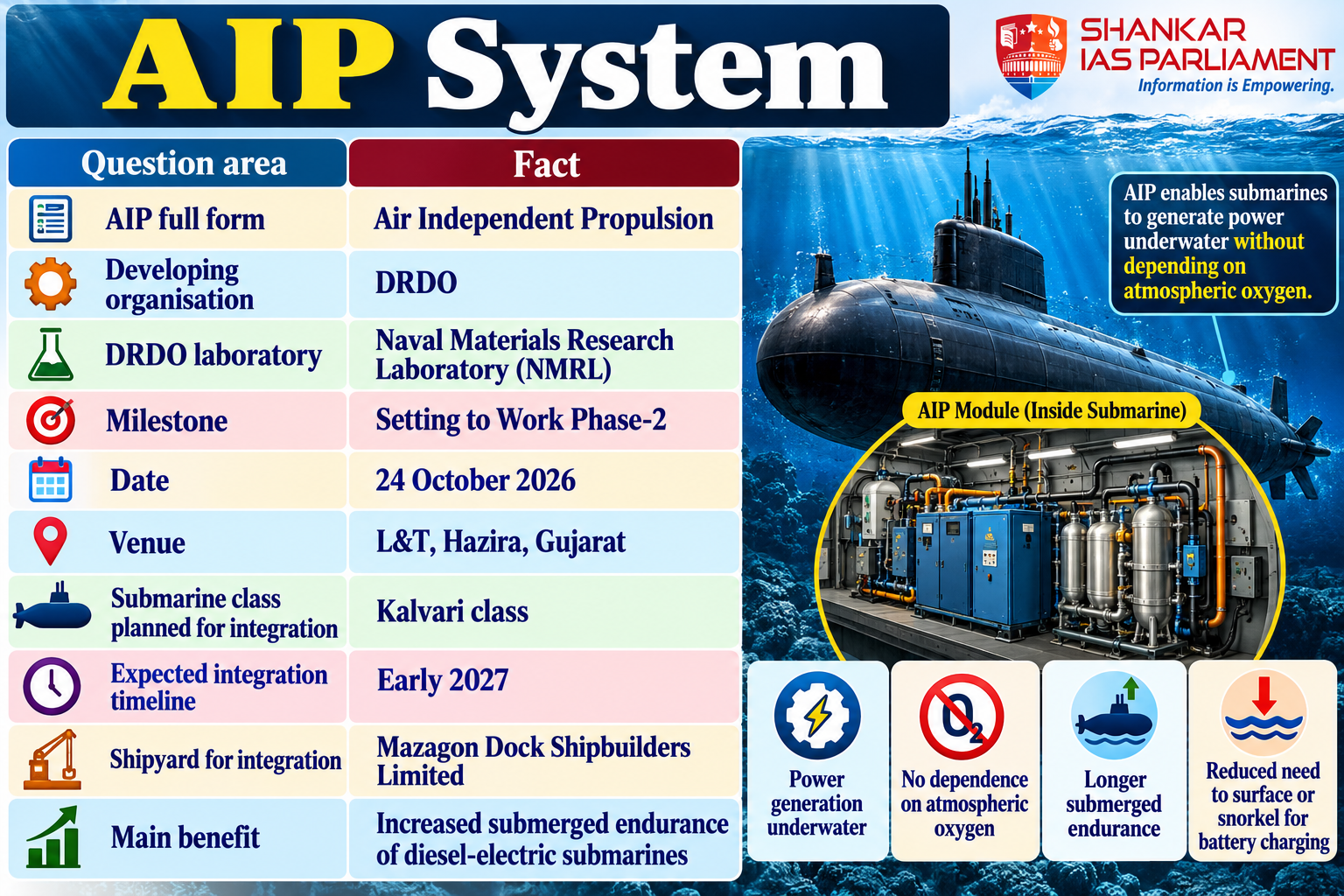
The DRDO marked a significant milestone with the inauguration of Setting to Work Phase-2 (STW-2) for the indigenous Air Independent Propulsion (AIP) system Energy Module.
aip-system-submarine-infographic.png

  • The Air Independent Propulsion (AIP) system was developed by the Naval Materials Research Laboratory (NMRL) of DRDO.
  • Inauguration at – Larsen & Toubro’s A. M. Naik Heavy Engineering Complex in Hazira, Gujarat.
  • The system is scheduled for integration into a Kalvari-class submarine in early 2027, following additional testing and transfer to Mazagon Dock Shipbuilders Limited (MDL).

Air Independent Propulsion (AIP) Systems

  • Air Independent Propulsion (AIP) is a technology that allows conventional diesel-electric submarines to remain submerged for extended periods without relying on atmospheric oxygen.
  • Conventional diesel-electric submarines typically must surface or use a snorkel at regular intervals to operate their diesel engines and recharge their batteries.
  • The integration of an AIP system reduces this reliance, thereby increasing underwater endurance and improving operational stealth.

Key Features

  • Enhanced endurance – Enables diesel-electric submarines to remain submerged for extended durations.
  • Improved stealth – Minimises the frequency of surfacing or snorkelling, thereby decreasing the risk of detection.
  • Indigenous defence technology – Enhances India's self-reliance in the development of submarine propulsion systems.
  • Industrial collaboration – Integrates efforts of DRDO, the Indian Navy, and Larsen & Toubro.
  • Strategic capability – Augments India's underwater operational effectiveness.

Important Organisations and Their Roles

Organisation

Role

DRDO

Defence research and development; developer of the indigenous AIP system.

Naval Materials Research Laboratory (NMRL)

DRDO laboratory responsible for developing the AIP Energy Module.

Indian Navy

Conducts testing and validation and establishes protocols for the system.

Larsen & Toubro (L&T)

Associated with the STW-2 activity at its Hazira facility.

Mazagon Dock Shipbuilders Limited (MDL)

Expected to receive the Energy Module for integration into a Kalvari-class submarine.

Setting to Work Phase-2 Milestone

  • STW-2 represents a stage in the programme designed to prepare the AIP Energy Module for operational readiness and subsequent testing.
  • The subsequent phase will involve energising the module to initiate power production.
  • The system will undergo comprehensive testing in accordance with Indian Navy protocols.
  • Upon successful completion of testing, the module is expected to be transferred to MDL for integration in early 2027.

AIP vs Nuclear Propulsion

Feature

AIP diesel-electric submarine

Nuclear-powered submarine

Energy source

Conventional propulsion system supplemented by AIP

Nuclear reactor

Atmospheric oxygen

AIP reduces dependence on atmospheric oxygen

Reactor does not require atmospheric oxygen for operation

Underwater endurance

Greater than conventional diesel-electric operation without AIP, but limited by system capacity and other onboard requirements

Generally, much longer, limited by provisions, maintenance and operational factors

Main advantage

Improved stealth and submerged endurance at comparatively lower complexity than nuclear propulsion

Sustained high-power underwater operation

Classification

Conventional submarine technology

Nuclear propulsion technology

Reference

PIB | Air Independent Propulsion (AIP) Systems

There are no reviews yet. Be the first one to review.

ARCHIVES

sidetext


