Blending Physical and Virtual Worlds
From Digital to Immersive: India’s Next Leap
- India’s digital ecosystem, supported by UPI, Aadhaar, DigiLocker, UMANG and BHASHINI, is moving towards more interactive and experiential digital services through Artificial Intelligence (AI), high-speed connectivity and advanced computing.
- Immersive technologies enable realistic digital experiences across education, healthcare, tourism, culture, gaming, entertainment and retail.
- India’s immersive technology market generated USD 1,259.5 million in 2023 and is projected to reach USD 7,818.7 million by 2030, growing at a CAGR of 29.8%.
- India has the potential to become a global hub for immersive technology through research, startups, skilled talent, content and indigenous innovation.
Creative Minds, Catalyzing Science, Empowering Technologies
- The second edition of the Emerging Science, Technology and Innovation Conclave (ESTIC-2026) will be held from 27–29 October 2026 at Bharat Mandapam, New Delhi.
- Organised by the Council of Scientific & Industrial Research (CSIR), it will cover 12 thematic areas, including Generative Extended Reality (XR) and Spatial Computing.
Understanding Immersive Technologies
Immersive technologies create interactive digital experiences by combining physical and virtual environments, enabling users to engage with digital content through multiple senses.
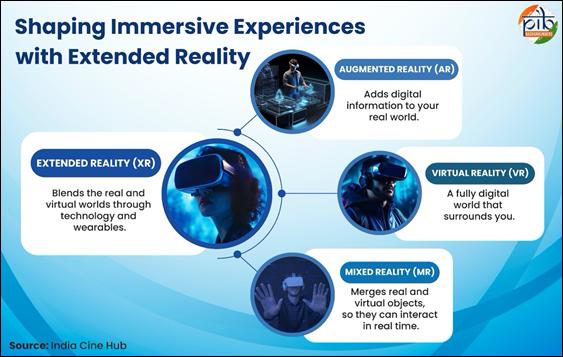
Extended Reality (XR)
XR encompasses three major technologies:
- Virtual Reality (VR): Creates a completely digital environment that users explore through specialised devices.
- Augmented Reality (AR): Overlays digital information or objects onto the real-world environment.
- Mixed Reality (MR): Integrates physical and digital environments, allowing digital objects to interact with real surroundings.
Other related technologies include 360-degree video, which enables viewing in every direction, and Haptic Technology, which uses vibrations, pressure or other physical sensations to simulate touch.
Stepping Into the Experience: How India Is Using Immersive Technology
Education
- IIT Madras is developing AR/VR-enabled learning solutions for rural secondary schools, enabling interactive learning in history, science, social science and languages.
- Virtual laboratories and three-dimensional models can improve conceptual understanding and make classroom learning engaging.
Heritage and Tourism
- JATAN software digitises museum artefacts and records; eight national-level museums and two ASI museums have been digitised.
- The Indian Museum, Kolkata, uses AI-based interactive features and AR tools, while ASI museums at Hampi and Nalanda offer mobile-based virtual tours.
Governance and Infrastructure
- The Department of Telecommunications’ Sangam: Digital Twin initiative integrates digital twins with 5G, IoT and AI for infrastructure planning.
- Varanasi’s Urban 3D Spatial Planning project demonstrates its application. India aims to develop a National Digital Twin for major urban centres by 2035.
- Digital twins simulate real-world objects or systems, helping assess infrastructure impacts, mobility patterns and transport requirements before implementation.
Creative Economy and Entertainment
- India’s gaming sector is projected to grow from USD 3.8 billion in 2024 to USD 9.2 billion by FY2029.
- Platforms such as the WAVES summit showcase India’s creative and immersive media capabilities globally.
Powering Immersive Technology: India’s Key Initiatives
India promotes immersive technology through the broader Animation, Visual Effects, Gaming, Comics and Extended Reality (AVGC-XR) framework.
AVGC-XR Promotion Task Force
- Constituted by the Ministry of Information and Broadcasting in April 2022, it promotes public-private collaboration, inter-ministerial coordination and integrated sectoral development.
Indian Institute of Creative Technologies (IICT)
- Established in 2025 as a National Centre of Excellence, IICT develops skilled talent for the AVGC-XR sector.
- By March 2026, it had introduced 18 courses with over 135 students enrolled.
GENESIS
- Launched in 2022 by MeitY, the scheme aims to support around 1,600 technology startups in Tier-II and Tier-III cities over five years.
- It supports 84 AR/VR startups and 106 incubators.
AVGC Content Creator Labs
- The Union Budget 2026–27 allocated ₹250 crore for labs in 15,000 secondary schools and 500 colleges.
- IICT, Mumbai, will coordinate implementation and promote practical skills in animation, VFX, gaming and digital content creation.
WaveX
- The Ministry of Information and Broadcasting’s media-tech startup accelerator supports AVGC-XR and emerging media technology startups in developing market-ready solutions.
States Leading India’s AVGC-XR Growth Story
- Karnataka: AVGC-XR Policy 3.0 and a ₹20-crore KITVEN AVGC Fund.
- Maharashtra: AVGC-XR Policy 2025 with a ₹3,268-crore financial plan.
- Telangana: Hyderabad-based ecosystem with 150+ AVGC/VFX companies and 30,000 direct jobs.
- Tamil Nadu: Policy targets 200+ startups, around two lakh jobs and up to 20% of India’s AVGC-XR market by 2030.
- Kerala: Policy targets 50,000 new industry jobs by 2029.
- Madhya Pradesh: Promotes centres of excellence, skilling and investment incentives.
- Uttar Pradesh: Developing an AVGC-XR Park at Jewar.
- Rajasthan: Offers production incentives for eligible animation, VFX, AR/VR and gaming projects.
- Gujarat: Developing a comprehensive policy supported by 16 institutions offering relevant courses.
Way Forward
Immersive technologies can strengthen India’s creative economy, education and cultural preservation. Coordinated national and state initiatives, alongside investment in talent, research and indigenous innovation, can help India emerge as a global hub for immersive content and contribute to the vision of Viksit Bharat 2047.
Reference
PIB



