Why in news?
Four leaks were reported (two in Swedish waters and 2 in Danish waters) in Nord Stream pipelines linking Russia and Europe.
What is Nord Stream Pipeline?
- Owned by the Russian energy giant, Gazprom, Nord Stream Pipeline is the longest subsea pipeline.
- It is an export gas pipeline that runs under the Baltic Sea carrying gas from Russia to Europe.
- The gas for Nord Steam comes mainly from the Bovanenkovo oil and gas condensate deposit in Western Siberia.
- Nord Stream consists of two pipelines, which have two lines each.
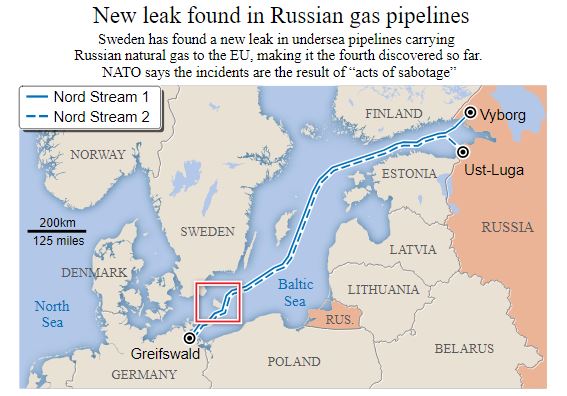
- Nord Stream 1 that runs from Vyborg in Russia to Lubmin in Germany was completed in 2011.
- Nord Stream 2 that runs from Ust-Luga in Russia to Lubmin in Germany was completed in 2021.
- Both the pipelines together can transport a combined total of 110 billion cubic metres of gas a year to Europe for at least 50 years.
- The Nord Stream crosses the Exclusive Economic Zones (EEZs) of several countries including Russia, Finland, Sweden, Denmark and Germany, and the territorial waters of Russia, Denmark, and Germany.
- While both pipelines are not currently running commercially, they had millions of cubic metres of gas stored in them.
What is the current leak about?
- Two leaks were detected on the Nord Stream 1 pipeline, both in an area northeast of the Danish island of Bornholm.
- Sweden had reported two separate underwater explosions, very close to where the leaks occurred.
- Possible causes of the leak- The investigations have not yet revealed the cause behind the leaks.
- Possible causes range from technical malfunctions to a lack of maintenance, to even possibly sabotage (deliberate damage or destruction of equipment or property which belongs to the enemy).
- The European Union (EU) and North Atlantic Treaty Organisation (NATO) called the leaks acts of sabotage.
- Russia, which controls the pipeline, has not ruled out sabotage either.
- Ukraine said the leaks were likely the result of a terrorist attack carried out by Russia.
- Various European countries, such as Sweden and Denmark, have launched separate investigations into the matter.
What will be the impact of the leaks?
- Economic impact- European gas prices immediately spiked after the reports of the leaks emerged.
- As a result of the leak, all the stored gas is escaping.
- The pipelines are unlikely to provide any gas to Europe through the forthcoming winter months.
- Depending on the intensity of the damage caused by these ruptures, permanent closure of the Nord Stream lines was also a possibility.
- Environmental impact- Methane is a large component of natural gas and is also a potent greenhouse gas.
- It is the second-largest contributor to climate change after CO2.
- Other impacts- Vessels could lose buoyancy if they enter the area, and there might be a risk of leaked gas igniting over the water and in the air.
What steps can countries take to protect their critical infrastructure?
- The Nord Stream incident shows the importance of surveillance, and making sure countries know which boats and submarines are around the pipeline.
- The steps involves
- Building more protective pipes that can withstand intrusion
- Controlling access to pipelines
- Monitoring them
- Intercepting potential attacks
References
- https://www.thehindu.com/news/international/explained-the-nord-stream-pipeline-leaks-what-happened-and-what-is-at-stake/article65950516.ece?homepage=true
- https://www.npr.org/2022/10/03/1126517181/nord-stream-pipeline-leaks-protecting-critical-infrastructure
- https://www.aljazeera.com/news/2022/9/27/qa-what-is-known-so-far-about-the-nord-stream-gas-pipeline-leak



