Why in news?
Sri Lanka has reached a staff-level agreement (formal arrangement) with the IMF that promises access to 29 billion dollar over a 4-year period.
What is the case with Sri Lanka?
- Sri Lanka’s economic crisis- Sri Lanka’s economic situation has worsened with 51 billion dollars of external debt.
- So, the country has reached an agreement with IMF to access credit under IMF’s Extended Finance Facility.
- Conditions- It comes with a host of conditions varying from
- Raising fiscal revenue
- Reducing corruption vulnerabilities
- Safeguarding financial stability
- Persuading the country’s multiple creditors to restructure and reschedule past debt
- Significance- The agreement is a step towards convincing foreign creditors and investors to return to the country.
- Steps taken- The Central Bank has
- Floated the rupee
- Raised interest rates sharply
- Increased electricity tariffs and fuel prices
- Restored tax cuts
What are the challenges?
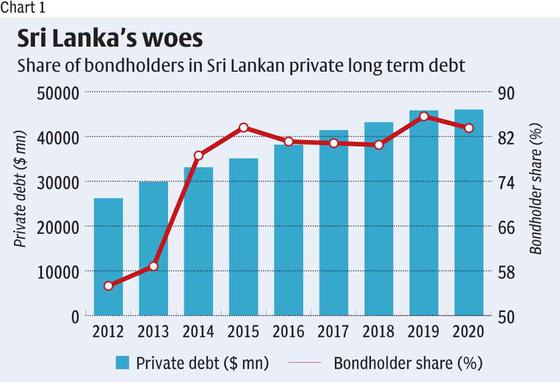
- The outstanding long-term debt had risen from 26.2 billion dollar from 2012 to 46 billion dollar in 2022.
- The share of private creditors had risen to 37%.
- The bondholders in private credit had risen to 84%.
- Private bondholders would be less willing to accept any deal that requires them to take some losses.
- Talks with International Sovereign Bond (ISB) holders is a more complex exercise, with geopolitical dimensions.
How can Sri Lanka’s crisis be compared with other countries?
- Similiarities- Private long-term external debt outstanding of countries identified by the World Bank belonging to the low and middle income category more than doubled from 2012 to 2020.
- The share of bondholders in that debt rose from 63% in 2013 to 80% in 2020.
- Differences- The variation is based on bond-based borrowing by government in the different regions.
- Overall, the share of governments in foreign currency bond issues across emerging market and developing economies (EMDEs) has fallen between 2002 and 2021.
- The fall has been largely driven by declines in developing Europe and Latin America and the Caribbean.
- The share of government issuance has risen in Africa and the Middle East and in developing Asian and the Pacific.
- But foreign currency bonds may not be the best channel to mobilise resources as foreign borrowing requires debt service commitments to be covered in foreign currency.
- Increased dependence of less developed nations on sovereign bondholders has not only contributed to a debt crisis but made resolution near impossible.
References
- https://www.thehindubusinessline.com/opinion/foreign-currency-bonds-courting-the-devil/article65854368.ece
- https://www.thehindu.com/news/international/the-international-monetary-funds-staff-level-agreement-with-sri-lanka/article65849757.ece



