Why in News?
Recent attacks on commercial ships near the Red Sea amidst the ongoing Gaza war impacts India’s global trade.
What is Red sea?
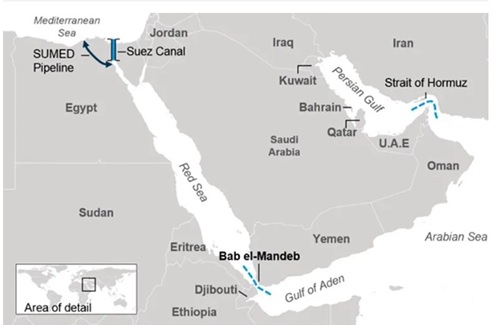
- The Red Sea is a narrow inland sea between Africa and the Arabian Peninsula.
- The nearly 2,000-km Red Sea connects the Mediterranean Sea with the Indian Ocean via the narrow Suez Canal (since 1869).
- It is connected to the Arabian Sea and the Indian Ocean to the south through the Gulf of Aden and the narrow strait of Bab el Mandeb.
- The Bab-el-Mandeb Strait, also known as the "Gate of Tears" in Arabic, is a crucial trade route that connects the Mediterranean Sea and the Indian Ocean via the Red Sea and the Suez Canal.
- Bordering countries – Egypt, Saudi Arabia, Yemen, Sudan, Eritrea and Djibouti.
To know about Red Sea, click here
Why trade across red sea is important?
- Historical significance – There are evidences of Indian diaspora in the Middle East even at the time of Meluha (the Indus Valley Civilisation, c. 3300-1300 BCE).
- In the 1st and 2nd century CE, maritime highway linked the Roman Empire and India through the Red Sea, with many 100’s of ships going in both directions each year.
- Economic significance – Suez Canal was opened in 1869 and since then, it has become the busiest trade route as it reduced distance between Europe and Asia by 7000km.
- Geopolitical significance – The narrow Suez Canal is strategically located connecting west and east.
What is the impact of Red Sea trouble on Indian trade?
- Stopping vessel movements – Major cargo shipping lines decided they would not operate on this route and even small feeder vessels have of late stopped plying in these waters.
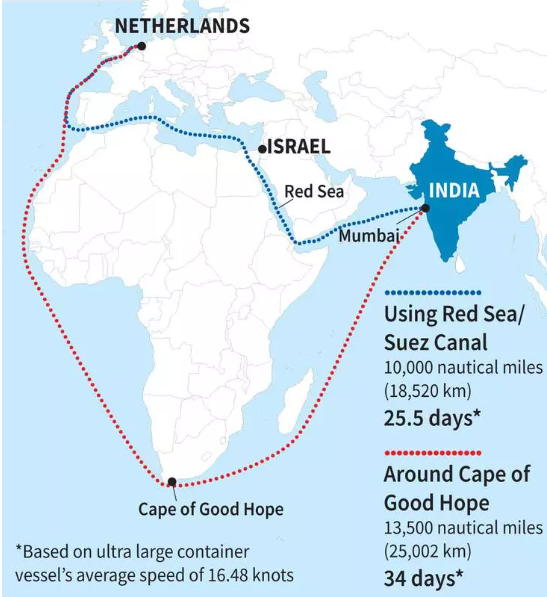
- Re-routing of ships – Almost 90% of western hemisphere cargo, both inbound or shipped from India is now getting re-routed through the Cape of Good Hope.
- The remaining 10% of Indian import or export cargo is either not moving or using a transit facility.
- Higher transit time – Trade with Europe, the U.S. east coast and to North Africa is taking the longer route and thus elongating both export and import cycles.
- Holding back the consignment – Roughly 20-25% consignments are being held up.
- Increase in freight costs – It may affect all consignments by up to 6-fold in some cases which may also be due to peak season surcharge and contingency surcharge.
- Increased Insurance costs – They are not sure of what will happen to the ships as more escorts are needed.
- Higher fuel burning – Long route ships could burn a million dollars’ worth of fuel per trip.
 Costlier imports – Final products could turn dearer and it could affect the plans to reduce pump prices of petrol and diesel.
Gross imports of crude oil and petroleum products as a share of India’s gross imports in value terms was 25.8% in 2022-23, and 22.6% in the 1st half of the current fiscal.
- Affects commodity sectors – The worst affected sectors are chemicals, plastic, petrochemicals, because margins are not there to absorb the hike in freight.
What lies ahead?
- The Indian navy is monitoring the overall situation in coordination with national maritime agencies.
- Enhanced maritime surveillance – Indian Navy’s destroyers and frigates are undertaking maritime security operations and rendering assistance to merchant vessels in case of any incident.
- INS Chennai closely followed the hijacked MV Lila Norfolk ship and rescued all 21 crew, including 15 Indians, onboard.
- Aerial surveillance – A complete maritime domain awareness is done by using long-range maritime patrol aircraft and remotely piloted aircraft.
- Strengthening ‘Operation Prosperity Guardian’ – US spearheaded multinational operation to keep the sea lanes open and free of threats but India is yet to decide on joining it.
References
- The Hindu| Red Sea trouble impacts India’s Trade
- The Hindu| The Strategic Chokepoint