Why in news?
Nearly three years into the pandemic, China is sticking with a strict COVID-19 containment policy that has caused mounting economic damage and widespread frustration.
What is Zero-Covid?
- Dynamic-zero - China’s zero-covid policy is not geared towards having zero cases at all times but about dynamically taking action when cases surface.
- Dynamic-zero is two-pronged - prevention and containment.
- Prevention - Prevention focuses on early detection through regular PCR tests.
- Potential or suspected cases are isolated at home or placed under quarantine at a government-supervised facility.
- Containment - Control tactics is aimed at swiftly cutting off transmission chains to prevent outbreaks.
- It involve quarantining cases at government-supervised facilities and locking down buildings, communities or even entire cities.
- Since March 2020, China's borders have remained shut to most visitors.
- Some local authorities have taken extreme measures, such as forcing workers to sleep inside factories so they can work while quarantined.
What is the need for following such stringent restrictions?
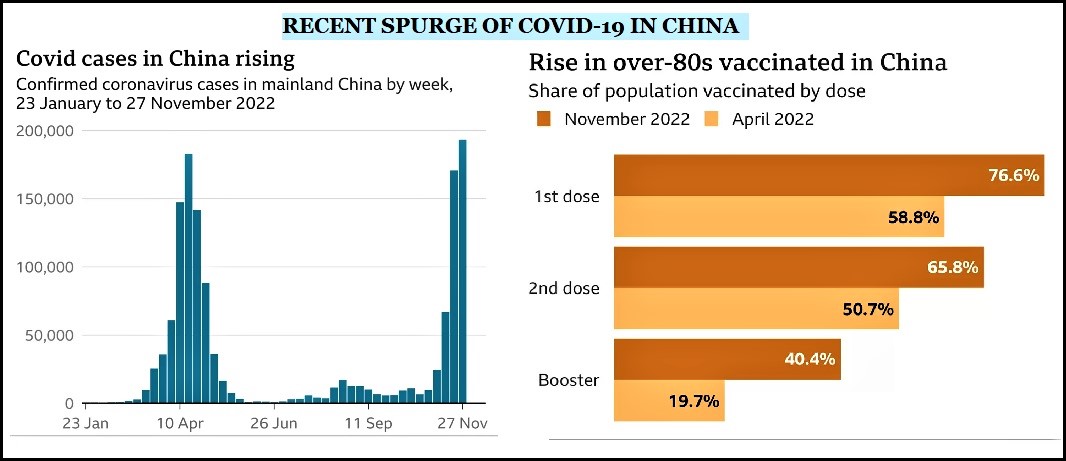
- New infections - New infections have been reported throughout China, but the worst affected cities have been Guangzhou, Shanghai, and Chongqing.
- Vaccination rate among elderly - Overall, China says more than 90% of the population has been fully vaccinated.
- However, less than half of people aged 80 and over have received three doses of vaccine.
- Effectiveness of vaccines - There are doubts over whether the main vaccines used in China - Sinovac and Sinopharm - are effective against Omicron.
- The World Health Organization has urged China to change its method of dealing with Covid.
- However, Chinese President Xi Jinping has said the zero Covid policy is scientific and effective.
 What effect have zero covid policies had on China's economy?
- Lockdowns - In recent months, lockdowns have taken place in several cities including Shenzhen (technology hub) and Shanghai (manufacturing, trade and financial hub).
- The shutting of factories and ports for long periods have affected work with foreign companies.
- Economic growth - China's economy has grown by only 3.9% over the past year, compared with its target of 5.5% for 2022.
- Unemployment - Unemployment is rising, especially amongst young people, and the property market is weakening.
- Supply chain - China's lockdown measures are also affecting businesses and consumers in the rest of the world, who rely on China for supplies of goods.
- Factory closures have also led to fears of a shortage of toys ahead of Christmas.
- Other effects - Anger over China's zero-Covid policy has sparked protests in major cities, including Beijing, Shanghai and Guangzhou.
- There has been a nationwide protests calling for an end to lockdowns and greater political freedom.
- China has rolled back its most severe Covid policies - including forcing people into quarantine camps - just a week after landmark protests against the strict controls.
References
- BBC│ What is China's zero Covid policy and what are its rules?
- Economic Times│ How does China's zero-Covid policy work?



