Why in News?
India and USA have agreed to negotiate the first stage of a mutually beneficial, multi-sector Bilateral Trade Agreement (BTA) by the fall of 2025.
What is Bilateral Trade Agreement(BTA)?
- Bilateral Trade Agreement - It is a deal between two countries to set the terms and conditions for trade between them.
- Objective - These agreements are designed to encourage economic cooperation and remove barriers like tariffs, quotas, or import restrictions.
- Components of BTA - These include stipulations governing customs duties and other levies on imports and exports, commercial and fiscal regulations, transit arrangements for merchandise, customs valuation bases.
- Most bilateral trade agreements, either explicitly or implicitly, provide for
- Reciprocity
- Most-favoured-nation treatment
- National treatment of nontariff restrictions on trade.
What is the trade relationship between India and USA?
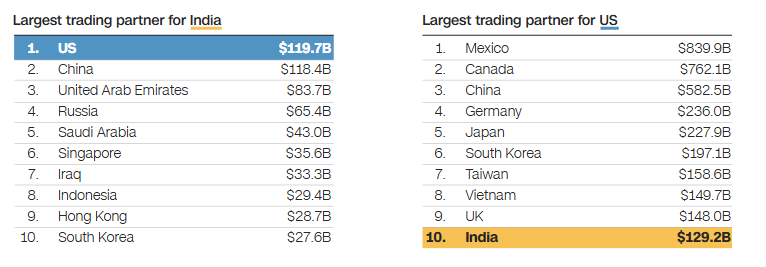
- Largest trading partner - India’s was once the largest trading partner of US, accounting for almost $120 billion in trade.
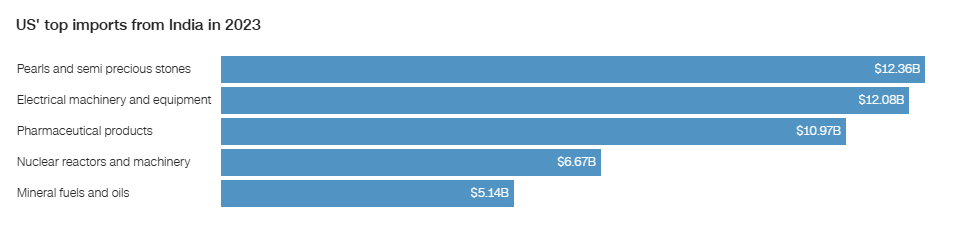
- India’s export to USA – It is mostly semi-precious stones, electrical machinery , Pharmaceutical products to USA
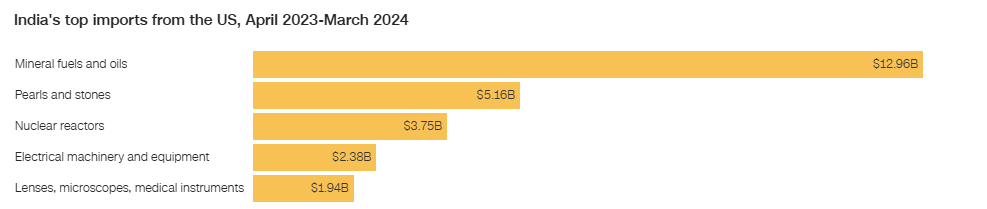
- India’s import from USA - India gets crude oil and related products, gems and stones, nuclear reactors and electrical and medical equipment.
- Investment - USA is the 3rd largest investor in India with cumulative FDI inflows of US$ 65.19 billion from April 2000-March 2024.
What are the challenges in implementing BTA between India and USA?
- International trade regulations - A significant portion of international trade law is codified in the General Agreement on Tariffs and Trade (GATT) and governed by the World Trade Organization (WTO).
- Since both the U.S. and India are members of the WTO, their bilateral trade dealings must align with the standards set by WTO law.
- MFN principle - The WTO system operates on the most favoured nation (MFN) principle, which prohibits discrimination between trading partners.
- Therefore, an FTA that grants preferential access to certain countries violates the MFN rule.
Countries can still establish FTAs under specific conditions.
- WTO law - If India and the U.S. reduce tariff rates on each other’s limited products, as part of some bilateral deal, without extending similar treatment to other countries, it would violate WTO law.
- Inclusion of all trade - Article XXIV.8(b) of the GATT, requires member countries to eliminate customs duties and other trade barriers on “substantially all the trade” within the FTA.
- Therefore proposed BTA between India and the U.S. must cover “substantially all trade” to be legally valid.
What can be done?
- Interim agreement – India and the U.S can notify the agreement as an ‘interim agreement’, leading to the formation of an FTA.
|
GATT Interim Agreement
|
- Article XXIV of GATT permits them to sign ‘interim agreements’ that pave the way for an eventual FTA, subject to specific conditions
- Under Article XXIV.5 of GATT, countries can enter into an ‘interim agreement’ if it is necessary for forming a free trade area.
- This ‘interim agreement’ must include a plan or schedule for establishing an FTA within a reasonable timeframe, which should typically not exceed 10 years.
|
- Enabling Clause -WTO law provides another exception to the MFN principle in the form of what is known as the ‘enabling clause’.
- As per this arrangement, WTO countries can deviate from the MFN principle if it is meant to provide better market access to the products of developing countries.
- Way Forward
- The proposed Bilateral Trade Agreement (BTA) between India and the USA aims to deepen economic connections and reach the "Mission 500" trade target. Challenges include WTO compliance and trade requirements.
- Solutions involve interim agreements and careful negotiation to address barriers and promote growth for both countries.
References
The Hindu | An India-U.S. trade agreemen



