Prelims: Current events of national and international importance | Geography
Why in News?
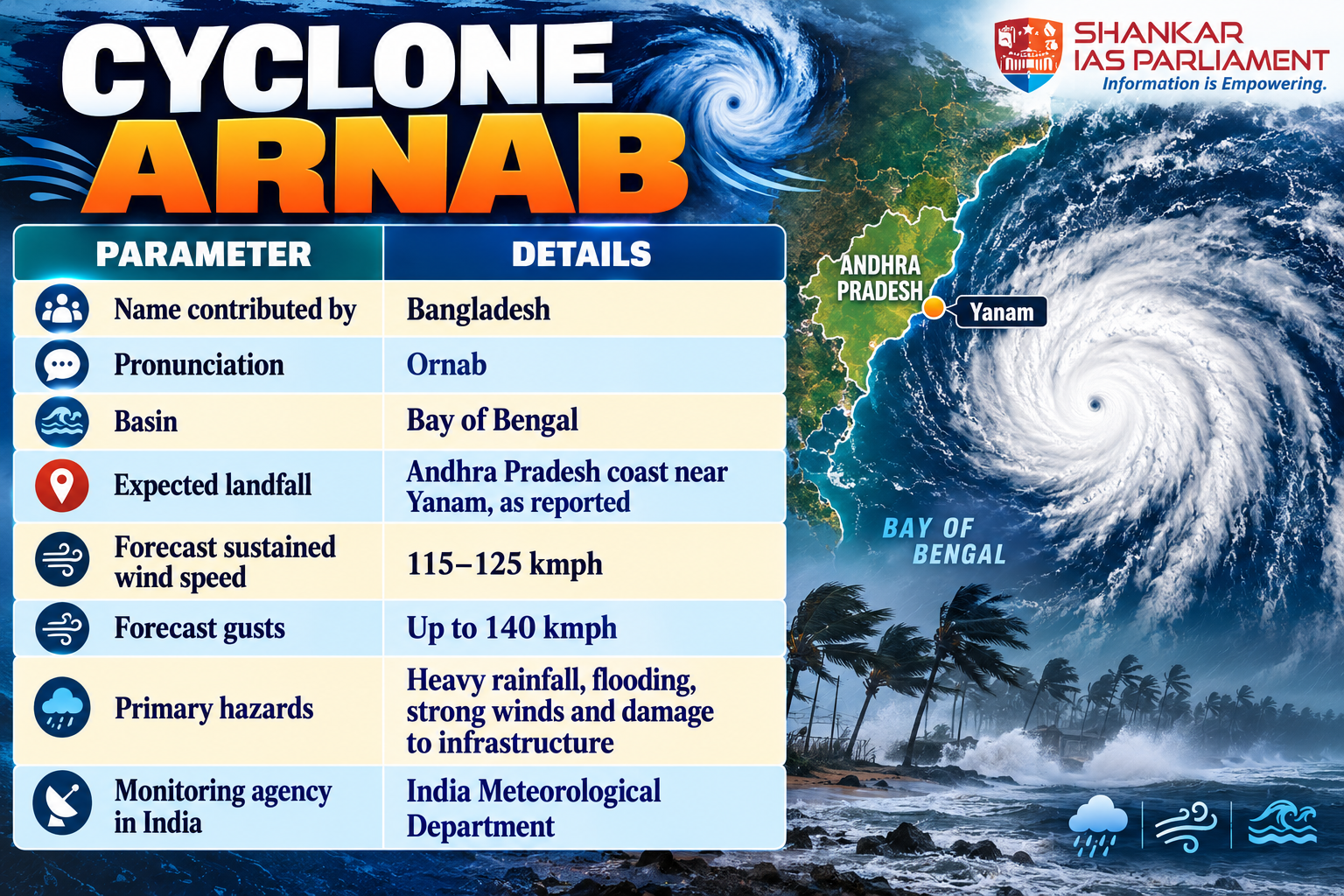
Cyclone Arnab, designated by Bangladesh, is projected to make landfall along the Andhra Pradesh coast near Yanam, between Bapatla and Visakhapatnam.
- The India Meteorological Department (IMD) has forecast maximum sustained winds of 115 to 125 kmph, with gusts up to 140 kmph.
- Heavy rainfall, strong winds, and potential flooding are anticipated across regions of Andhra Pradesh, Odisha, Jharkhand, West Bengal, and Uttar Pradesh.
Naming of Tropical Cyclones in the North Indian Ocean
- The formal naming system for tropical cyclones in the North Indian Ocean was initiated in 2004.
- Names are assigned by the World Meteorological Organization/United Nations Economic and Social Commission for Asia and the Pacific (WMO/ESCAP) Panel on Tropical Cyclones.
- The current list, adopted in April 2020, comprises 52 names contributed by 13 member countries.
- Names are utilised sequentially in a column-wise manner, following the established list.
- Each name is used only once and is not repeated in subsequent naming lists.
- The Regional Specialised Meteorological Centre (RSMC) in New Delhi, operated by the India Meteorological Department (IMD), assigns names to cyclones over the Bay of Bengal and Arabian Sea once they reach the prescribed intensity.
Countries Contributing Names
- The 13 countries contributing names are Bangladesh, India, Iran, Maldives, Myanmar, Oman, Pakistan, Qatar, Saudi Arabia, Sri Lanka, Thailand, United Arab Emirates, and Yemen.
Prerequisites for the Formation of Tropical Cyclones
- Tropical cyclones typically develop when the following environmental conditions are present:
- Warm sea surface temperatures – Typically, at or above 26.5°C, extending to a sufficient ocean depth.
- Moist atmosphere – Sufficient moisture in the middle troposphere is necessary to support cloud development.
- Atmospheric instability – The ascent of warm, moist air results in the release of latent heat during condensation.
- Coriolis force – This force imparts the necessary rotation for organised circulation. As a result, cyclones seldom form in proximity to the equator.
- Low vertical wind shear – Minimal variation in wind speed and direction with altitude enables the storm’s vertical structure to remain organised.
- Pre-existing disturbance – The presence of a low-pressure system or atmospheric disturbance initiates cyclonic circulation.
Key Geographical Characteristics
- Tropical cyclones are referred to as hurricanes in the Atlantic and eastern North Pacific, typhoons in the northwestern Pacific, and cyclones in the North Indian Ocean.
- In the Northern Hemisphere, tropical cyclones exhibit an anticlockwise rotation.
- The Bay of Bengal typically experiences a higher frequency of tropical cyclones compared to the Arabian Sea.
- The North Indian Ocean experiences both pre-monsoon and post-monsoon cyclone seasons, with especially favorable conditions occurring during April to May and October to November.
Expected Impacts and State-wise Preparedness
|
State/region
|
Major concerns reported
|
|
Andhra Pradesh
|
Coastal winds, heavy rain, flooding and possible infrastructure damage
|
|
Odisha
|
Heavy to very heavy rainfall; suspension of tourist boat and ferry operations at Chilika Lake
|
|
Jharkhand
|
Heavy rain, thunderstorms, lightning, waterlogging and crop damage
|
|
West Bengal
|
Heavy rain in parts of south Bengal and the sub-Himalayan region; rough seas
|
|
Uttar Pradesh
|
Unseasonal rain, thunderstorms, strong winds and a possible fall in daytime temperatures
|
Reference
TOI | Cyclone Arnab



