Why in News?
Recently, the World Meteorological Organization (WMO) has warned that an El Niño event is highly likely to develop, with an 80% chance during June–August.
El Nino (Warm Phase)
- El Niño – It is a natural climate pattern characterized by the warming of ocean surface temperatures in the central and eastern tropical Pacific Ocean.
- Trade winds weaken or reverse.
- Warm water shifts eastward toward South America.
- Effects on India – Often associated with weaker southwest monsoon rainfall.
- Can increase the likelihood of drought conditions and heat waves.
- Global Effects – Droughts in Australia and parts of Southeast Asia.
- Increased rainfall in western South America.
- Warmer global temperatures.
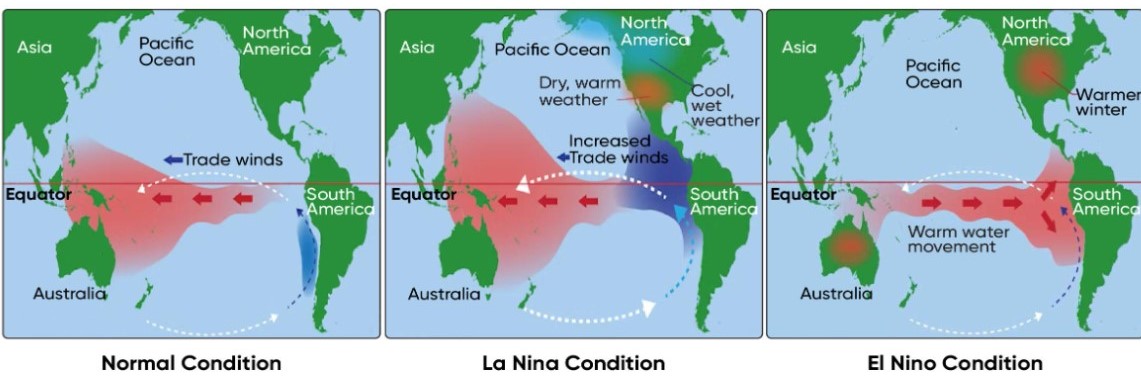
La Niña (Cool Phase)
- La Niña – Sea surface temperatures in the central and eastern tropical Pacific become cooler than normal.
- Trade winds strengthen.
- Warm water is pushed further west toward Asia and Australia.
- Effects on India – Generally linked to stronger monsoon rainfall.
- Can increase the risk of floods in some regions.
- Global Effects – Wetter conditions in Australia and Southeast Asia.
- Drier conditions in western South America.
- Slight cooling of global temperatures.
To know more about El Niño click here
Recent warnings of WMO
- Noted that unusually warm subsurface ocean temperatures—more than 6°C above average in some areas—are fueling the warming trend.
- Recent sea surface temperatures are rising toward El Niño thresholds, indicating the phenomenon is approaching.
- 80% chance of El Niño developing between June and August.
- El Niño can last from a few months to two years.
- It increases the likelihood of extreme weather worldwide.
- Warm Pacific Ocean temperatures are driving its development.
- The UN warns it could intensify the impacts of climate change.
Reference
The Indian Express| El Nino



