Mains: GS III – Infrastructure & Renewable energy
India’s solar capacity has increased significantly making solar the largest contributor to the country’s renewable energy mix.
Capacity Growth – From an installed capacity of approximately 3 GW in 2014, the sector has expanded more than fiftyfold, reaching 162.15 GW till 30 June 2026.
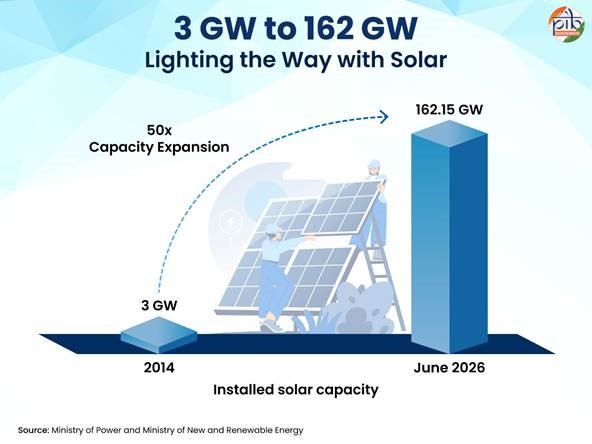
The country has added 37 GW of solar capacity in 2025, surpassing the United States in annual additions.
India has also emerged as the world's second-largest solar growth market, underlining its growing role in the global clean energy transition.
Record Growth in FY (2025-26) – India added 44.61 GW solar capacity, nearly double FY 2024–25; solar module manufacturing rose to 172 GW (from 2.3 GW in 2014).
Non‑fossil fuel capacity – It reached 283.46 GW with record annual addition of 55.29 GW, on 29 July 2025, Renewable Eenergy met 51.5% of electricity demand, the highest monthly share.
Major contributing states – Solar deployment spans diverse geographies and climatic zones, with Rajasthan, Gujarat, Karnataka, Tamil Nadu, Andhra Pradesh, and Maharashtra accounting for a major share of installed capacity.
Some of the large solar projects include the
Bhadla Solar Park (Rajasthan),
Pavagada Solar Park (Karnataka), and
Rewa Ultra Mega Solar Park (Madhya Pradesh).
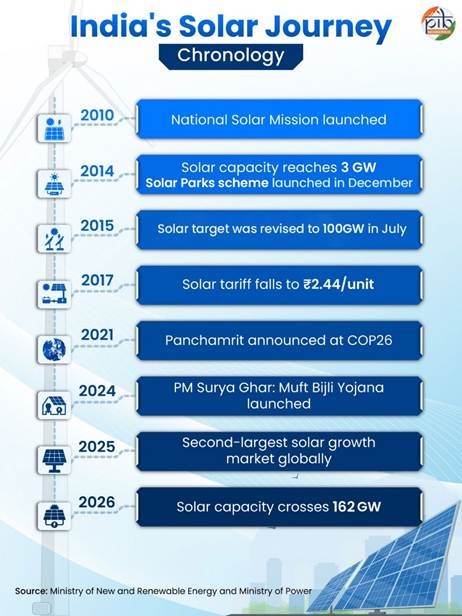
COP26 in Glasgow – India announced the Panchamrit goals, which include 500 GW of non-fossil fuel capacity by 2030 and net-zero emissions by 2070.
These targets were integrated into India’s updated Nationally Determined Contributions under the Paris Agreement.
Mission LiFE – It promotes sustainable consumption and eco‑friendly citizen practices.
National Solar Mission – It established long-term capacity targets and provided an early impetus to solar deployment.
Renewable Purchase Obligations (RPOs) – It require electricity distribution companies and other obligated entities to procure a specified share of their electricity from renewable sources.
It provides long-term market certainty for developers and investors while encouraging greater renewable energy adoption.
Supporting schemes – PM Surya Ghar drives household rooftop solar adoption, while PM‑KUSUM supports solar pumps and feeder solarisation in agriculture.
Together, they broaden the solar market and boost participation across consumers, farmers, businesses, and utilities.
Auction Mechanism - e-Reverse Auction mechanism, which encourages developers to compete to supply electricity at the lowest possible rate.
Tariffs Trend – It declined from around Rs.18 per unit in 2010 to a record-low of Rs.2.44 per unit, attained at the Bhadla Solar Park auction in 2017.
Falling tariffs have made solar power highly affordable, placing India among the world’s lowest‑cost solar markets.
Solar Parks Scheme – Initially launched with a target of 20 GW and later expanded to 40 GW in 2017.
Supported by – Green Energy Corridor (GEC) Programme aims to facilitate the transfer of power from RE-rich areas to demand centres across the country.
It enhanced transmission networks enabled evacuation of 24,567.8 MW RE by Feb 2026.
Green Energy Corridor projects in 10 states target 44 GW evacuation, strengthening national grid integration.
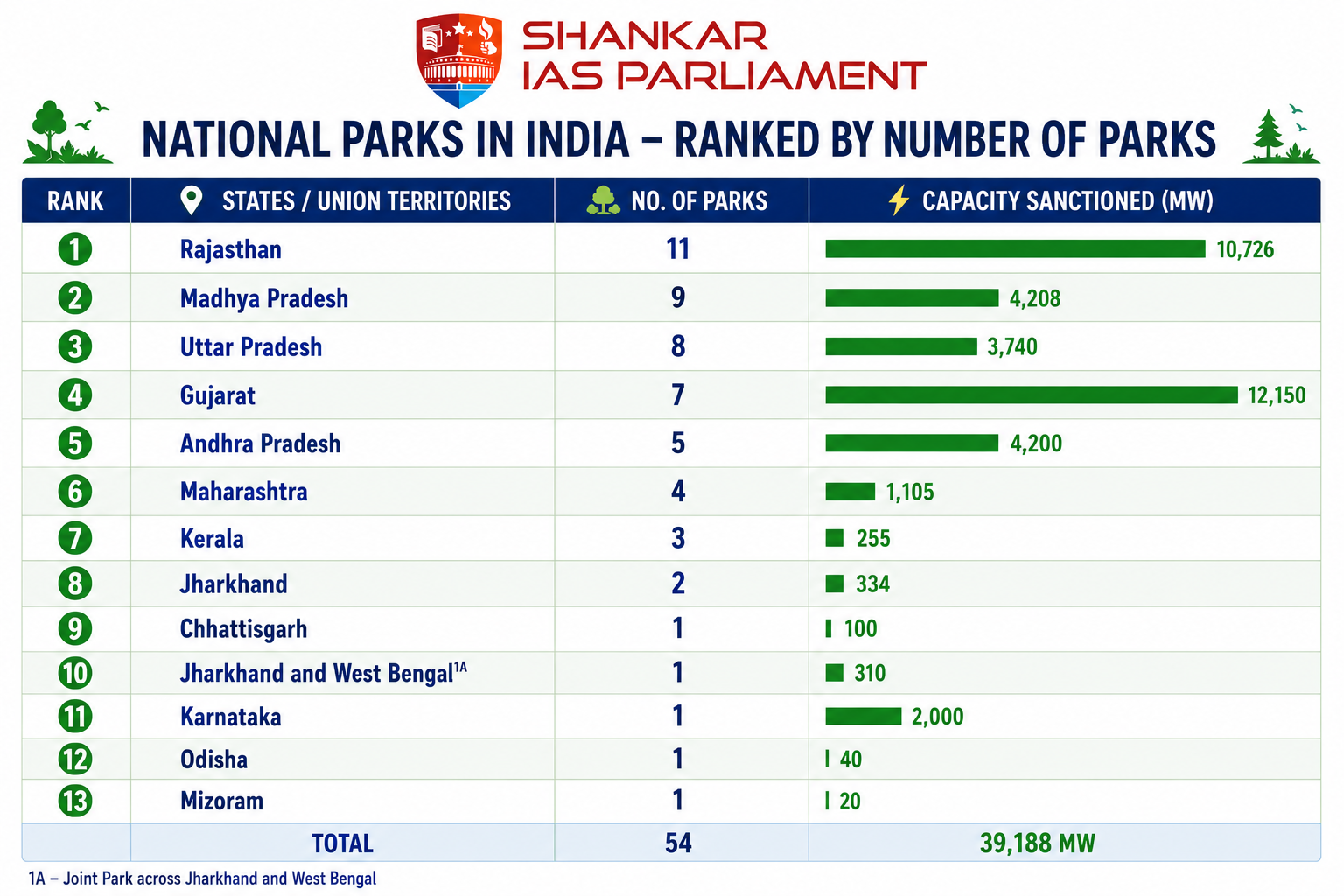
As of February 2026, 54 solar parks with a combined sanctioned capacity of 39,188 MW have been approved across the country.
PLI Scheme for High-Efficiency Solar PV Modules - Launched in 2021, with Rs.4, 500 crore and expanded in 2022 with Rs.19,500 crore, promotes domestic manufacturing and reduces import dependence.
By October 2024, it attracted Rs.35,000 crore investment and created about 10,000 direct jobs.
Approved List of Models and Manufacturers (ALMM) – Introduced in 2019, it ensures only approved solar PV modules and cells meeting quality standards are eligible for government‑supported and competitively bid projects.
It promotes domestic manufacturing by mandating approved products, thereby strengthening India’s solar ecosystem alongside the PLI Scheme.
|
PM Surya Ghar: Muft Bijli Yojana |
|
|
Pradhan Mantri-Kisan Urja Suraksha Evam Utthaan Mahabhiyan (PM-KUSUM) |
|
|
Pradhan Mantri Surya Sarovar Yojana (PM‑SSY) |
|
International Solar Alliance (ISA) – Co-founded by India and France at COP21 in Paris in 2015, the ISA has emerged as a key platform for global solar cooperation.
It brings together countries including the Maldives, Greece, Germany, Italy, Bhutan, Luxembourg, and Argentina to accelerate solar deployment, share knowledge and technology.
It has evolved into an important platform for cooperation among member countries.
One Sun One World One Grid (OSOWOG) – Proposed by India in 2018, OSOWOG is a vision for an interconnected global renewable energy network.
To advance this vision, India and the United Kingdom launched the Green Grids Initiative–One Sun One World One Grid (GGI–OSOWOG) at COP26 in 2021.
The initiative is supported by Australia, France, the United States, and the International Solar Alliance.
It promotes cross-border Renewable Energy trade through interconnected electricity grids, strengthening energy security and accelerating the clean energy transition.
India has strengthened renewable energy cooperation across the Global South through the ISA and, during its G20 Presidency, built consensus on tripling global RE capacity by 2030.
As India progresses towards its Panchamrit commitments and net-zero target by 2070, solar power will remain a key pillar.
It will continue to drive the clean energy transition.



