Mains: GS-III – Ecology & Environment
Why in News?
At the global stage, India has emerged as a credible voice for climate justice, equity and sustainable development, its approach demonstrates that conservation and climate action are mutually reinforcing pillars of growth, and that prosperity for people and the protection of the planet can advance together.
What is India’s Biodiversity overview?
- India’s Biodiversity – India is one of the world's 17 mega-biodiverse countries.
- Despite occupying just 2.4% of the global land area, it accounts for approximately 8% of all recorded species worldwide.
- The country is home to over 96,000 animal species and 47,000 plant species, including almost half of the world's aquatic plant species.
- Governance framework – Anchored in the Biological Diversity Act, 2002, supported by the National Biodiversity Action Plan & aligned with the Convention on Biological Diversity (CBD).
- India became a signatory of CBD in 1992.
- Core Environmental Laws
- Wildlife (Protection) Act, 1972 – Protection of wild animals, birds and plants; creation of protected areas.
- Water (Prevention and Control of Pollution) Act, 1974 – Prevention and control of water pollution.
- Forest (Conservation) Act, 1980 – Regulation of diversion of forest land for non-forest use.
- Air (Prevention and Control of Pollution) Act, 1981 – Control and abatement of air pollution.
- Environment (Protection) Act, 1986 – Umbrella legislation empowering the Central Government to protect and improve the environment.
- Biological Diversity Act, 2002 – Conservation of biodiversity, sustainable use and access-benefit sharing.
What are the Protected Areas & Wildlife Conservation Programmes of India?
- Protected Areas Network – It expanded from 745 (2014) to 1,134 (2025), & Wildlife corridors are identified to connect habitats and ensure safe animal movement.
- Project Tiger – Tiger Reserves are increased from 46 (2014) to 58 (2025), covering ~85,000 sq. km.
- Newest addition – Madhav Tiger Reserve, Madhya Pradesh.
- The 6th cycle of All India Tiger Estimation is underway, previous assessment in 2022 recorded 3,167 tigers.
- Project Elephant – Elephant Reserves increased from 26 (2014) to 33 (2025), an additional 8,610 square kilometres under protection.
- There are 150 elephant corridors across 15 states.
- Project Cheetah – It has entered into the expansion phase (2025).
- Cheetahs were introduced into Gandhisagar Wildlife Sanctuary, planned to expand in Noradehi & Banni Grasslands.
- As of Dec 2025, the cheetah population has reached 30, including 19 cubs born in India.
- Project Snow Leopard – Completed first nationwide Snow Leopard Population Assessment (2019 – 2023), with the estimated population of 718 snow leopards - Ladakh (477) & Uttarakhand (124).
- Snow Leopard Population Assessment India 2.0 – launched during Wildlife Week 2025 to strengthen conservation.
- Project Dolphin – The nationwide survey (2021 – 2023) estimated 6,327 riverine dolphins.
- The 2nd range-wide estimation launched in January 2026, from Bijnor covers Ganga River, Indus River, Brahmaputra, Sundarbans and Odisha.
- Species assessed - Ganges River Dolphin, Indus River Dolphin, Irrawaddy Dolphin.
- International Big Cat Alliance – Launched in 2023, led by India to conserve 7 big cat species globally, entered into force on 23 January 2025, with membership expanding to 18 countries.
- National-Level Species Projects (Wildlife Week 2025)
- 5 Projects - Project Dolphin (Phase II), Sloth Bear, Gharial;
- 4 Action Plans & Field Guides – River Dolphins, Tigers, Snow Leopards, Bustards.
What about the Ecosystem Restoration measures taken by India?
- Forest & Biosphere Ecosystems
- Biosphere reserve network – Currently has 18 notified Biosphere Reserves covering 91,425 square kilometres, of which 13 are recognised under UNESCO’s World Network of Biosphere Reserves (WNBR).
- Recent inclusion - Cold Desert Biosphere Reserve in Himachal Pradesh ( Sept 2025).
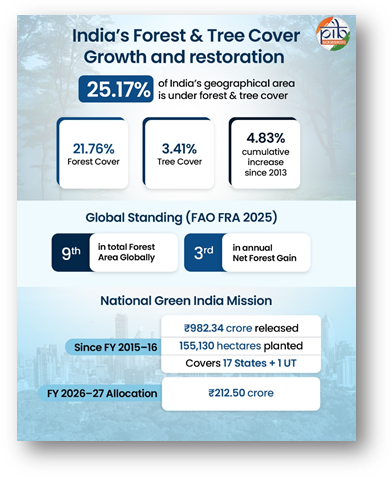
- Forest Fire Management – The satellite-based real-time monitoring by Forest Survey of India, alerts via SMS/email & 24×7 national control room.
- Ek Ped Maa Ke Naam (Plant4Mother Campaign) – Nationwide people’s campaign - “One Tree in Mother’s Name”, encourages citizens to plant trees as a tribute to mothers.
- Wetlands & Coastal Ecosystems
- Mangrove Initiative (MISHTI) – In 2025, the initiative restored 4,536 hectares of mangroves & identified 22,560 hectares (across 13 States/UTs) of degraded mangrove areas for future plantation and restoration.
- Ramsar Sites – In 2025, 11 new Ramsar Sites were declared, for a total of 98 sites (Jan 2026).
India is highest in Asia & 3rd largest globally by number of sites.
- Recent additions – Patna Bird Sanctuary (UP), Chhari-Dhand (Gujarat).
- Wetland Cities – Udaipur & Indore became India’s first Ramsar-accredited Wetland Cities.
- National Coastal Mission (2025–31) - Aim to enhance the climate resilience of India’s coastline through integrated coastal zone management, ecosystem restoration and community-based adaptation.
- Focus – Mangroves, coral reefs, erosion control, sea-level rise, sustainable livelihoods.
- Blue Flag beaches – These are coastal sites certified for maintaining international standards of cleanliness, water quality, safety and sustainable management.
- Awarded by - Foundation for Environmental Education & implemented in India by the Ministry of Environment, Forest and Climate Change (MoEFCC).
- Certification – For 18 beaches across 7 states & 4 UTs (2025–26 season).
- Human-Wildlife Conflict Management
- Centre of Excellence for Human-Wildlife Conflict Management & Project on "Tigers Outside Tiger Reserve" were launched during the Wildlife Week 2025 (October 2-8).
- The MoEFCC issues advisories under the Wildlife Protection Act for hotspot identification, rapid response teams and relief within 24 hours.
What are the Climate & Strategic Policy Frameworks of India?
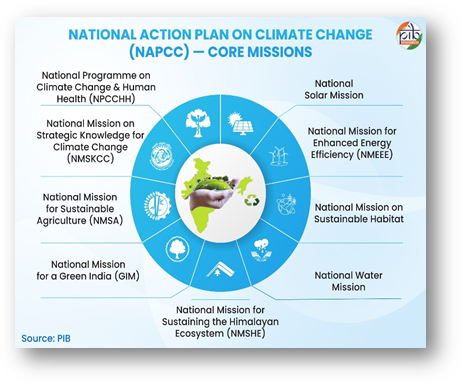
- National Action Plan on Climate Change (NAPCC) – It provides the overarching framework for India’s climate strategy and integrates adaptation & mitigation into sectoral planning.
- 9 National Missions under NAPCC
- Nationally Determined Contribution (NDC) - Paris Agreement – India’s updated NDC (2022) commitments include
- Reduce emissions intensity of GDP by 45% (from 2005 levels) by 2030.
- Achieve 50% cumulative electric power capacity from non-fossil sources by 2030.
- Progress by June 2025 – Emissions intensity has reduced by 36% (2005–2020) & crossed 50% non-fossil installed capacity ahead of the scheduled timeline.
- Long-Term Low Emissions Development Strategy (LT-LEDS) – Submitted to the UNFCCC in 2022, India’s LT-LEDS outlines pathways toward net-zero emissions by 2070.
- National Green Hydrogen Mission (NGHM) & Renewable Energy Expansion – Launched in 2023, aims to make India a global hub for green hydrogen production, usage, and export, with a target of 5 million metric tonnes annually by 2030.
- Mission LiFE – Launched to promote climate-conscious individual and community action.
- Future estimates – Nearly 3 billion people could face water shortages by 2050, & Global GDP could shrink by 18%.
- Behavioural change potential – If 1 billion people adopt sustainable lifestyles, emissions could drop by 20%.
What are India’s International Climate Commitments & Multilateral Engagement?
- Article 6 of the Paris Agreement (Carbon Market) – To operationalise international carbon market mechanisms, India has designated the National Designated Agency as the national authority for the implementation of Article 6.
- UNFCCC COP30 (Belém, Brazil – Nov 2025) – India highlighted its climate leadership & emphasised enhanced climate finance & technology transfer for developing countries.
- India welcomed Brazil’s Tropical Forests Forever Facility (TFFF) and joined as an Observer.
- International Solar Alliance (ISA) – India continues to lead global solar cooperation under the vision “One World, One Sun, One Grid.”
- 8th ISA Assembly (Oct 2025, New Delhi) – Saw a wide number of participants, reinforcing global commitment to clean energy transition.
- Montreal Protocol – India has phased out major ozone-depleting substances ahead of timelines.
- Kigali Amendment – Ratified it in 2021, advancing HFC phase-down, by 2025, India achieved a 67.5% reduction in hydrochlorofluorocarbons (HCFC) production & consumption.
- CBD Commitments – In 2024, at COP16 of CBD in Cali, Colombia, India launched its updated National Biodiversity Strategy and Action Plan (NBSAP) 2024–2030.
- Aim – To halt and reverse biodiversity loss by 2030, with a long-term vision of living in harmony with nature by 2050.
What about India’s Clean Energy Expansion & Structural Energy Transition?
- Strategic Shift – India’s clean energy expansion marks a decisive structural shift from fossil-fuel dependence to diversified, low-carbon sources.
- Guided by commitments under UNFCCC and domestic reforms, the transition aims to enhance energy security, sustainability, and long-term economic resilience.
- Installed Capacity Milestones – In 2025, India achieved over 50% cumulative installed electricity capacity from non-fossil fuel sources, 5 years ahead of its 2030 target.
- As of 31 Jan 2026,
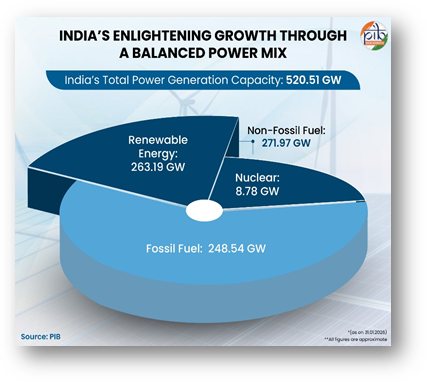
- Global Standing – As per International Renewable Energy Agency (IRENA) Renewable Energy (RE) Statistics 2025,(with data as on December 2024), globally, India stands
- 3rd - Solar Power installed capacity.
- 4th - Wind Power capacity.
- 4th - Total Renewable Energy capacity.
- Landmark Projects
- Modhera, Gujarat - India’s first 24×7 solar-powered village.
- Omkareshwar Floating Solar Park, Madhya Pradesh - India’s largest, among Asia’s largest floating solar parks.
- Policy & Market Instruments – Supported by regulatory frameworks, market-based mechanisms, and technological innovation, reinforce long-term emission reductions across sectors.
What about Carbon Markets, Industrial Transition and Climate Finance Mechanisms?
- Carbon Credit Trading Scheme – It establishes compliance and offset mechanisms aligned with global practices and supports measurable emission reductions.
- Operationalised under the Indian Carbon Market framework.
- Sectoral Coverage Expansion – Coverage expanded to 490 obligated entities across major emission-intensive industries, enhancing transparency, accountability, and sectoral decarbonisation.
- Carbon Capture, Utilisation & Storage (CCUS) – It emerged as a key low-carbon technology for reducing industrial emissions by capturing and reusing or safely storing carbon dioxide.
- Union Budget 2026–27 – Rs. 20,000 crore allocated over 5 years, to support CCUS development across emission-intensive sectors, including chemicals and heavy industries.
- Pollution Control & Environmental Governance
- Commission for Air Quality Management in NCR & Adjoining Areas Act, 2021 – Strengthens coordination for air quality governance.
- Implementation – In coordination with State Governments & local bodies.
- Enforcement – Ensured by the Central Pollution Control Board & State Pollution Control Boards or Pollution Control Committees.
What are India’s Clean Air Programme & Pollution Reduction measures?
- National Clean Air Programme (NCAP) – Launched in January 2019, aims to improve air quality across 130 cities.
- Focus areas – Road dust, vehicular emissions, waste burning and industrial pollution.
- Progress (2024–25 vs 2017–18 baseline) – 103 cities out of 130 showed improvement in PM10 levels; 64 cities achieved 20% reduction & 25 cities achieved 40% reduction.
- Fly Ash Management & Utilisation
- Mandate – The MoEF&CC mandates coal & lignite-based thermal power plants to achieve 100% fly ash utilisation within prescribed timelines.
- Risk – Unscientific disposal of fly ash can lead to land degradation, health concerns, and ecological risks due to toxic trace elements & particulate matter.
- End-use applications – Of the total fly ash generated were used in the construction of roads and flyovers, the cement industry & manufacturing bricks and tiles.
- Waste Recycling Expansion – The number of waste recycling plants increased from 829 (2019–20) to 3,036 (2024–25), supporting SDG 12 (Responsible Consumption & Production).
- Extended Producer Responsibility (EPR) – Frameworks notified for plastic packaging, e-waste, tyres and batteries to promote scientific waste management.
- As of Dec 2025, 71,401 producers & 4,447 recyclers are registered, facilitated recycling of 375.11 lakh tonnes of waste.
- Sustainable Development & Inclusive Growth
- NITI Aayog – Nodal agency for SDG coordination at national and state levels, monitors performance across all 17 Goals.
- SDG India Index 2023–24 – India’s composite score improved to 71, rising steadily from 66 (2020–21) & 57 (2018).
What lies ahead?
- India’s vision of living in harmony with nature by 2050 is supported by measurable action across sectors.
- By aligning domestic implementation with global cooperation, India continues to contribute to climate stability, biodiversity conservation and sustainable development for present and future generations.
Reference
PIB | India’s Green Pathway