Why in news?
Recently, a study on Southern ocean “Closing the loops on Southern Ocean dynamics: From the circumpolar current to ice shelves and from bottom mixing to surface waves “ revealed more details on the dynamic nature of Southern Ocean.
What are the characteristics of Southern Ocean?
- It is also known as the Antarctic Ocean, comprises the southernmost waters of the world ocean.
- It used to be part of the Pacific Ocean and it is separated from other Oceans by currents, not Continents.
- Location – It is generally taken to be south of 60° S latitude and encircling Antarctica.
- Size - It is the second-smallest of the five oceans.
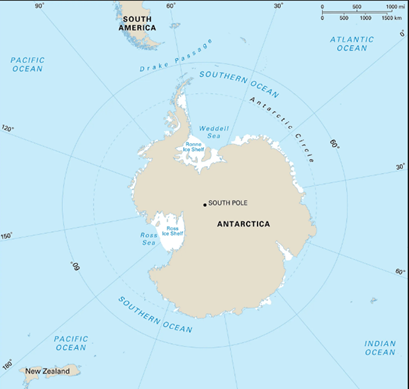
- Characteristics – It experiences Earth’s strongest winds and largest waves.
- It is home to city-sized icebergs.
- Antarctic Ice Sheet is the largest ice mass on Earth, equivalent to 58 metres of the global sea level.
- The ice sheet flows onto the Southern Ocean surface in the form of giant ice shelves.
- It acts as an ocean hub as waters from the Atlantic, Pacific and Indian basins converge and mix in Southern ocean.
- It experiences dramatic seasonal changes and cold temperatures.
- During winter, Southern Ocean freezes into a fringe of sea ice, almost doubling the size of Antarctica.
- It encompasses the biggest ocean current on the globe, as well as tiny turbulent flows that fit inside a teacup.
- Antarctic Circumpolar Current (ACC)
- Antarctic Slope Current
- Sub-polar gyres
- The meridional overturning circulation.
Antarctic Circumpolar Current (ACC) is the longest, strongest, deepest-reaching current on earth and circulates clockwise around the continent, carrying more water around the globe than any other current.
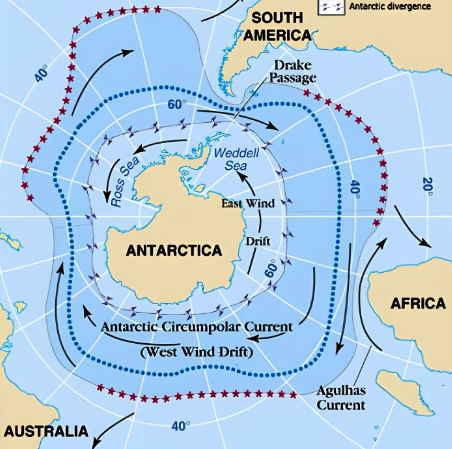
Why Southern Ocean is called as a global engine room?
- It is crucial to Earth’s natural systems.
- Creates masses of Ice - Much of the sea ice is produced in small regions of open water, called “polynyas”, formed by strong and cold winds blowing off Antarctica.
- Contributes to Ocean volume - As the ice forms, it ejects salt into the ocean surface and this extra salt, in addition to cooling effects from the atmosphere, makes the surface seawater heavier/ dense.
- The dense water sinks into the deep ocean.
- The resulting dense water mass produced here accounts for 40% of the global ocean volume.
- It is ultimately lifted back to the ocean surface by centimeter-scale turbulent eddies.
Sothern Ocean acts as a time capsule as it takes hundred year for the ocean water from the surface to sink and return to surface. Water returning to the surface today reflects the cooler, pre-industrial climate when it first sank to the ocean depths.
- Forms Ice shelves – Antarctic ice sheets flows onto the Southern Ocean surface in the form of giant ice shelves.
- Solar reflector - Millions of square kilometers of a layer of sea ice acts as a giant solar reflector.
|
Forms of Ice
|
- Ice sheet – It is also known as a continental glacier, is a mass of glacial ice that covers surrounding terrain and is greater than 50,000 km².
- The only current ice sheets are the Antarctic ice sheet and the Greenland ice sheet.
- Ice sheets- They are bigger than ice shelves or alpine glaciers
- Ice shelf – It is a large platform of glacial ice floating on the ocean.
|
- Heat sink – It stores excess heat generated due to global warming.
- Carbon Sink – Excess carbon generated by anthropogenic greenhouse gas emission activities are absorbed by them.
- Regulates sea level – It controls the flux of heat to the huge ice sheet of Antarctica, the greatest threat to runaway global sea-level rise.
- It shields ice shelves from powerful Southern Ocean waves.
- Productive ecosystem - Powerful currents, cold temperatures and nutrient and oxygen-rich waters make the Southern Ocean one of the most productive marine ecosystems on Earth.
- In summer billions of microscopic algae (phytoplankton) proliferate, spreading into blooms large enough to be seen from space.
2021-2030 is adopted as UN Decade of Ocean Science for Sustainable Development.
- Recent Challenges - Southern Ocean’s sea ice has dramatically declined in recent years due to global warming.
- Lowest ever recorded sea ice minima in the past two Austral summers.
- Warmer, less salty and more buoyant water is less prone to sinking.
- Thus affecting the ocean current system.
What lies ahead?
- Advance Southern Ocean science by bringing in the scientific and broader community together to protect this vital natural asset.
- Promote technological innovation to develop more cost-effective observing systems such as drones and drifting robotic instruments.
- Governments need to make long-term commitments to scientific study of Antarctica and the Southern Ocean.
- Enhance national and international collaboration to make the best use of available resources.
- Take a multidisciplinary effort to model the Southern Ocean's response to anthropogenic forcing as a key priority.
SWOT satellite is a joint project of the European Union and United States to measure the ocean surface at unprecedented resolution
References
- ASOC | Southern Ocean
- Down To Earth | Giant waves, monster winds and Earth’s strongest current
- PhyOrg | Mysterious Southern Ocean



