Prelims: Current events of National & International importance |Art and culture
Why in News?
Recently, Gingee Fort in Tamil Nadu was recognised as UNESCO World Heritage Site.
Gingee fort
- Located in - Villupuram district, Tamil Nadu.
- Located atop three hillocks – Rajagiri, Krishnagiri and Chandragiri
- Built by - Ananta Kon of the Konar Dynasty.
- Built in - 1200 CE.
- Known as –The ‘Troy of the East.’
- Part of -The Maratha Military Landscapes.
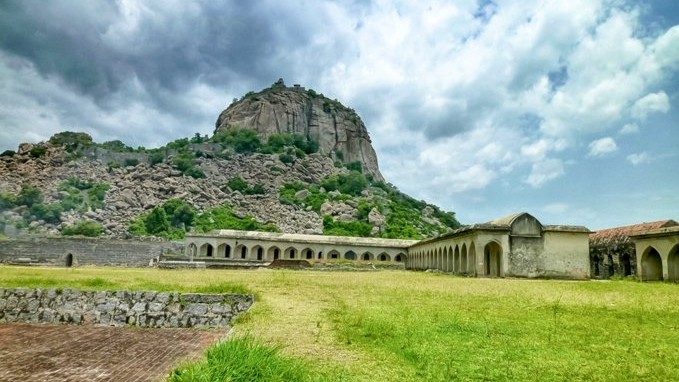
- Historic legacy - It was under the possession of several empires, such as the Vijayanagar Nayaks, Marathas, Mughals, Nawabs, the French and British.
- Features- Stepped well, a Kalyana Mahal, a durbar hall, a cannon, a clock tower, an armoury, an elephant tank, a stable, a granary, a gymnasium, the Venkataramana temple, and the Sadathtulla mosque.
- Water supply system -It consists of two elaborate systems for water supply, which ensured that even the top of the structure had continuous supply of water.
Maratha Military Landscapes of India
- The network of 12 forts demonstrates the strategic military vision and architectural ingenuity of the Maratha Empire.
- Located in - Maharashtra and Tamil Nadu.
- Constructed during – 17th to 19th centuries CE.
- Selected sites - Salher, Shivneri, Lohgad, Khanderi, Raigad, Rajgad, Pratapgad, Suvarnadurg, Panhala, Vijaydurg, and Sindhudurg in Maharashtra.
- Gingee Fort in Tamil Nadu.
- Classifications -Based on the location
- Hill forts - Salher, Shivneri, Lohgad, Raigad, Rajgad, and Gingee.
- Hill forest forts – Pratapgad.
- Hill-plateau fort – Panhala.
- Coastal fort – Vijaydurg.
- Island forts -Khanderi, Suvarnadurg, and Sindhudurg.
Reference
PIB| UNESCO World Heritage Site- Maratha Military Landscapes