Why in news?
A recent report of The India Human Development Survey (IHDS) shows that despite advancements in education and societal engagement, women's wage labour participation has stagnated.
What is women empowerment?
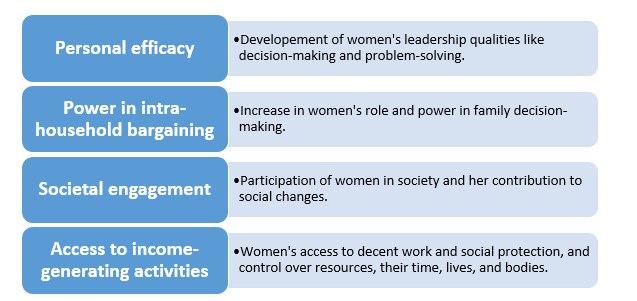
- Women's empowerment – It is the process of women gaining the power and control to make their own choices, and to influence social change. It includes four areas of development,
- Personal efficacy
- Power in intra-household bargaining
- Societal engagement
- Access to income-generating activities
India ranks 129th out of 146 countries in the Global Gender Gap Index.
|
Findings of the IHDS survey
|
- Advancements in education – The India Human Development Survey (IHDS) highlights a dramatic rise in women's educational attainment.
- College degree attainment among women has more than doubled, from 12% to 26%, achieving parity with men.
- Delayed marriages – The delay in marriage aligns with increased educational opportunities and changing aspirations.
- In 2011-12, 76% of the women in their 20s were married, by 2022-24 the proportion had dropped to 66%.
- Expanding horizons – Women’s autonomy and societal engagement are gradually improving.
- Comfort with solo travel rose from 42% to 54%.
- Membership in Self Help Groups doubled from 10% to 18%.
- Participation in gram Sabha meetings also showed modest growth.
- Increased self-employment – The share of self-employed women in the labor force increased from 51.9% in 2017–18 to 67.4% in 2023–24.
|
What are the concerns in women employment?
- Stagnated waged employment – Among the four key areas there is an improvements in the first three domains and the fourth, access to waged employment has stagnated.
- The IHDS recorded a drop from 18% in 2012 to 14% in 2022 among women aged 20-29.
- For women in their 30s, participation levels have also plateaued.
- Unpaid contribution – Women continue to contribute to the economy by working on family farms, and it reflects the increase in women’s participation in work as per the Periodic Labour Force Survey.
- Skewed employment growth – U-shaped relationship between education and FLFP rate where the FLFP rate is generally higher among women with little or no education.
- As the level of education increases, the FLFP rate declines, before eventually rising for highly educated women.
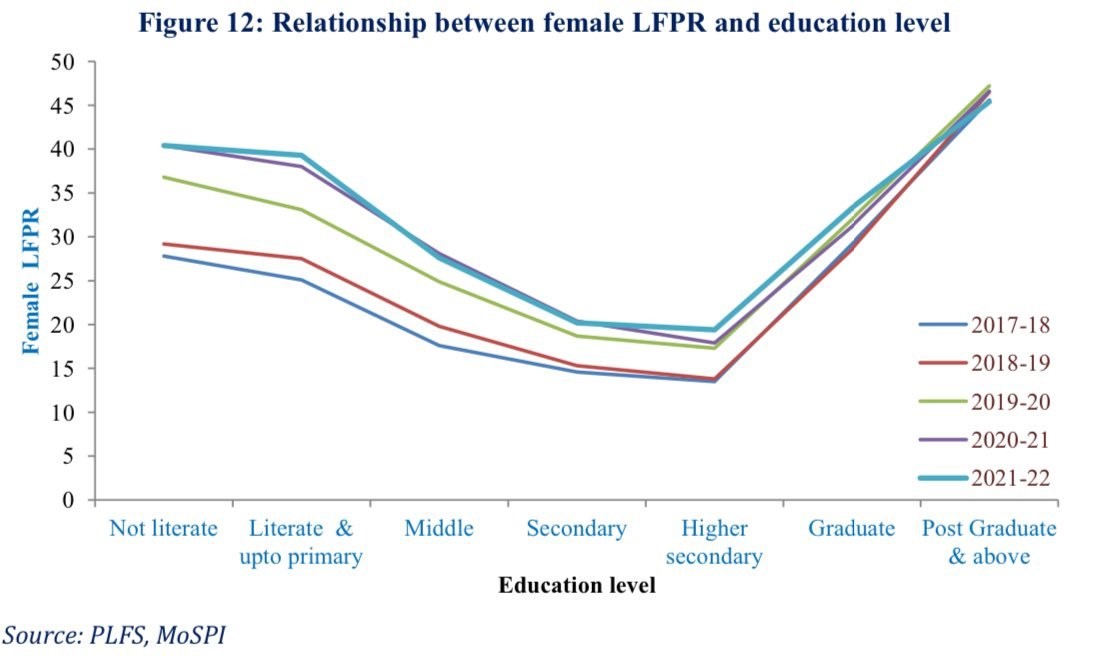
According to the World Bank data, the employment to population ratio is 72.2% for males and 25 % for females. It is a paradox where India have more female graduates but less working women and researchers.
What are the underlying factors?
- Lack of suitable opportunities – Surveys reveal that most women and families are open to wage work, provided suitable opportunities exist.
- Job scarcity – Due to growing unemployment the roles for women with higher qualifications got reduced.
- Conservative social norms – It emphasis the duty, traditional values, and social institutions.
- Preservation of traditional family structures and gender roles.
- Patriarchal mindset – Which causes intolerance towards women in society has created the largest obstacle for women to succeed.
- Socio-cultural misconceptions – Women empowerment is often seen as opposing Indian culture, especially when women challenge traditional norms.
- Work place hurdles – Women in the workplace face other challenges such as sexual harassment, pregnancy discrimination, imposter syndrome.
- Infrastructure limitations, such as inadequate childcare and work commutes, exacerbate the issue.
- Unhealthy practices – Unequal opportunities and distribution of work in private sector.
- Issues related to privacy such as asking personal questions to female candidates discourage women from entering the workspace.
- Lack in proper execution of gender-friendly policies fuel the increasing gender gap in employment.
- Unequal wages – For the same work and designation in demand driven jobs is discouraging women’s from participating in waged employment.
- Sectoral dynamics – While women continue to contribute significantly to family farms and government schemes like MGNREGA, these avenues do not translate into formal wage employment.
India’s GDP growth rate can climb above 9% if women were given an equitable share of jobs according to a World Bank.
What lies ahead?
- Access to income-generating activities lags behind.
- Expand skill development programs tailored to emerging industries.
- Enhance support systems like transportation and childcare.
- Promote equitable hiring practices in the private sector.
- Gender-inclusive employment guarantee scheme to help women come forward and avail job opportunities on a greater level.
Reference
- Indian Express |Stagnation In Women’s Participation in Work
- ORF |Gap between Women’s Education and Employment Widen



