Why in News?
New research has found that one species of the enormous Goliath beetles faces extinction in West Africa.
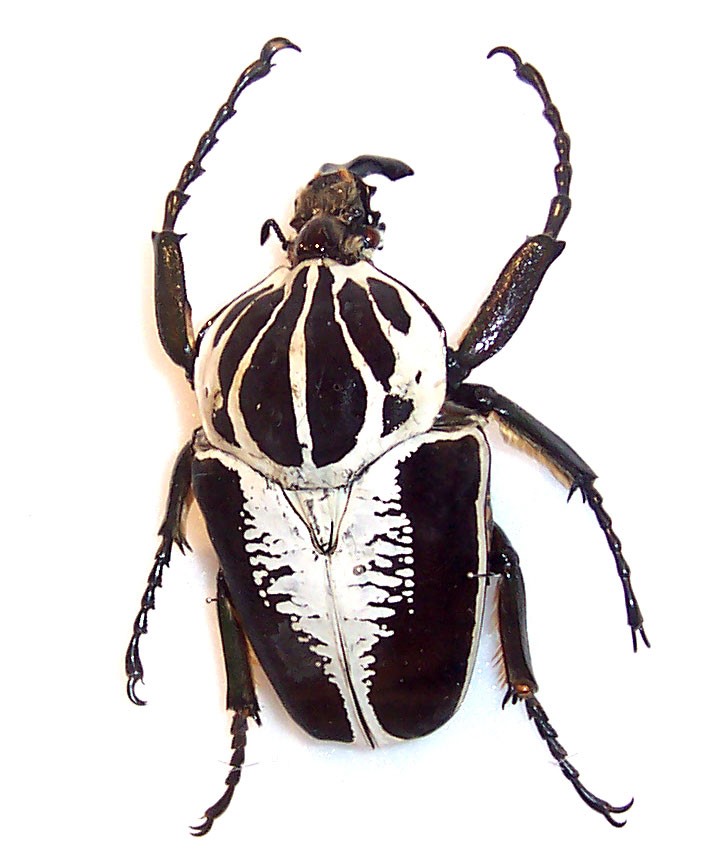
- The Goliath beetles (genus Goliathus) are among the world’s biggest insects.
- Types - Goliathus regius Klug, Goliathus cacicus Olivier, Goliathus cacicus, Goliathus goliatus, Goliathus albosignatus Boheman, Goliathus orientalis Moser.
- Size - They grow up to 110mm long, males have Y-shaped horns and females do not have horns.
- Distribution -Found in the rainforests of
- Sierra Leone, Liberia, Guinea, Cote d’Ivoire, Ghana, Burkina Faso, Benin, Nigeria, Cameroon, the Democratic Republic of Congo, Uganda and South Sudan.
- Diet -Beetle larvae, or grubs, are omnivorous and likely scavenge on meat as well as debris of plants.
- The adult beetles feed only on the sap of a few tree species in mature rainforest areas.
- Goliathus cacicus –Smaller compared to Goliathus regius beetle species, it’s up to 95mm long (normally 60-84mm) and lives only in mature rainforests.
- Goliathus regius - It can grow up to 105mm long (normally 75-95mm) and prefers to live in drier forests.
- Occasionally, they both live in the same patch of forest and even on a same tree and mate, giving birth to natural hybrids.
- Significance to ecosystem - They have an important role in moving nutrients throughout the forest ecosystem to nourish other plants and animals.
- Goliath beetle is an excellent indicator of forest health, if they are abundant in a forest, it means the forest is in a good enough condition to support other species.
- But when their populations decline, this is an early warning indicator of emptying forests and eroding ecosystems.
- Threats - Goliathus regius Klug and Goliathus cacicus Olivier, are threatened with extinction.
- Goliathus cacicus has had a catastrophic decline over the past 30 years.
- Goliathus cacicus seemed to have gone extinct in several areas of west Africa, like the Banco Forest National Park in Abidjan, Cote d’Ivoire.
- Forests in Nigeria, Cameroon, Uganda, South Sudan, Rwanda and Kenya offer valuable shelter to Goliathus goliatus.
- Gabon, the northern Republic of Congo and northern Democratic Republic of Congo have vast and largely pristine, inaccessible forests where Goliathus goliatus beetles are not under threat.
- Goliath beetles are not currently evaluated on the IUCN Red List.
- The beetles has been almost wiped out by the West African cocoa industry and, to a lesser extent, by the international trade in dried insects.
Reference
The Hindu | Goliath beetles



