Why in news?
A determined battle by environmentalists in the Supreme Court of India against genetically modified (GM) herbicide-tolerant (HT) mustard is all that stands between GM food and Indian farmers and consumers.
What are GM crops?
- A crop which has a gene artificially inserted into it from another species to give some desired properties (pest resistant, herbicide tolerant, etc.) is known as GM crop.
- Soya bean, maize, cotton, and canola are the most widely grown GM crops around the world.
- Bt cotton - It is the only GM crop that is allowed in India.
- It has two alien genes from the soil bacterium Bacillus thuringiensis (Bt) that allows the crop to develop a protein toxic to the pest pink bollworm.
- GM Mustard - It is the first GM food crop that India has permitted for commercial release.
- It is a product of crossing two plants containing alien ‘barnase’ and ‘barstar’ genes derived from a soil bacterium.
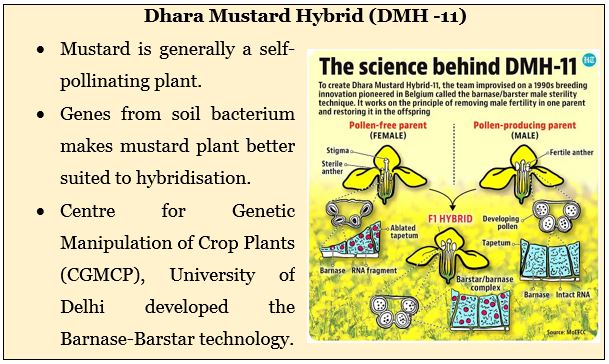
For More Details about GEAC's Approval for GM-Mustard - Click here.
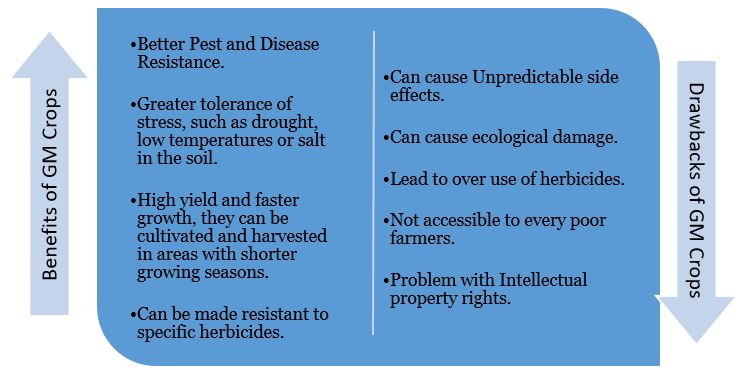
What are the pros and cons of GM Crops?
What are the regulatory and approval authority for GM crops in India?
- The Acts and rules that regulate GM crops in India include:
- Environment Protection Act, 1986 (EPA)
- Biological Diversity Act, 2002
- Plant Quarantine Order, 2003
- GM policy under Foreign Trade Policy
- Food Safety and Standards Act, 2006
- Drugs and Cosmetics Rule (8th Amendment), 1988
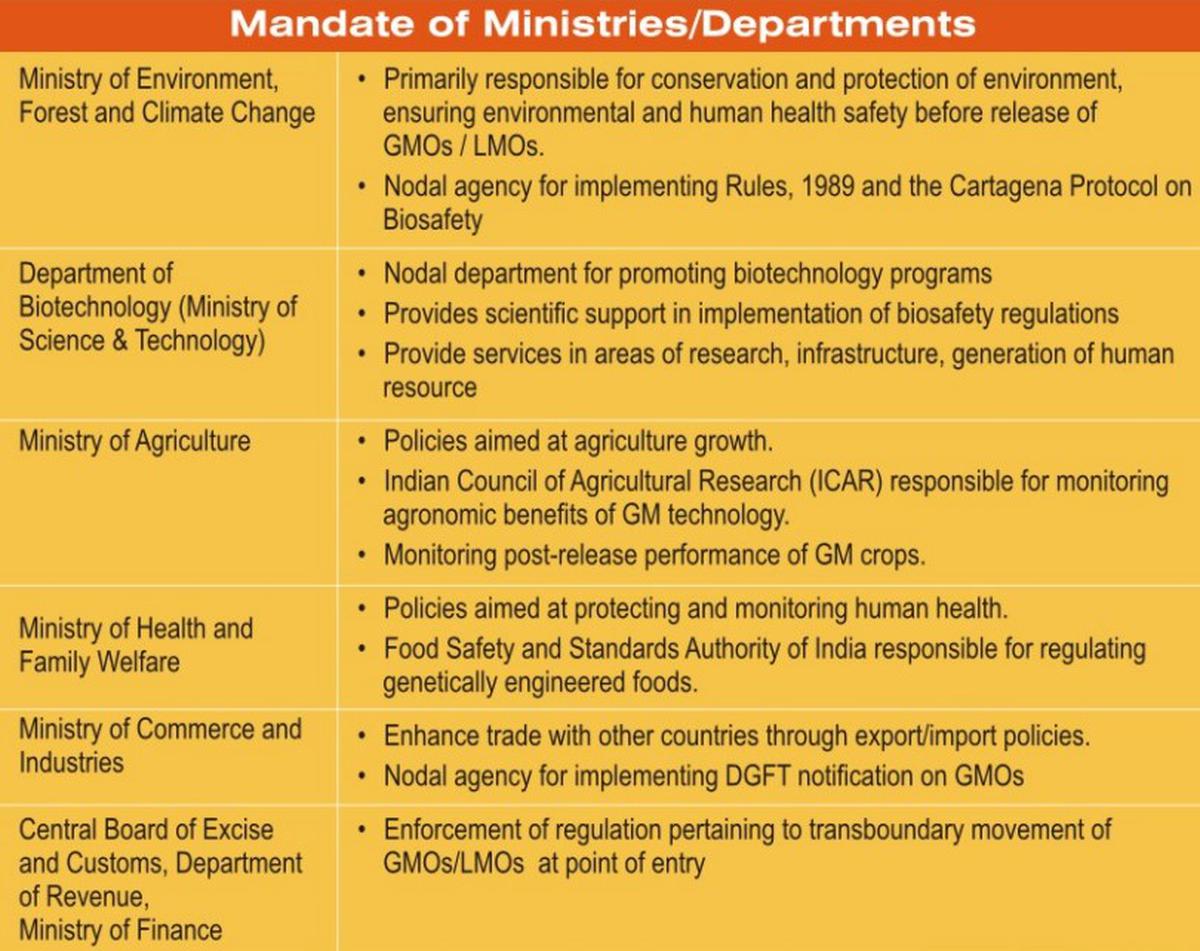
Genetic Engineering Appraisal Committee (GEAC)
- GEAC is responsible for appraisal of proposals relating to the release of GM organisms and products into the environment.
- It functions in the Union Ministry of Environment, Forest and Climate Change.
- It operates as per the Rules, 1989, under the Environment Protection Act, 1986.
- It applies to large scale use of hazardous microorganisms and recombinants in research and industrial production from the environmental angle.
What is the issue around GM Mustard?
- GM Mustard is the first genetically modified food crop permitted for commercial release thus it requires attention towards environmental, agricultural and public health.
- The government is pushing ahead with GM mustard disregarding both science and the law.
- The full biosafety database of GM mustard is not placed in the public domain.
- It has not adequately responded to criticisms that already available non-GM mustard hybrids have better yields than GM mustard.
- There is a growing evidence of long-term ecological and health risks of HT crops.
- The government has argued that GM mustard should not be considered HT at all in the Supreme Court hearing.
HT crop - A crop that can withstand herbicides. (HT - Herbicide Tolerant)
What are the reports on GM crops?
- Two Standing Committees of the Parliament independently and comprehensively examined GM crops and food.
- The 2 reports concerning GM foods are by
- The Standing Committee on Agriculture in 2012
- The Standing Committee on Science and Technology, Environment and Forests in 2017.
- Report takeaways - The two committees unanimously highlighted major weaknesses in the regulatory system, and called for utmost caution before releasing GM food.
- REC Report - The Supreme Court also appointed a Technical Expert Committee (TEC) in the public interest litigations.
- The TEC warned of serious harm to the environment, rural livelihoods and sustainable agriculture if they were released.
What is the way forward?
- If the Supreme Court allows GM mustard to go through, it will likely pave the way for the release of other HT crops such as cotton, rice, and maize.
- The government needs to approach the issue of HT crops transparently and robustly with an emphasis on precaution.
- GM food crops involves public health, environmental protection and agricultural livelihoods.
- The government should address the science-based concerns of GM crops.
- It should also comprehensively strengthen regulation before allowing GM food.
References
- The Hindu - A push for GM mustard disregarding science, the law
- The Hindu - Genetically modified crops and their regulation in India



