Prelims: Current events of national and international importance | Environment
Why in news?
According to a new study published in the journal Science Advances highlighted major gaps in global wildlife trade monitoring.
- Led by – The researchers at the University of Melbourne and the University of Sheffield.
Key findings of the study
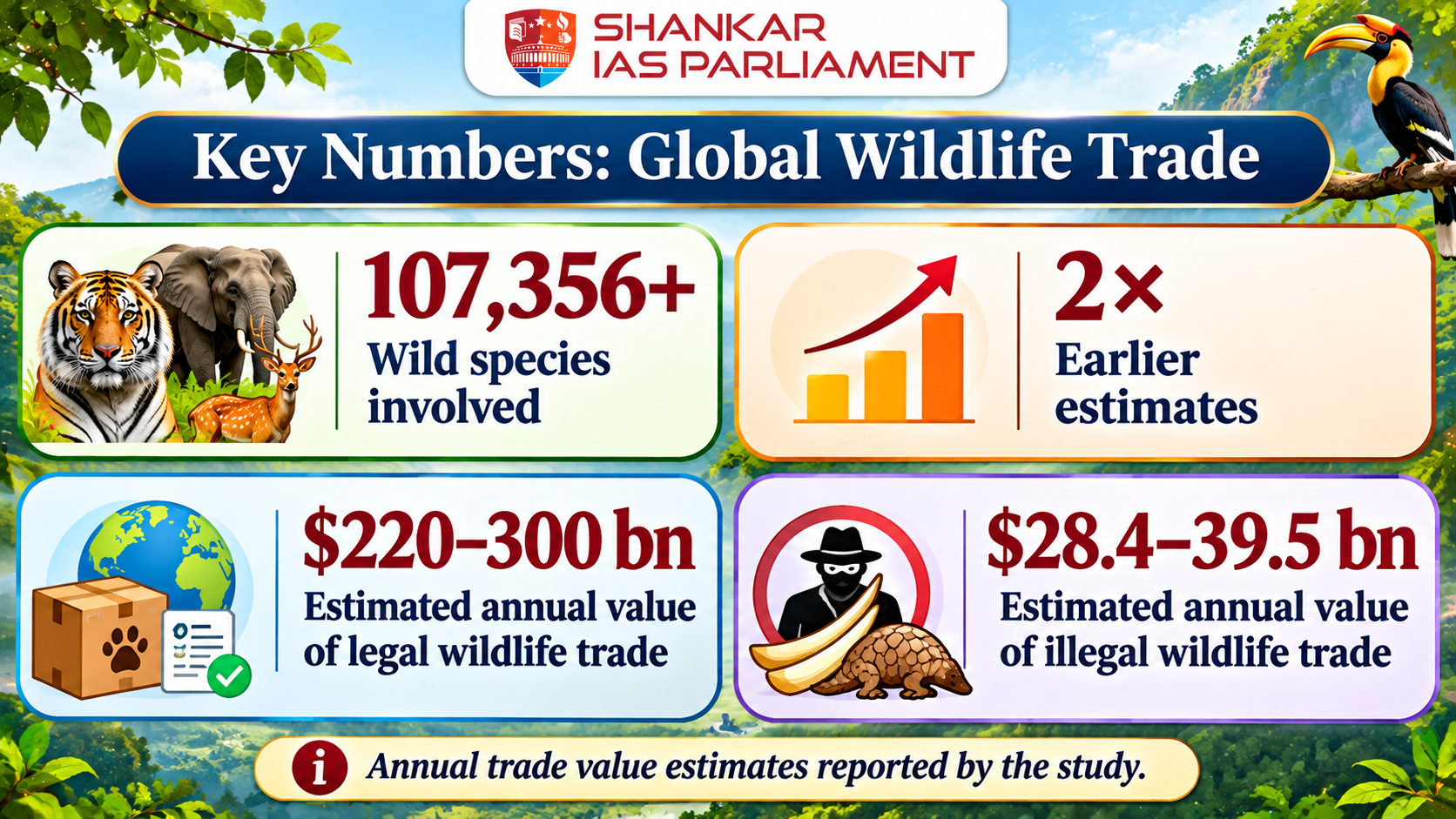
- Estimated species – At least 107,356 species of wild animals, plants and fungi are involved in wildlife use and trade worldwide, compared with nearly 50,000 identified in a 2022 assessment by the Intergovernmental Science-Policy Platform on Biodiversity and Ecosystem Services.
- 1st comprehensive assessment – The identified 47,685 animal species and at least 49,723 plant species and thousands of fungi are recorded in trade, making it the first global assessment of wildlife trade monitoring systems across all three groups.
- Of the 47,685 animal species identified in trade, up to 31,306 were vertebrates, representing 42% of all described vertebrate species.
- Other important findings –
- At least 16,829 animal species are confirmed to be traded commercially.
- Around 26,842 plant species are used for medicinal purposes.
- About 13,418 plant species are used for timber and other materials.
- Invertebrates (insects, spiders, etc.) are poorly represented in trade records
- Purpose of the trade – Wildlife is traded for medicinal products, biomedical research, exotic pets, ornamental plants, fashion, food and industrial materials.
- Exotic pet and aquarium species – Including songbirds, reptiles, amphibians, arachnids, butterflies and ornamental fish.
- Wildlife is also harvested for leather goods, jewellery, decorative items and hunting trophies, while fisheries and wild meat supply food and other products.
- Trade value (legal vs illegal) – Estimated annual value of legal wildlife trade at 220 billion-300 billion (£170 billion-£230 billion approximately), compared with 28.4 billion-39.5 billion for illegal trade.
- Monitoring gaps – The indicators under the UN's Kunming-Montreal Global Biodiversity Framework capture only a small proportion of species involved in wildlife trade.
- These indicators cover an estimated 6-11% of internationally traded vertebrate species and just 1.8-2.5% of species recorded in wildlife use and trade.
- Major concern – More than 98% of species involved in wildlife use and trade may remain outside some forms of international monitoring.
- The inadequate monitoring could increase the risks of overexploitation, the spread of diseases from animals to humans and the introduction of invasive species.
- Proposed Solutions – To improve oversight, the researchers recommended implementing digital permits, standardised customs reporting, and expanded species-level tracking across all taxonomic groups.
Reference
Down to Earth | Global wildlife trade involves more than 107,000 species, twice previous estimates



