Why in News?
A recent World Bank forecast reveals an unprecedented global employment crisis
What is the central issue facing the Global South?
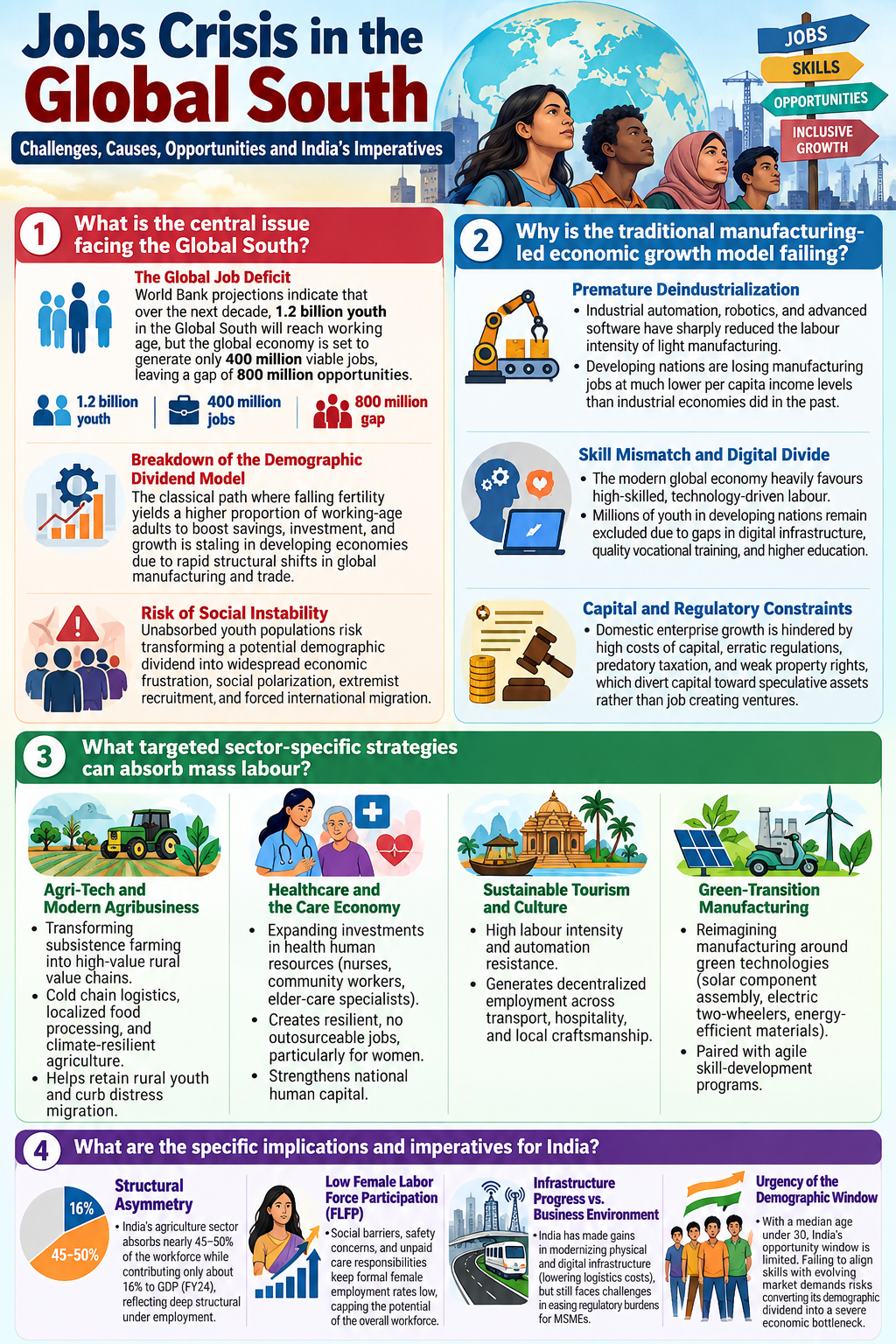
- The Global Job Deficit – World Bank projections indicate that over the next decade, 1.2 billion youth in the Global South will reach working age, but the global economy is set to generate only 400 million viable jobs, leaving an unprecedented gap of 800 million opportunities.
- Breakdown of the Demographic Dividend Model – The classical economic path where falling fertility yields a higher proportion of working-age adults to boost savings, investment, and growth is stalling in developing economies due to rapid structural shifts in global manufacturing and trade.
- Risk of Social Instability – Unabsorbed youth populations risk transforming a potential demographic dividend into widespread economic frustration, social polarization, extremist recruitment, and forced international migration.
Why is the traditional manufacturing-led economic growth model failing?
- Premature Deindustrialization – Industrial automation, robotics, and advanced software have sharply reduced the labour intensity of light manufacturing.
- Developing nations are losing manufacturing jobs at much lower per capita income levels than industrial economies did in the past.
- Skill Mismatch and Digital Divide – The modern global economy heavily favours high-skilled, technology-driven labour.
- Millions of youth in developing nations remain excluded due to gaps in digital infrastructure, quality vocational training, and higher education.
- Capital and Regulatory Constraints – Domestic enterprise growth is hindered by high costs of capital, erratic regulations, predatory taxation, and weak property rights, which divert capital toward speculative assets rather than job creating ventures.
What targeted sector-specific strategies can absorb mass labour?
- Agri-Tech and Modern Agribusiness – Transforming subsistence farming into high-value rural value chains through cold chain logistics, localized food processing, and climate-resilient agriculture to retain rural youth and curb distress migration.
- Healthcare and the Care Economy – Expanding investments in health human resources (nurses, community workers, elder-care specialists) to create resilient, no outsourceable jobs particularly for women while strengthening national human capital.
- Sustainable Tourism and Culture – Capitalizing on the high labour intensity and automation resistance of tourism, which generates decentralized employment across transport, hospitality, and local craftsmanship.
- Green-Transition Manufacturing – Reimagining manufacturing around green technologies (solar component assembly, electric two-wheelers, energy-efficient materials) paired with agile skill-development programs.
What are the specific implications and imperatives for India?
- Structural Asymmetry – India's agriculture sector absorbs nearly 45–50% of the workforce while contributing only about 16% to GDP (FY24), reflecting deep structural under employment.
- Low Female Labor Force Participation (FLFP) – Social barriers, safety concerns, and unpaid care responsibilities keep formal female employment rates low, capping the potential of the overall workforce.
- Infrastructure Progress vs. Business Environment – While India has made gains in modernizing physical and digital infrastructure (lowering logistics costs), it still faces challenges in easing regulatory burdens for Micro, Small, and Medium Enterprises (MSMEs).
- Urgency of the Demographic Window – With a median age under 30, India's opportunity window is limited, failing to align skills with evolving market demands risks converting its demographic dividend into a severe economic bottleneck.
Reference
The Hindu | Job Crisis



