Mains: GS I & III – Art & Culture | Economy
Why in News?
Geographical Indication (GI) Tags are in focus as India seeks to transform its rich regional products and traditional craftsmanship into globally recognised brands.
What is GI Tag?
- GI Tag – It is a sign used on products that have a specific geographical origin. The products must possess qualities, reputation, or characteristics essentially attributable to that origin.
India is home to over 800 registered GI products and 607 GIs have been granted since 2014.
Leading export destinations for Indian GI products include the UK, Italy, UAE, Bahrain, Qatar, the USA, South Korea.
- Global directives – As a form of intellectual property, recognised under the Paris Convention for the Protection of Industrial Property and the World Trade Organization’s (WTO) Agreement on Trade-Related Aspects of Intellectual Property Rights (TRIPS).
- India’s legal framework – It’s registration and protection are overseen by the Geographical Indications Registry under the 1999 Act. And the accompanying Rules notified in 2002.
- The framework became operational in 2003, and GI registrations commenced in 2004–05.
- The Geographical Indications of Goods (Registration and Protection) Rules, 2002, were amended in 2025.
The GI Registry is located at Geographical Indications Registry, Chennai, which has all-India Jurisdiction.
What are the key sectoral categories of GI tagged products?
- Handicraft products – For examples include Pashmina from Jammu & Kashmir, Baluchari Saree from West Bengal and Banaras Gulabi Meenakari Craft from Uttar Pradesh.
- Agricultural products – It spanned a diverse range of crops, including cereals, fruits, vegetables, spices, and non-basmati rice.
- Manufacturing products – For example, such as Nashik Valley Wine and Kannauj Perfume.
- Food products – It encompassed prepared, cooked, or processed delicacies are GI tagged.
- For eg. West Bengal's Bardhaman Mihidana and Sitabhog, Odisha's Kendrapara Rasabali, and Andhra Pradesh's famous Tirupathi Laddu.
- Natural products – 5 natural products include
- Makrana Marble (Rajasthan),
- Chunar Balua Patthar (Uttar Pradesh),
- Lac of Purulia (West Bengal),
- Panna Diamond (Madhya Pradesh) and
- Ambaji White Marble (Gujarat) are GI-tagged in India.
- While these are strictly "Natural" products, hundreds of other natural-origin goods fall under the Agricultural Products category.
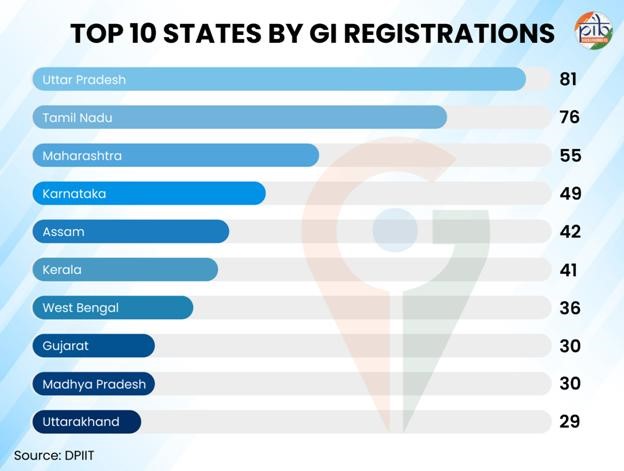
What are the GI registration framework in India?
- Eligibility – Any legally established producers’ association, organisation, or authority can apply for GI registration, provided it represents the interests of the concerned producers.
- Application Process – Documents must be filed directly with the GI Registry (Chennai), and non‑producer applicants must prove they represent producers’ interests
|
GI Exclusions: What Cannot Be Registered
|
- Generic product names no longer protected in their country of origin.
- Indications that mislead consumers or falsely suggest a different geographical origin.
- Indications that offend religious sentiments or contain scandalous, offensive, or obscene matter.
- Indications not eligible for legal protection or that violate any law in force.
- The registration of a GI is valid for ten years, but may be renewed from time to time.
|
- Authority to Cancel – Under Section 27, any aggrieved person may seek cancellation/variation of a GI, and the Registrar/Appellate Board can also act suo moto.
- Grounds for Revocation – Fraud/misrepresentation, loss of protection in origin country, disuse, consumer deception, violation of law, or scandalous/obscene matter.
What are the benefits of GI tag?
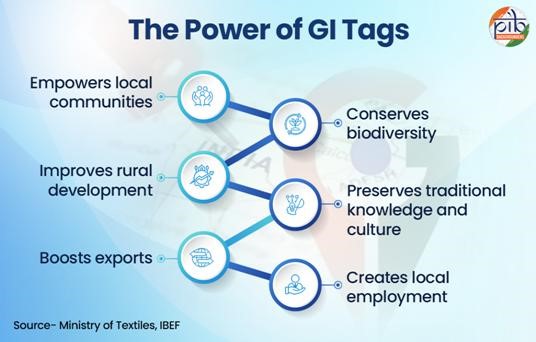
- Income Impact – GI tag increases rural artisans’ incomes by 20 to 30 percent (Ministry of Textiles).
- Market Appeal – Certification of origin and heritage builds buyer confidence and enhances the appeal of the product.
- Consumer Demand – As a symbol of authenticity, tradition, and craftsmanship, the GI tag enhances consumer perceptions of product quality.
- Producer Gains – Producers benefit from increased visibility, access to premium markets, stronger bargaining power, and a larger share of the product’s value.
- Sustainability & Heritage – It creates livelihood opportunities and preserves cultural heritage and indigenous craftsmanship for future generations.
- Community Empowerment – Aligned with the vision of Aatmanirbhar Bharat and Vocal for Local, these efforts are empowering artisans, farmers, and producer communities.
What are the schemes & policies bolstering GI Tag?
- PM Ekta Mall – Rs.5,000 crore allocated (FY 2023‑24) to set up malls across states for promoting ODOP items, GI‑tagged products, and handicrafts.
- OSOP Stalls – Railway booths provide space for GI products, expanding outreach of crafts, textiles, handlooms, and food items, giving direct market access to artisans and farmers.
- Tourism Integration – GI clusters are being linked to tourism itineraries (e.g., Pochampally Ikkat village, Darjeeling tea estates), blending experiential tourism with rural retail.
- Assam Initiative – In June 2026, Assam launched the Muga Silk Trail, Silk Tourism Park, and Muga Utsav festivals, positioning the state as a silk heritage tourism hub.
- MSME Innovative Scheme – Provides up to 100% reimbursement (max Rs.2 lakh) for GI registration costs under the IPR component, supporting IP protection and commercialization for eligible applicants.
- Support for GI Protection – Ministry of Textiles provides up to Rs.1.5 lakh for enforcing GI rights/legal expenses, along with aid under NHDP & NHD Programme for registration, training, and enforcement.
- Handloom Marketing Aid – As of June 2026, 104 GI handloom products and 53 registrations are supported under NHDP’s Handloom Marketing Assistance.
- Support Mechanism – APEDA aids farmers/exporters through quality improvement, capacity building, infrastructure, and market promotion for GI‑tagged agricultural products.
- Domestic Promotion – Craft fairs, Dilli Haat, GI programmes, seminars/workshops, and events like Virasat se Vikas Tak; showcased at World Food India 2025, Tribal Conclave 2025, India AI Summit 2026; promoted via airport/metro displays.
- Global Outreach – Overseas exhibitions and live demos, e.g., Autumn Fair International 2024 (UK) and Bazaar Berlin 2024 (Germany), enhancing global visibility of Indian GI products.
What are the global involvement of expanding GI tag products?
- EU-India FTA Connection – FTAs expand market access by reducing trade barriers. GI tags certify authenticity and origin, enhancing export opportunities for regional products.
- India–Oman CEPA – Export of 3 MT GI‑tagged Indi Lime to Oman under CEPA (2025) highlighted the value addition and market trust from GI certification.
- New Zealand GI Protection – New Zealand will allow registration of Indian GI products like Darjeeling Tea, Basmati Rice, and handicrafts, securing formal protection beyond the EU and expanding market access.
What lies ahead?
India aims for 10,000 GI registrations by 2030. GIs serve as a bridge between tradition and opportunity by protecting heritage, empowering producers, and expanding domestic and global market access to strengthen the heritage economy.
Reference
PIB| GI Tag