Why in news?
With India’s 132nd rank out of 191 countries in the Human Development Index 2021, there is a need to focus on the nation’s education, especially the foundational literacy and numeracy in all primary schools.
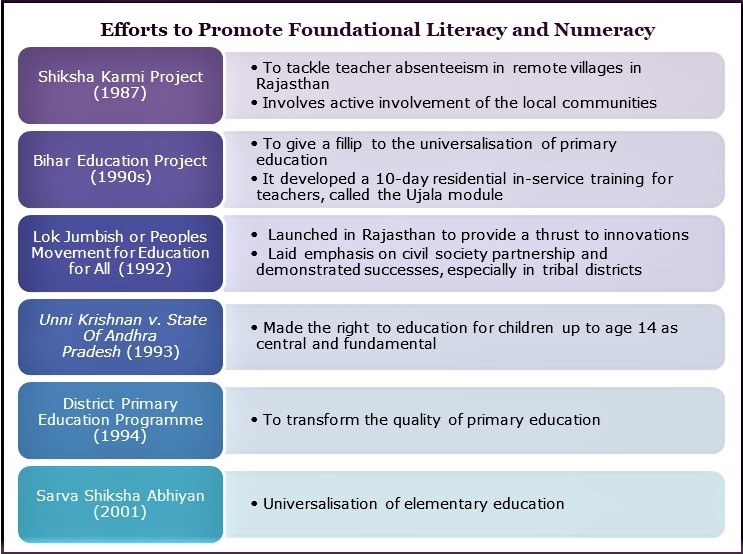
What efforts were taken over the years?
- International efforts - The 1990 World Declaration on Education for All at the Jomtien Conference affirmed the right of all people to education.
- NEP 2020 - The National Education Policy (NEP), 2020 states that a National Mission on Foundational Literacy and Numeracy will be set up for attaining universal foundational literacy and numeracy in all primary schools.
- It also aims to identify state-wise targets and goals to be achieved by 2025.
- Role of civil societies- There are many innovations in the civil society space, such as by Gyan Shala, Saksham, the Central Square Foundation, Room to Read, and Akshara.
What are the challenges?
- Communities view understaffed and ruined schools only as election booths.
- Improvement in school infrastructure, uniforms, toilet access, water and textbook availability, classroom processes remain a challenge.
- Lack of direct funds to schools, teacher vacancies, allocation of non-teaching tasks to teachers, etc. are other issues.
- A systemic way of recruiting good teachers and establishing teacher development institutions is still absent.
- Poor governance affects the effectiveness of face-to-face or digital teacher development initiatives like Nishtha, Pratham’s Read India campaign, etc.
What is the need of the hour?
- Community connects - To achieve the objective of foundational literacy and numeracy in all primary schools, we need to focus on community connects and parental involvement.
- The Panchayati Raj, Rural and Urban Development Ministries can work on community connect and make learning outcomes a responsibility of local governments.
- Decentralisation of funds - Providing decentralised funds to schools with the community overseeing such funds may aid in achieving the NEP objective.
- Use of technology - The Sampark Foundation uses audio battery-operated sound boxes and innovative teaching learning materials.
- It has launched a TV, which helps teachers use lesson plans, content and activity videos and worksheets to make classes more interactive.
Quick facts
The Education for All Programme
- Launched in 1990 with contributions from various foundations, international and non-governmental organizations, mass media and five intergovernmental agencies including the
- United Nations Educational, Scientific and Cultural Organization (UNESCO)
- United Nations Children's Fund (UNICEF)
- United Nations Population Fund (UNFPA)
- United Nations Development Programme (UNDP)
- World Bank
- The International Consultative Forum on Education for All was established as an interagency body to guide and monitor follow-up actions to the World Conference in Jomtien.
- The forum with its secretariat is located at UNESCO headquarters in Paris.
References
- The Hindu│ Where no child is left behind
- United Nations│Outcomes on Education



