Mains: GS-III – Ecology & Environment
Why in news?
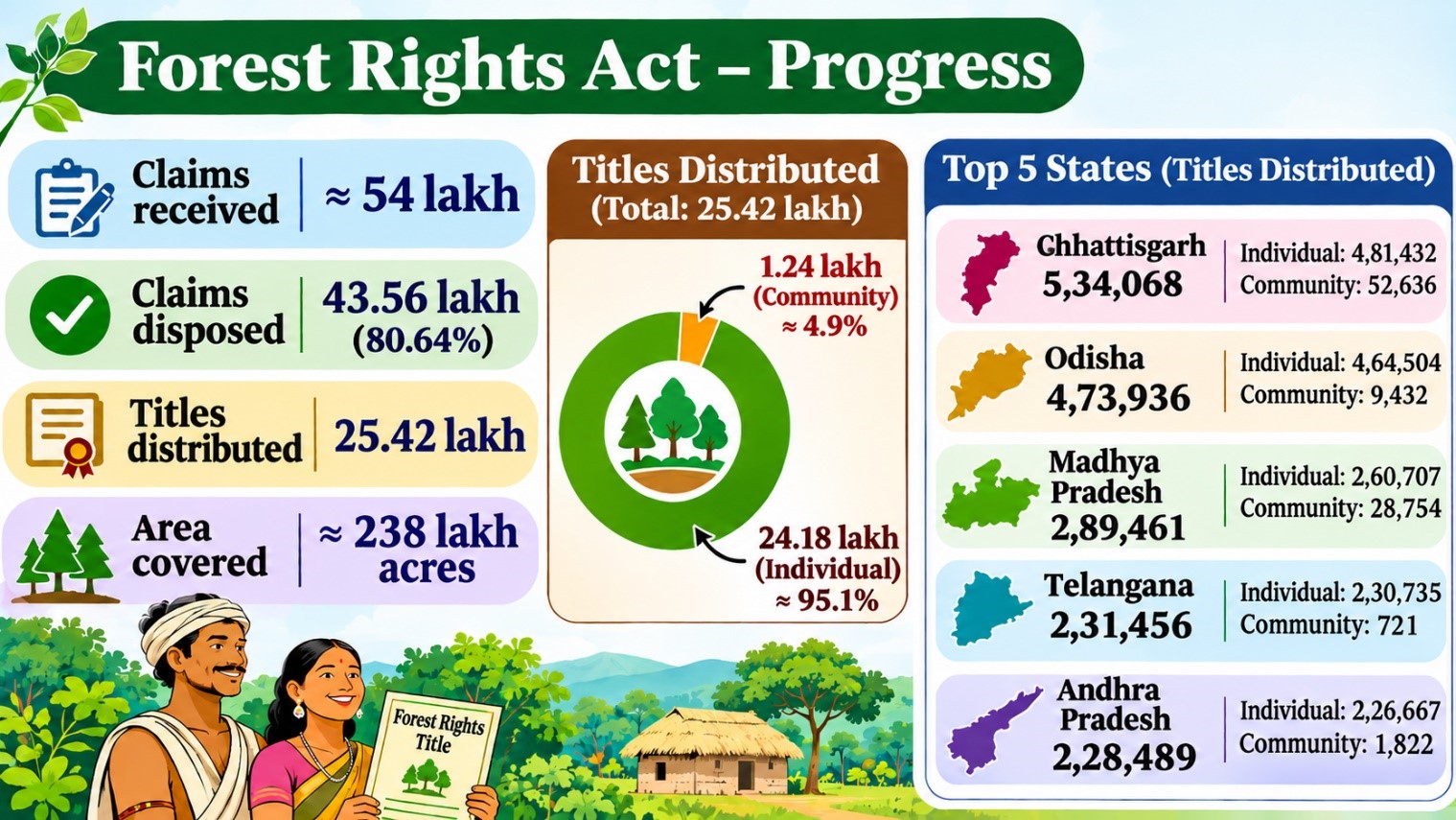
As of 31 August 2026, 25.42 lakh land titles were distributed, covering nearly 238 lakh acres of land; the focus is now on strengthening implementation, linking beneficiaries to livelihood schemes and digitising the claims process.
What is the Forest Rights Act?
- Forest-dwelling communities – They are groups—including indigenous Adivasi/Scheduled Tribes and other traditional forest dwellers—who live in and rely on forests for habitation, food, livelihood, and cultural practices for generations.
- Unrecorded land rights – However, many of their traditional rights over forest land remained unrecorded when forests were consolidated under government control during the colonial period and after Independence.
- Forest Rights Act (FRA) – The Scheduled Tribes and Other Traditional Forest Dwellers (Recognition of Forest Rights) Act, 2006, commonly known as the Forest Rights Act (FRA), seeks to address this historical gap.
- It recognises and vests legal rights over forest land in forest-dwelling Scheduled Tribes (FDSTs) and other traditional forest dwellers (OTFDs).
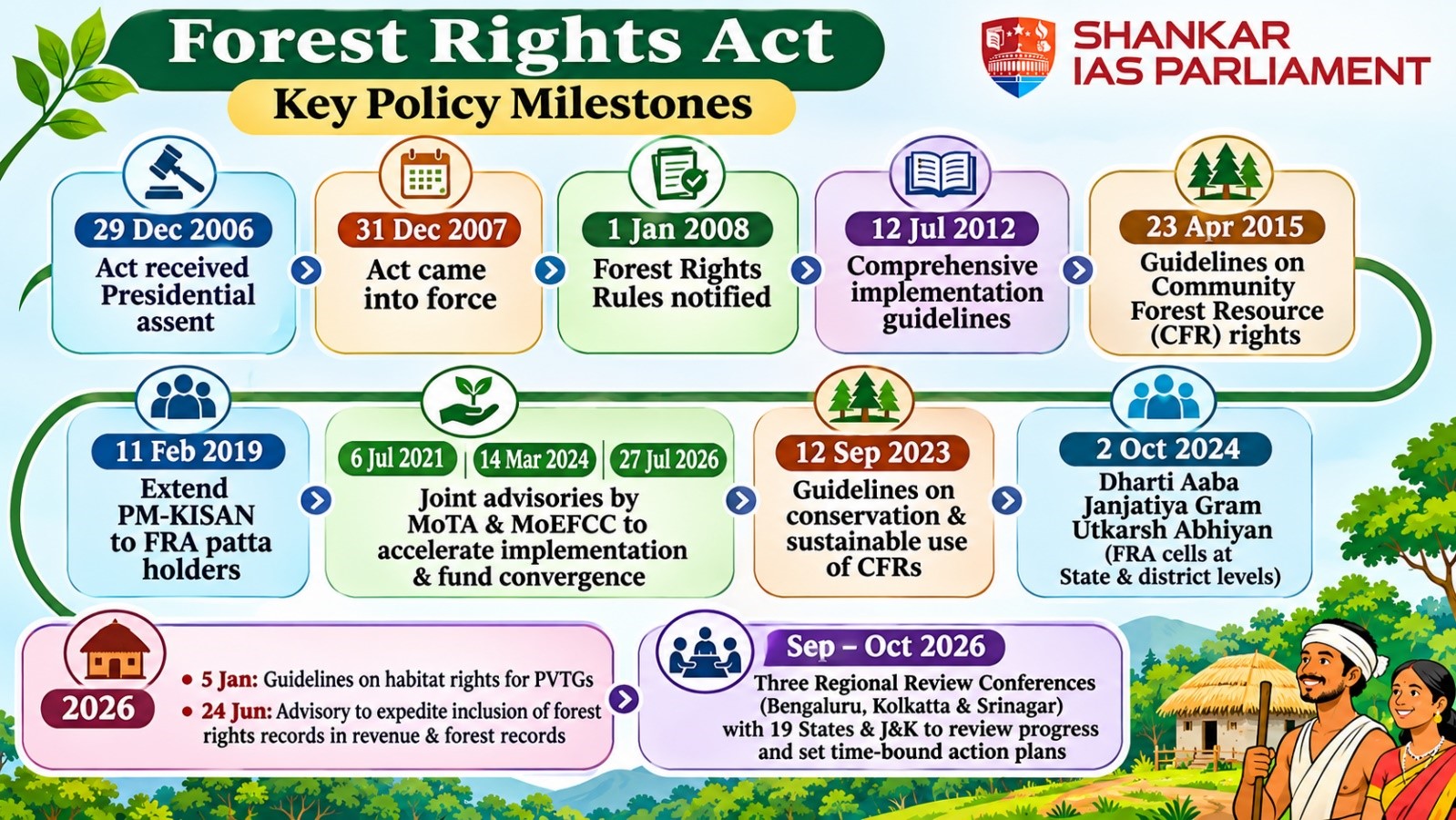
- Enactment – The Act received the President’s assent on December 29, 2006, and came into force on December 31, 2007. The Forest Rights Rules were notified on January 1, 2008.
- Objectives
- Recognising forest rights that were not recorded earlier;
- Providing secure land tenure, livelihood and food security to eligible communities; and
- Strengthening forest conservation by giving rights holders the responsibility and authority to use forests sustainably, conserve biodiversity and maintain ecological balance.
- Implementation – The Ministry of Tribal Affairs is the nodal ministry for implementing the Act, while State Governments and Union Territory Administrations are responsible for its implementation.
- Coverage – The Act is being implemented in 20 States and the Union Territory of Jammu and Kashmir.
Who is eligible to claim forest rights?
- 2 categories of communities – The Act covers two categories of communities
- Forest-dwelling Scheduled Tribes – Members of Scheduled Tribes who primarily reside in forests or forest land and depend on them for their bona fide livelihood needs.
- Other traditional forest dwellers – Individuals or communities who have primarily resided in and depended on forests for at least three generations, equivalent to 75 years, before December 13, 2005.
- The rights apply to forest land occupied before December 13, 2005.
- Limits on land claims – For land used for a home or cultivation, an individual claim is limited to the area actually occupied, subject to a maximum of 4 hectares.
- Coverage – The Act covers all categories of forest land, including reserved and protected forests, wildlife sanctuaries and national parks.
- Protection from eviction – It also provides that eligible forest dwellers cannot be evicted or removed from the land they occupy until the process of recognising and verifying their rights is complete.
- Essential public service utilisation – The Central Government may provide for the diversion of small areas of forest land, each measuring less than 1 hectare, for specified government facilities, subject to a recommendation from the Gram Sabha.
- These facilities include schools, hospitals, anganwadis, fair price shops, drinking water facilities, minor irrigation canals, roads and community centres.
What is a Forest Rights Title?
- Forest Rights Title – It is the official document recording a recognised forest right.
- It identifies the person or community holding the right, the village concerned, the land or forest area covered and its boundaries.
- Issuance of individual titles – For individual titles, the document is issued in the names of the eligible holders.
- In the case of a married couple, the title is issued jointly in both names.
- For a single-headed household, it is registered in the name of the single head of the household.
- Authorities responsible – A title is signed on behalf of the State Government by three district-level officers: the Divisional Forest Officer, the District Tribal Welfare Officer and the District Collector.
- Distribution – The individual rights holder receives a certified copy, while a community title is issued to the Gram Sabha.
- Heritable but non-transferable rights – Forest rights titles are heritable but cannot be sold or transferred. They provide legal recognition of the rights recorded in them.
What kinds of rights does the Act recognise?
- 3 broad categories of titles – covering individual land rights, community use rights and community forest management rights.
- Individual Forest Rights – These cover forest land occupied by an eligible individual or family for habitation or self-cultivation, subject to the maximum limit of four hectares.
- The title records the recognised land rights of the household.
- Community Forest Rights – These recognise the customary rights of a village community over resources it uses collectively.
- Such rights may include grazing areas, fishing grounds, water bodies and access to minor forest produce.
- The community holds the title, and any conditions attached to the recognised rights are recorded in it.
- Community Forest Resource Rights – These give the Gram Sabha or the community the right to protect, regenerate, conserve and manage forests within its customary boundaries.
- These are areas that the village has traditionally accessed and used.
- The Act also recognises the rights of forest dwellers over minor forest produce that they have traditionally collected.
- These include bamboo, honey, lac, tendu leaves and medicinal plants. Rights holders can collect, use and dispose of such produce.
- Special provisions for PVTGs – Particularly Vulnerable Tribal Groups (PVTGs) are entitled to habitat rights over the areas they have traditionally inhabited and used.
- These rights may cover customary habitats located in reserved and protected forests.
- The Ministry of Tribal Affairs issued guidelines on habitat rights on January 5, 2026.
- According to the latest information provided by the Ministry, habitat rights have been granted to 11 PVTGs in three States: Odisha, Chhattisgarh and Madhya Pradesh.
How are forest rights claims processed?
- Starting point of claims – The Gram Sabha, comprising all adult members of a village, is the starting point of the claims process.
- The Act provides for the full and unrestricted participation of women in its proceedings.
- Forest Rights Committee – The Gram Sabha elects a Forest Rights Committee consisting of 10 to 15 members to assist in receiving and verifying claims.
- At least two-thirds of the committee members must belong to Scheduled Tribes, while at least one-third must be women.
- 3 principal stages
- Stage 1: Gram Sabha verification
- The Gram Sabha receives claims, verifies the supporting information, maps the land and passes a resolution on the claims. The resolution is then forwarded to the Sub-Divisional Level Committee (SDLC).
- Stage 2: Sub-Divisional Level Committee scrutiny
- The SDLC examines the Gram Sabha’s resolution and prepares the record of forest rights, which lists the rights proposed for recognition. It then forwards the record to the District Level Committee (DLC).
- Stage 3: District Level Committee decision
- The DLC examines the case and takes the final decision. Its decision is final and binding under the Act.
- Composition of SDLC & DLC – The SDLC and DLC include officers from the State’s Revenue, Forest and Tribal Affairs departments, along with three members of Panchayati Raj Institutions.
- Of the three elected representatives, two must be Scheduled Tribe members and at least one must be a woman.
- Right to Appeal – The Act also provides an appeal mechanism. Anyone disagreeing with a Gram Sabha resolution or an SDLC decision can approach the next committee within 60 days.
- The committee may allow an additional period of up to 30 days under the Forest Rights Rules.
- Reason for rejection – The Ministry has emphasised that every rejection must be accompanied by a reasoned order communicated to the claimant.
- This ensures that applicants are informed of the grounds for rejection and can exercise their right to appeal.
- Updating official records – Once titles are issued, the recognised rights must be entered in the relevant revenue and forest records. The Forest Rights Rules have required this since 2008, while a 2012 amendment prescribed a time limit of three months for completing the process.
- State Level Monitoring Mechanism – At the State level, a State Level Monitoring Committee, chaired by the Chief Secretary, oversees implementation and is required to meet at least once every three months.
Why is entering titles in revenue records important?
- Recording the right is significant – Issuing a Forest Rights Title is an important step, but recording the recognised rights in revenue and forest records is equally significant.
- Significance of entry – The entry establishes an official record of the rights holder and the land concerned. It can also help eligible beneficiaries access government schemes and institutional support.
- Improved access to welfare measures – The Ministry has highlighted that recording titles in revenue records makes it easier for forest rights holders to benefit from PM-KISAN and other agriculture, fisheries and livelihood schemes.
- A key milestone in this direction came on February 11, 2019, when a direction was issued to extend PM-KISAN benefits to Forest Rights Patta holders.
- State-level initiatives – States are also helping connect forest rights records with other administrative systems.
- Maharashtra – A Government Resolution dated July 10, 2026, introduced separate village forms—7E for entering individual forest rights in revenue records and 12E for the crop register.
- These records can help beneficiaries access crop loans, Kisan Credit Cards, crop insurance and Direct Benefit Transfer.
- Andhra Pradesh – It has linked its Giribhumi FRA portal with the State’s revenue and banking systems.
- Telangana – Its online title system is integrated with the BhuBharathi revenue portal.
- These measures aim to make recognised forest rights more useful in accessing agricultural credit, insurance and welfare benefits.
How is the National FRA Digital Platform working?
- Digital transformation – To improve transparency, coordination and efficiency, the Ministry of Tribal Affairs has taken steps to digitise the implementation of the Act.
- National FRA Digital Platform – During Janjatiya Gaurav Pakhwada, observed from November 1 to 15, 2026, the Ministry launched the National FRA Digital Platform, with an aim to bring the entire claims process onto a single digital system, from submission of claims before the Gram Sabha to the issuance of digitally signed titles.
- National portal & Mobile app – The Ministry has demonstrated a national FRA Portal and a mobile application to support digitisation and mapping of forest rights records.
- States have been encouraged to link their records with the national platform.
- The digital initiative is expected to help streamline the processing of claims, improve access to information and strengthen monitoring of implementation.
- Monthly report – The Ministry receives monthly progress reports from States and Union Territories covering claims, titles and rejections.
- District Collectors and District Magistrates have been advised to ensure timely disposal of pending claims.
- Regular review meetings are held with State Tribal Welfare Departments, while grievances received by the Ministry are forwarded to the concerned States and Union Territories for necessary action.
How is the government supporting States?
- Dharti Aaba Janjatiya Gram Utkarsh Abhiyan (DA-JGUA) – Launched on October 2, 2024, provides financial and institutional support to State Governments to address infrastructure gaps in tribal villages.
- FRA cells – Under the DA-JGUA, the Ministry funds dedicated FRA cells at State and district levels for two years – to assist in settling pending claims and help ensure that SDLC and DLC meetings are held on time.
- Digital infrastructure & Mapping – Support is provided for State FRA portals, including digital mapping of land records, servers, software and security audits.
- Under the Support to Tribal Research Institutes scheme, the Ministry provides Rs. 25 lakh per State for mapping potential forest areas.
- The programme also supports Community Forest Resource Management Plans prepared by Gram Sabhas. The Ministry provides Rs. 15 lakh for each plan and an additional Rs. 1 lakh for technical support.
- Better coordination – A joint communication issued in July 2026 by the Ministries of Tribal Affairs & Environment, Forest and Climate Change allows Gram Sabha-prepared management plans to be aligned with Forest Department working plans while preserving the Gram Sabha's central role.
- Capacity building – Free courses on the Forest Rights Act are available on the iGOT Karmayogi platform. States are also conducting legal literacy camps to raise awareness about forest rights and the claims process.
What lies ahead?
- The Forest Rights Act, 2006, gives forest-dwelling communities the legal basis to claim rights over the forests they have long lived in and protected.
- With 25.42 lakh titles distributed over nearly 238 lakh acres, the focus now is on three things:
- Entering recognised rights in revenue and forest records,
- Linking forest rights holders to livelihood schemes, and
- Supporting Gram Sabhas to manage community forest resources.
Reference
DD News| Forest Rights Act: Recognising rights, securing livelihoods of forest-dwelling communities



