Transforming India’s Infrastructure Planning
PM GatiShakti National Master Plan (PMGS-NMP), launched on 13 October 2021, is a GIS-based platform that integrates infrastructure data from Ministries, States and Union Territories to enable coordinated planning and efficient project implementation.
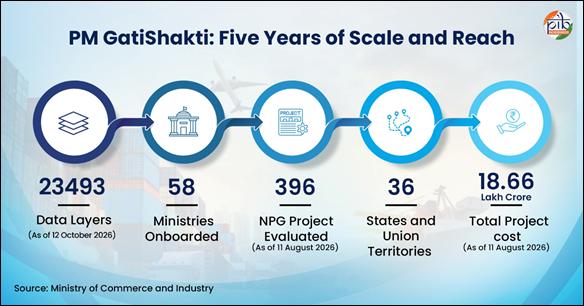
It currently covers 58 Central Ministries and Departments and all 36 States and Union Territories.
Key Features
- Seven Infrastructure Engines – Roads, railways, ports, waterways, airports, mass transport and logistics infrastructure.
- Integrated Planning – Combines infrastructure networks, geographic features, economic zones and demographic information on a common GIS-based platform.
- Data Integration – Over 23,493 data layers support infrastructure planning, while the public platform provides access to 230 approved datasets.
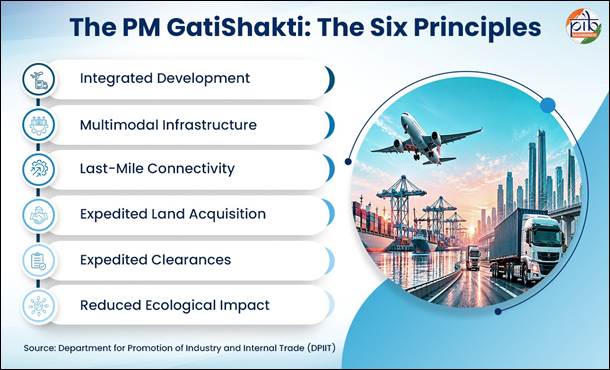
- Core Principles – Integrated development, multimodal connectivity, last-mile connectivity, expedited land acquisition, minimised clearances and reduced ecological impact.
Institutional Framework
PM GatiShakti has a three-tier institutional framework –
- Empowered Group of Secretaries (EGoS) – Oversees implementation and reviews changes to the National Master Plan.
- Network Planning Group (NPG) – Evaluates infrastructure proposals for integrated planning and optimisation.
- Technical Support Unit (TSU) – Provides technical expertise and supports project evaluation.
As of 11 August 2026, the NPG had evaluated 396 infrastructure projects worth ₹18.66 lakh crore. Of these, 256 had been sanctioned, including 198 under implementation.
Supporting Initiatives
- Integrated Transport and Logistics Authority (ITLA) – Will prepare a National Transport Master Plan with a planning horizon of ten years or more, appraise projects costing ₹500 crore or above, monitor implementation and develop a National Transport Data Repository.
- Gati Shakti Vishwavidyalaya (GSV) – Established in 2022 to promote specialised education, training and research in transport and logistics.
- It had trained over 2.4 lakh officers through PM GatiShakti-related courses by July 2026.
- Digital Logistics – The Unified Logistics Interface Platform (ULIP) integrates government logistics systems, while the Logistics Data Bank (LDB) tracks EXIM container movement. By July 2026, ULIP connected 46 government systems across 12 Central Ministries through 142 APIs.
- Private Sector Access – Since October 2025, regulated access to selected non-sensitive datasets has supported infrastructure planning and investment decisions.
Major Applications
- Pune–Bengaluru Expressway – Alignment revisions reduced forest land overlap by 19%. The project is expected to reduce travel time by 7–8 hours and save fuel and emissions.
- Jogighopa Multimodal Logistics Park – Integrates road, rail and inland waterways to improve cargo movement in Northeast India.
- Green Energy Corridor – The Ladakh–Haryana project will facilitate the integration of 13 GW of renewable energy through a 5 GW transmission system.
Conclusion
PM GatiShakti has evolved into a nationwide digital planning ecosystem, promoting integrated infrastructure development, improved logistics efficiency, multimodal connectivity and sustainable project implementation.
Reference
PIB



