Why in news?
Recently the Confederation of Indian Industry (CII) has suggested that Union Government should not set aggressive targets for fiscal deficit.
What is fiscal deficit?
- Fiscal deficit – Is the difference between total revenue and total expenditure of the government.
- The fiscal deficit for 2023-24 is 5.8% of the GDP.
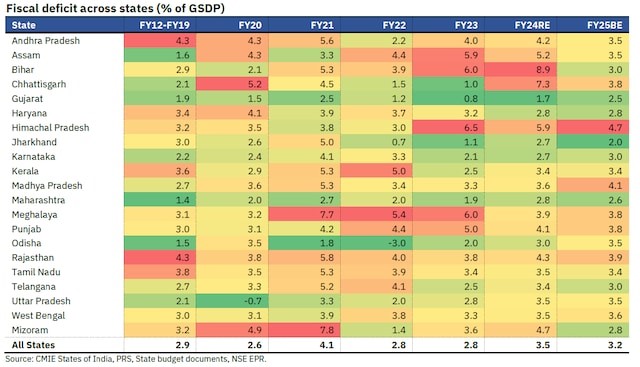
- The average fiscal deficit of Indian States is 3.5% in 2023-24.
- Target – Fiscal deficit target is at 4.9% of GDP for 2024-25 and aims to reduce it to 4.5% for 2025-26.
- Borrowing limit – Union government imposed the net borrowing ceiling of 3.5% of GSDP on states as recommended by the Fifteenth Finance Commission.
- Fiscal Responsibility and Budget Management Act, 2003 – To ensure inter-generational equity in fiscal management.
- It sets limit on fiscal deficit and borrowing for both the Central and State governments.
|
FRBM Act, 2003
|
- The Fiscal Responsibility and Budget Management (FRBM) Act was enacted in 2003 to implement the mandate in Article 292.
- Aim – To ensure fiscal discipline for the Union Government by setting targets including reduction of fiscal deficits and elimination of revenue deficit.
- Main objectives:
- To introduce transparent fiscal management systems,
- To introduce a more equitable and manageable distribution of the country's debts over the years and
- To aim for fiscal stability in the long run.
- Key features – The FRBM Act made it mandatory for the government to place the following components along with the Union Budget documents in Parliament annually. The components are:
- Medium Term Fiscal Policy Statement
- Macroeconomic Framework Statement
- Fiscal Policy Strategy Statement
- NK Singh Committee – In the Union Budget 2016-17, it was proposed to constitute a committee to review the implementation of the FRBM Act and give its recommendation.
- Debt-GDP ratio – NK Singh Committee recommended a debt-GDP ratio of 60% to be achieved by 2023, but the current ratio is about 81%.
|
- State fiscal responsibility acts – Each State may have its own Fiscal Responsibility Act, which further defines the limits and guidelines for borrowing and fiscal management within the State.
- Role of Union Government – It plays a significant role in overseeing fiscal matters, including approving borrowing limits for States based on recommendations from bodies like Finance Commission.
What are the Constitutional provisions related to fiscal management?
- Article 280 – It mandates to constituted Finance Commission every fifth year or earlier constituted to make fiscal matters.
- Article 293 – It grants fiscal autonomy to states, allowing them to borrow only from within the territory of India on guarantee from the Consolidated Fund of the State.
- 7th Schedule – Fiscal matters are delineated in the 7th Schedule of the Constitution, with Public Debt of the State falling under the State List, giving states exclusive jurisdiction over this matter.
- Distribution of revenues – Articles 268 to 272 of the Indian Constitution define the distribution of revenues between the Union and the States.
- Article 268 deals with certain duties are levied by the Centre but collected and retained by the States.
- Article 269 mentions about those taxes and duties that are levied and collected by the Centre but assigned in whole to the States.
- Article 270 deals with sharing of the proceeds of all Union taxes between the Centre and the States.
- Grants-in-Aid – The Constitution provides for grants-in-aid to the States from the Central resources.
- Statutory grants – Article 275 provides for compulsory statutory grants-in-aid to the revenues of States.
- Discretionary grants – Article 282 empowers both the Centre and the States to make any grants for any public purpose, even if it is not within their respective legislative competence.
- Other grants – These grants were to be given for a period of 10 years from the commencement of the Constitution.
What are the suggestions by CII to maintain fiscal discipline?
- Fiscal stability reporting – To aid longer-term fiscal planning, the government should consider instituting Fiscal Stability Reporting.
- This could include annual reports on fiscal risks under different stress scenarios and the outlook for fiscal stability.
- The exercise will help forecast potential economic headwinds or tailwinds and assess their impact on the fiscal path.
- State-level fiscal stability reporting – To ensure that states regularly assess and report their fiscal health, helping to identify risks and fiscal vulnerabilities at the state level.
- It would also bring more transparency to state finances and improve fiscal discipline.
- To maintain moderate targets – CII has suggested sticking to the fiscal deficit target of 4.9% of GDP for FY25 and a target of 4.5% for FY26.
- CII has also pointed out that overly aggressive targets beyond the ones mentioned could adversely affect economic growth.
- To allow states to borrow directly from the market – It provides states with more fiscal flexibility and states sometimes provide guarantees for borrowings by State Public Sector Enterprises (PSEs).
- These guarantees can have significant implications for the state's fiscal health and should be carefully managed.
- Credit rating system for States – CII suggests that the Central Government create an independent and transparent credit rating system for states.
- It would incentivize fiscal discipline by linking the cost of borrowing to a state’s fiscal performance.
- If states maintain sound fiscal health, they would be rewarded with better credit ratings, reducing their borrowing costs.
- This would provide an additional layer of accountability and encourage states to maintain fiscal prudence.
|
Quick facts
|
- Confederation of Indian Industry (CII) – It is a non-governmental, industry-led and industry-managed organization headquartered in New Delhi that was founded in 1895.
- Objective – It works to create and sustain an environment conducive to the development of India, partnering Industry, Government and civil society, through advisory and consultative processes.
- CII was appointed as the B20 India Secretariat by the Government of India to lead the B20 India process during India's G20 Presidency in 2023.
|
Reference
The Hindu | CII Urges Centre to Stick To Fiscal Deficit Target