0.1030
7667766266
x

First Radio Signal from Moon’s Far Side

iasparliament Logo
September 12, 2026

Prelims: Current events of national and international importance | Science and Technology

Why in News?

Scientists are preparing to deploy miniature space observatories, primarily the UK-led CosmoCube mission along with India's proposed PRATUSH project into lunar orbit.

Target Signal
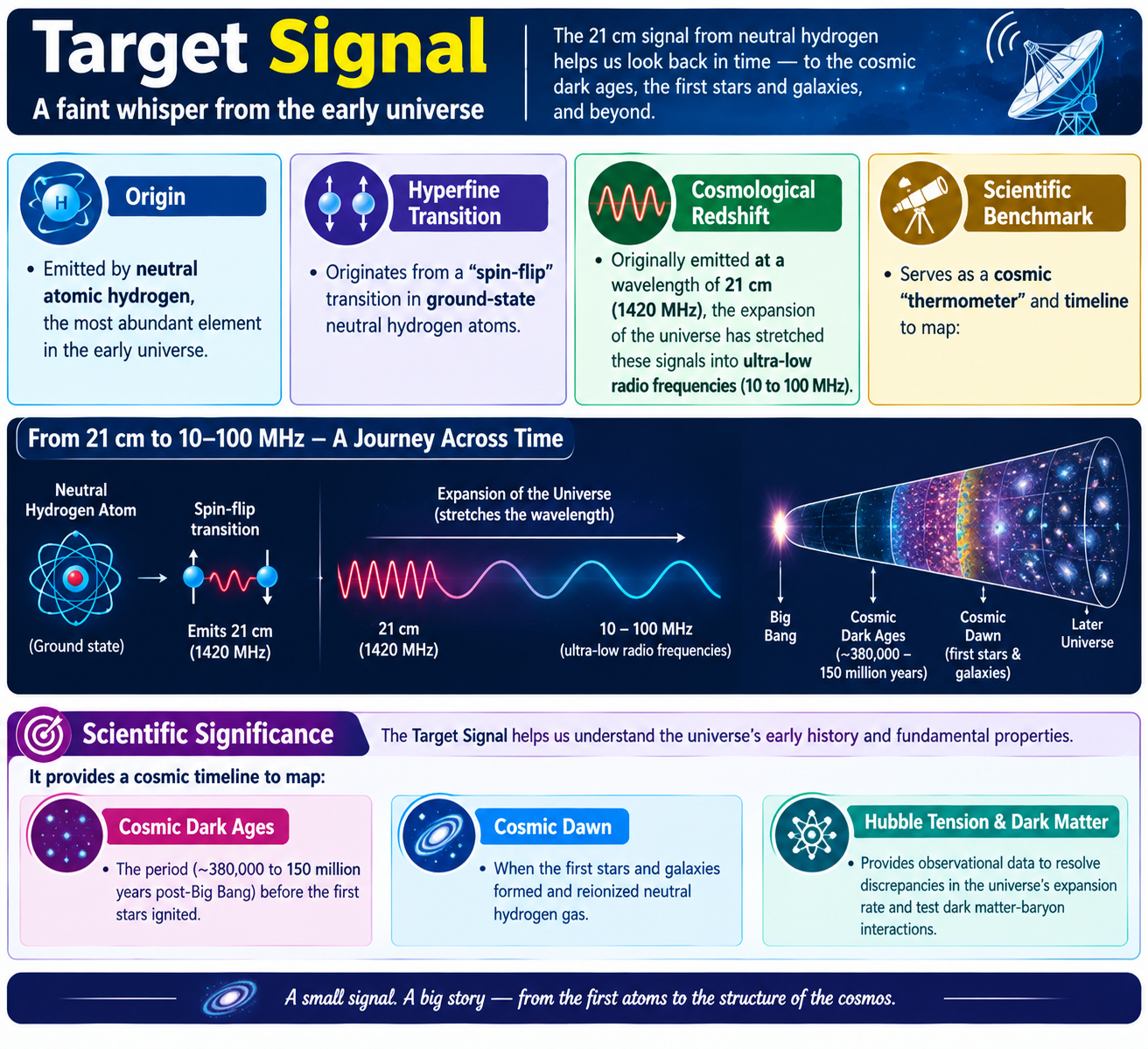
  • Origin - Emitted by neutral atomic hydrogen, the most abundant element in the early universe.
  • Hyperfine Transition - Originates from a "spin-flip" transition in ground-state neutral hydrogen atoms.
  • Cosmological Redshift - Originally emitted at a wavelength of 21 cm (1420 MHz), the expansion of the universe over ∼13.5 billion years has stretched these signals into ultra-low radio frequencies (10 to 100 MHz).
  • Scientific Benchmark - Serves as a cosmic "thermometer" and timeline to map:
  • Cosmic Dark Ages - The period (380,000 to 150 million years post-Big Bang) before the first stars ignited.
  • Cosmic Dawn - When the first stars and galaxies formed and reionized neutral hydrogen gas.
  • Hubble Tension & Dark Matter - Provides observational data to resolve discrepancies in the universe's expansion rate and test dark matter-baryon interactions.

First Radio Signal from Moon’s Far Side

Far Side of the Moon

  • Radio-Quiet Zone - The far side of the Moon is the most pristine, radio-quiet environment in the inner Solar System.
  • Earth Noise Shielding- The Moon acts as a physical shield against human-made Radio-Frequency Interference (RFI), such as FM radio, satellite networks, and aircraft communications.
  • Ionospheric Bypass - Ground-based radio telescopes struggle to detect these low-frequency signals because Earth's ionosphere refracts and blocks radio waves below 30 MHz.
  • Observation Window - During a typical 2-hour lunar orbit, a satellite gets approximately 40 minutes of absolute radio silence while positioned behind the lunar far side.

Feature

CosmoCube

PRATUSH

Lead Organization

UK-led international consortium (University of Cambridge, STFC RAL Space)

Raman Research Institute (RRI), Bengaluru (supported by ISRO/DST)

Form Factor

Suitcase-sized small satellite (CubeSat class)

Space-borne radio telescope payload

Target Orbit

Lunar Orbit (collecting data behind the far side)

High Earth Orbit / Lunar Orbit

Instrumentation

Ultra-sensitive RF-System-on-Chip (RFSoC) radiometer and deployable antenna

Precision wideband radiometer designed for sub-microvolt cosmological signals

Reference

The Hindu | A satellite to look for the first radio signal

There are no reviews yet. Be the first one to review.

ARCHIVES

sidetext


