Mains: GS II Polity & Governance| Social Justice
Recently, the Supreme Court has ruled that states may withdraw or close FIRs against protesting students, provided that procedure prescribed by law is followed.
First Information Report (FIR) – It is a written document prepared by the police when they receive information about the commission of a cognizable offence.
It’s the first step in the criminal justice process and triggers a police investigation into the matter.
Governed by – Criminal Procedure Code, 1973 (CrPC), specifically:
Section 154 of the CrPC – It lays down the procedure for recording an FIR.
It mandates that the information about a cognizable offence given to an officer in charge of a police station must be recorded in writing.
Section 157 of the CrPC – Stipulates the procedure for investigating a cognizable offence upon receiving information about it through an FIR.
Closure of Investigation – If an investigation fails to uncover sufficient evidence, the police may submit a closure report to the Magistrate.
The police are not authorized to unilaterally terminate the criminal process solely on the basis of a government directive to withdraw a case.
The Magistrate reviews the closure report and exercises judicial oversight.
Withdrawal from Prosecution – Section 360 of the Bharatiya Nagarik Suraksha Sanhita (BNSS) mentions, A Public Prosecutor or Assistant Public Prosecutor may request withdrawal from prosecution, provided that the court grants consent prior to the delivery of judgment.
Two primary safeguards govern this process:
The decision must demonstrate the independent judgment of the Public Prosecutor, rather than simply executing a government directive.
Obtaining the court's consent is mandatory; withdrawal from prosecution does not occur automatically.
In Sheonandan Paswan v. State of Bihar (1986), the Supreme Court held that the court must assess whether the withdrawal is:
In good faith,
Consistent with public policy and justice, and
Not intended to thwart the criminal justice process.
The victim must also be afforded an opportunity to be heard.
Quashing of FIR by the High Court – The High Court may exercise its inherent powers under Section 528 of the Bharatiya Nagarik Suraksha Sanhita (BNSS) to:
Prevent abuse of the legal process; or
Secure the ends of justice.
An accused individual may directly approach the High Court to seek quashing of the FIR.
However, this power is extraordinary and discretionary, and should generally be exercised sparingly, particularly when the investigation is at a preliminary stage.
In 1980, the Supreme Court dealt with the withdrawal of prosecution in the Baroda Dynamite case against George Fernandes and others following the Emergency.
The court allowed the withdrawal to stand and recognised that lack of evidence is not the only ground on which a prosecution may be withdrawn.
Public interest may also justify ending prosecutions arising from periods of unrest.
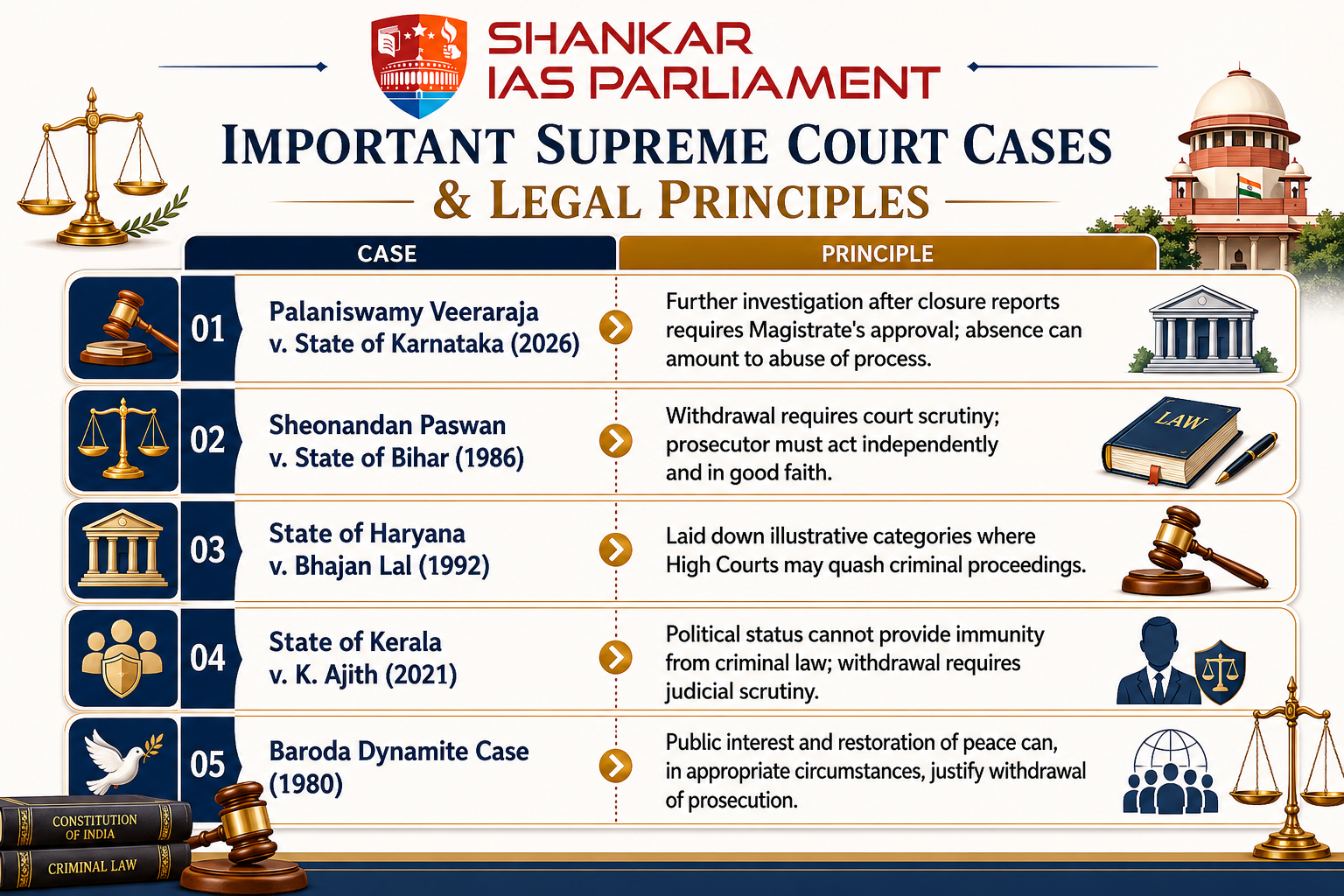
Abuse of Process – Criminal law should not be employed as an instrument for harassment, retaliation, or political vendetta.
No Prima Facie Offence – Even if the allegations are accepted as true, the essential elements constituting an offence may be absent.
Mala Fide Proceedings – The prosecution may be initiated due to personal, political, or extraneous motivations.
Legal Bar – A statutory or procedural prohibition may prevent the continuation of prosecution.
Protection of Fundamental Rights – Unjustified criminal proceedings may adversely impact the following fundamental rights:
Personal liberty,
Dignity,
Reputation,
Freedom of expression and association.
Failure of Due Process – As highlighted in Palaniswamy Veeraraja, failure to adhere to required judicial supervision can undermine the legality of subsequent proceedings.
The power to quash an FIR is a safety valve against abuse of criminal law, not a political escape route from accountability.
The Supreme Court noted that prosecutions related to “mass agitations, communal riots, regional disputes, industrial conflicts, student unrest” may be withdrawn to help restore peace or maintain a settlement.



