Prelims: Current events of national and international importance | Conservation
Why in News?
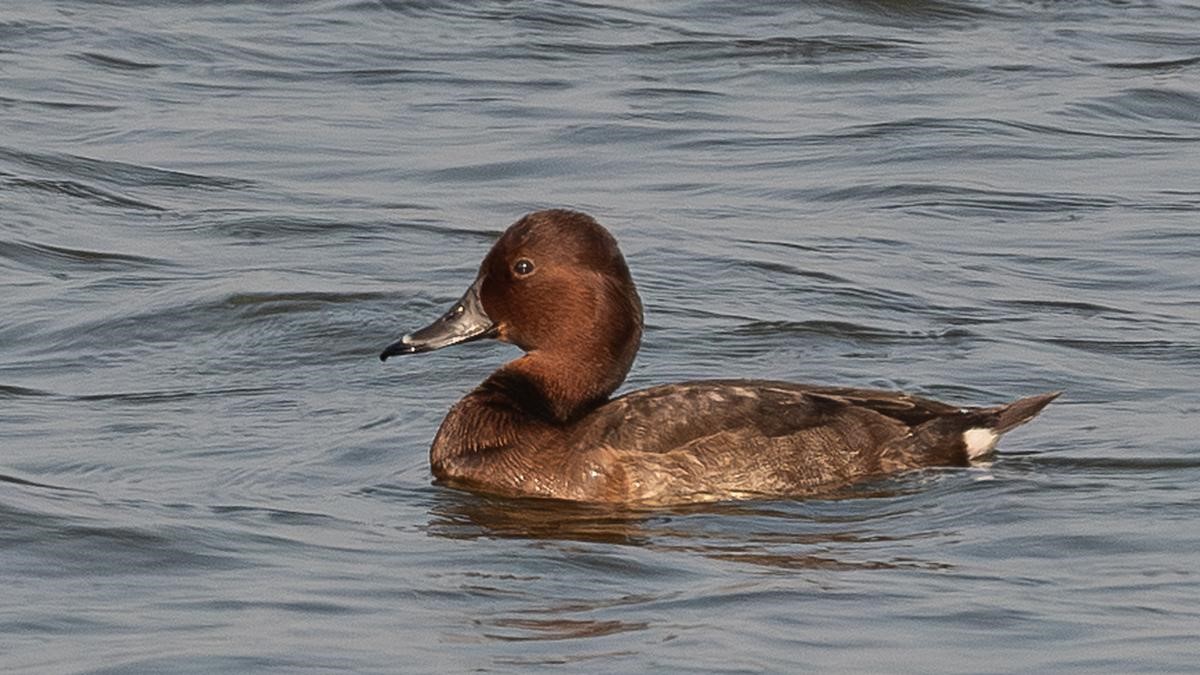
A lone Ferruginous Pochard was found among a flock of Common Pochards at Amoor lake Chengalpattu, Tamil Nadu recently.
- Scientific Name - Aythya nyroca.
- It is commonly known as the White-eyed Pochard or Ferruginous Duck.
- It is a medium-sized diving duck known for its striking mahogany plumage and "shy" nature.
- Key Identification - The Ferruginous Pochard is often mistaken for the Tufted Duck or the Common Pochard, but a few specific markers set it apart:
- Coloration- Adults have a rich, dark chestnut (ferruginous) head, breast, and flanks.
- The "White Eye" - Breeding males have a distinct, piercing white iris, while females and juveniles have dark brown eyes.
- Undertail - It has a very prominent pure white undertail patch, which is a key field mark even when the bird is swimming.
- In Flight - Look for a broad, bright white wing stripe that extends almost to the wingtips, contrasting sharply with the dark upperparts.
- Habitat - Unlike many other diving ducks that prefer open water, the Ferruginous Pochard is a specialist of shallow, heavily vegetated wetlands.
- Distribution - Historically widespread across Eurasia and North Africa, it is now a species of conservation concern.
- Behavior & Diet – Feeding - They are omnivorous. While they are diving ducks, they also frequently "upend" (dabble) like mallards to reach aquatic plants, seeds, mollusks, and small fish.
- Social Life - They are generally less gregarious than other pochards, often seen in small groups or pairs, though they may join large mixed-species flocks during winter.
- Nesting - They build concealed nests on the ground near water or even floating nests in thick reed beds.
- Conservation Status – IUCN - Near Threatened.
- Threats - Habitat Loss, Human Disturbance, Hybridization.
Reference
The Hindu | Ferruginous Pochard