What is the issue?
There have been accusations on anti-defection law being failed to discourage defection with varying suggestions from Former Vice President Hamid Ansari, ECI and Supreme Court.
What is the anti-defection law?
- The anti-defection law punishes individual MPs/MLAs for leaving one party for another.
- It was added by 52 nd Constitutional Amendment Act as the Tenth Schedule in 1985.
- Its purpose was to bring stability to governments by discouraging legislators from changing parties.
- It was a response to the toppling of multiple state governments by party-hopping MLAs after the general elections of 1967.
- The Presiding Officers of the Legislature (Speaker, Chairman) are the deciding authorities in such cases.
- The decision can be challenged before the higher judiciary.
What constitutes defection?
- The law covers three kinds of scenarios.
- When legislators elected on the ticket of a political party voluntarily give up membership of that party or vote in the legislature against the party’s wishes.
- When an MP/MLA who has been elected as an independent joins a party later.
- When nominated legislators join a political party after six months of being appointed to the House.
- Violation of the law in any of these scenarios can lead to a legislator being penalised for defection.
- But it allows a group of two-third MP/MLAs to join (i.e. merge with) another political party without inviting the penalty for defection.
What are the loopholes in defection law?
- The law does not provide a time-frame within which the presiding officer has to decide a defection case.
- There have been many instances where a Speaker has misused this in not determining the case of a defecting MLA until the end of the legislature term.
- Parties often sequester MLAs in resorts to prevent them from changing their allegiance or getting poached by a rival party.
- Recent examples are Rajasthan (2020), Maharashtra (2019), Karnataka (2019 and 2018), and Tamil Nadu (2017).
Have any suggestions been made to improve the law?
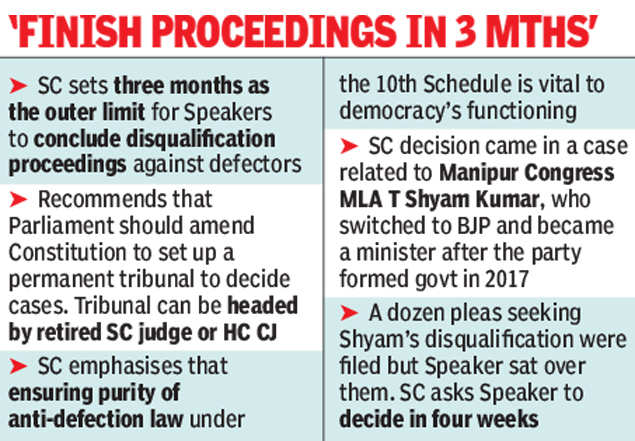
- Last year, the Supreme Court held that ideally Speakers should take a decision on a defection petition within three months.
- It also said that Parliament should set up an independent tribunal headed by a retired judge of the higher judiciary to decide defection cases swiftly and impartially.
- The Election Commission has suggested it should be the deciding authority in defection cases.
- Former Vice President Hamid Ansari has suggested that anti defection should be applicable only to save governments in no-confidence motions.
Source: The Indian Express



