Why in News?
According to a recent report by the Comptroller and Auditor General, the Commerce Ministry needs to properly monitor the Export Promotion Capital Goods (EPCG) scheme.
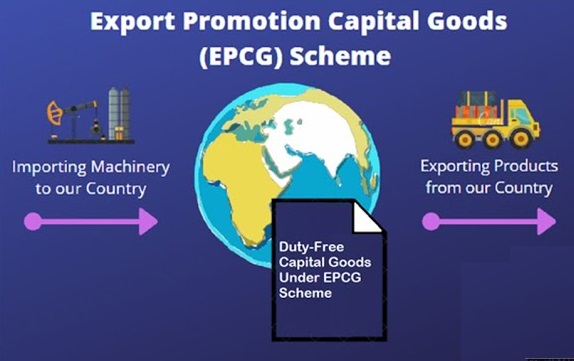
- EPCG Scheme – It allows the import of capital goods for pre-production, production and post-production at zero customs duty.
- It is one of the earliest export promotion schemes that is presently in operation.
- Established in – 1992.
- Nodal Ministry – Ministry of Commerce and Industry.
- Administered by – Regional Licensing Authorities (RLAs) under the Director General of Foreign Trade (DGFT).
- Governed by – Foreign Trade Policy (FTP).
- Objective – To facilitate the import of capital goods to produce quality goods and services and enhance India's manufacturing competitiveness.
- Imported capital goods
- Computer systems and software are part of Capital Goods,
- Spares, moulds, dies, jigs, fixtures, tools & refractories
- Catalysts for initial charge plus one subsequent charge
- EPCG License – It is granted to exporters to import capital goods at a concessional rate of customs duty.
- The licensees have to fulfil 2 types of Export Obligation (EO), which are:
- Average export obligation for preceding 3 years exports.
- Specific exports 6 times the duty saved amount in 6 years.
- Coverage – It covers the following:
- Manufacturer exporters with or without supporting manufacturer(s),
- Merchant exporters tied to supporting manufacturer(s) and
- Service providers, including Common Service Provider (CSP).
- Pre-Requisite – An Importer-Exporter Code (IEC) is required to be eligible under the scheme.
- Exemption - Integrated Goods and Services Tax (IGST) and Compensation cess on the import of capital goods are exempted until 31 March 2020.
References
- Business Standard| CAG Report on EPCG
- DGFT| Export Promotion Capital Goods Scheme
- Indian Trade Portal| EPCG



