What is the issue?
ASEAN has decided to exclude Myanmar’s military junta from its annual summit which is a major setback for the Generals’ attempt to gain regional legitimacy for their brutal regime.
Why did the coup occur?
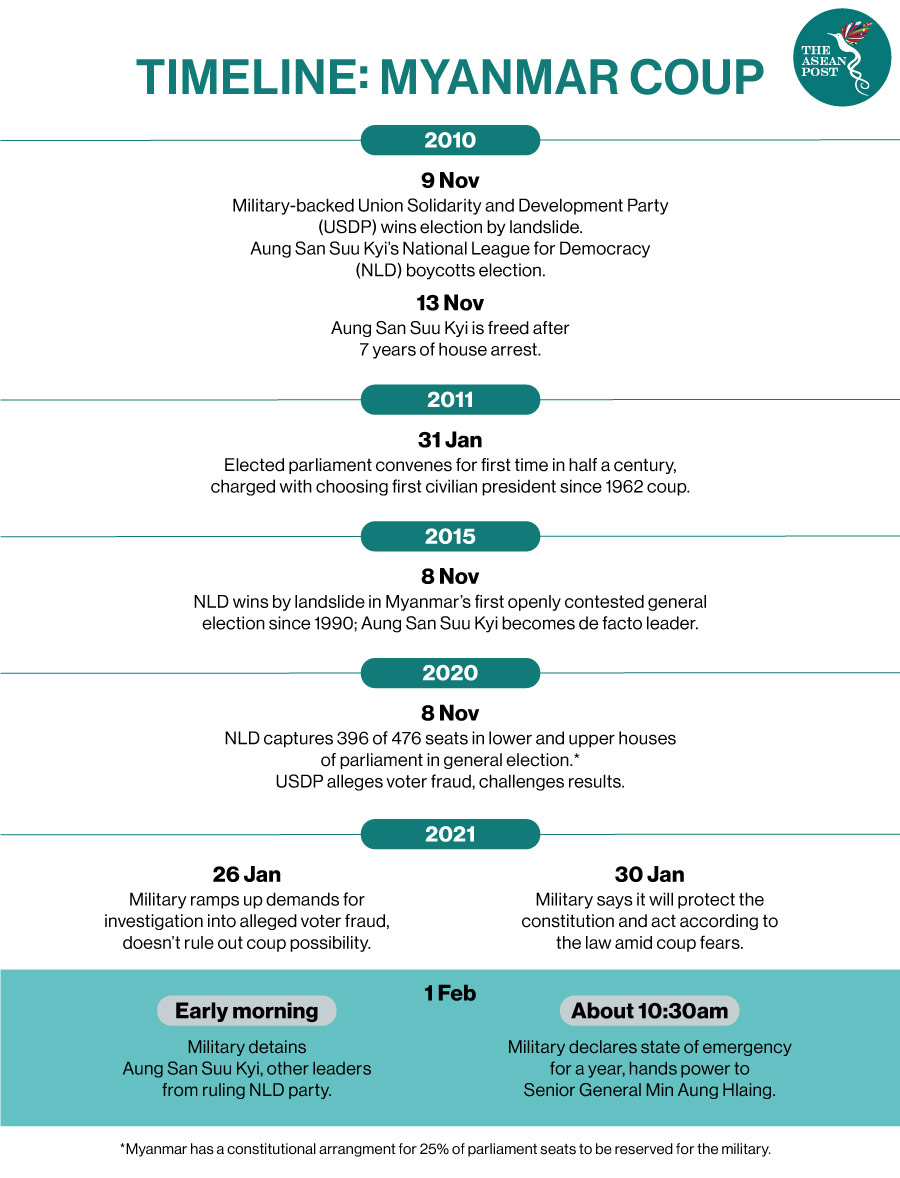
- The Military had a tight grip on Myanmar as the constitution guarantees it a quarter of all seats in parliament and control of its most powerful ministries.
- In the last November's general election, military-backed party- USDP-performed poorly whereas the NLD did even better than in 2015.
- This created tensions between the armed forces and the government.
- The opposition raised allegations of widespread fraud in the election which was not backed by the electoral commission.
- Later, Myanmar's military seized power after detaining Aung San Suu Kyi and other democratically elected leaders.
What was the followup of the power siege?
- The junta has unleashed a reign of terror claiming an estimated 1,000 lives.
- Ms. Suu Kyi who had been the State Councillor for five years from 2015 heading the quasi-democratic government has been in detention.
- Thousands of others were arrested by the military for their democratic protests.
- In cities, protests turned into armed fighting between pro-democracy protesters and security personnel, while in the jungles, anti-junta groups joined hands with rebels for military training.
- The situation was so grave that the UN Special Envoy warned that Myanmar had descended into a civil war.
- Recently, Myanmar's military sentenced a close aide of ousted civilian leader Aung San Suu Kyi to 20 years in prison.
What has been the international reaction to the coup?
- US Secretary of State Antony Blinken has accused the security forces of a "reign of terror".
- The US, UK and European Union have all responded with sanctions on military officials.
- South East Asian countries have been pursuing diplomatic efforts to end the crisis.
- China blocked a UNSC statement condemning the coup, but has backed calls for the release of Ms Suu Kyi and a return to democratic norms.
What led to the exclusion of the junta by ASEAN?
- In April, Gen. Min Aung Hlaing was invited to Jakarta for emergency talks with ASEAN members which led to the ASEAN’s Five-Point Consensus.
- The Consensus that includes immediately ending violence, starting the reconciliation process and allowing a regional special envoy to meet all stakeholders has not been met by the military regime.
- There have been reports of the junta torturing political prisoners.
- Regime violence, political crises and strikes and counter-attacks by protesters have all led to the exclusion of Myanmar.
- According to the UN, around 3 million people are in need of life-saving assistance because of conflict, food insecurity, natural disasters and COVID-19.
- The international community should continue to put pressure on the junta and urgently start a reconciliation process.
References
- https://www.thehindu.com/todays-paper/tp-opinion/descent-into-chaos/article37244869.ece
- https://www.bbc.com/news/world-asia-55902070
Quick facts
Myanmar
- Myanmar, also known as Burma is in South East Asia.
- It neighbours Thailand, Laos, Bangladesh, China and India.
- The main religion is Buddhism.
- The biggest city is Yangon (Rangoon), but the capital is Nay Pyi Taw.
- There are many ethnic groups in the country, including Rohingya Muslims.



