Why in News?
World Food Day 2024 was observed on October 16 with the theme “Right to foods for a better life and a better future”.
What is equitable food system?
- Food system - It encompasses every stage of food production and consumption from growing, harvesting, processing, packaging, transporting, marketing, consuming, and disposing.
- Stakeholders of food system - It involves farmers, processors, retailers, consumers, and even policy makers, each playing a role in influencing the flow and quality of food.
- Equitable food system - It is a framework that ensures access to safe, nutritious, and culturally appropriate food to all individuals while promoting fairness and justice throughout the food supply chain.
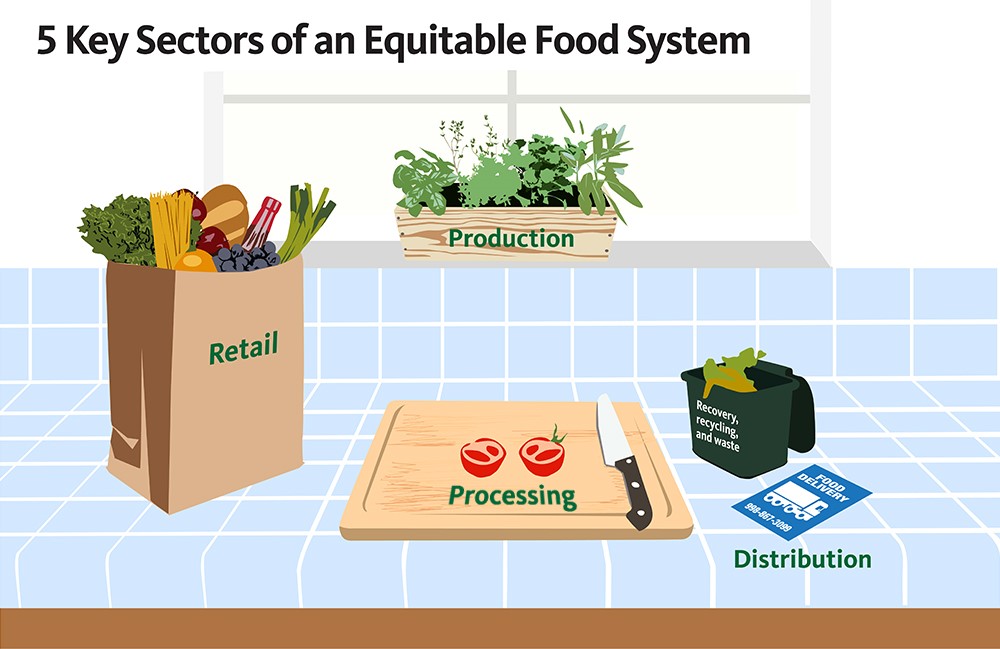
- Production - Network of farms, ranches, and fisheries that use natural resources, capital, labor, and other inputs to cultivate food
- Processing - Network of factories and facilities that transform agricultural goods into a range of food products for consumption
- Distribution - Network of aggregators and shippers responsible for transporting food products across the supply chain by land, air, and sea
- Retail - Constellation of stores of all kinds and direct-to-consumer and other operational models that transact the final sale of food products to customers and consumers
- Recovery, recycling, and waste - Network of municipalities, companies, and nonprofits that handle remainder, discarded, expired, and unused food from numerous end points along the supply chain.
- Significance of equitable food system - Addressing inequalities and empower marginalised communities by prioritising the right to food and nutrition security is essential for peaceful, prosperous communities.
How has India’s food system evolved?
- Once a food-deficient nation, India has made significant strides in food security over the past 60 years and has transformed into a food-surplus country.
- Increase in Food Availability – Green Revolution, White Revolution, Yellow Revolution, Gold Revolution, Blue Revolution have increased the Cereal, Milk, Oil , Horticulture, Fish availability in India.
- Food Research - Agricultural research institutes that play a crucial role in advancing agricultural practices, improving crop yields, and addressing food security challenges.
- Indian Agricultural Research Institute (IARI), New Delhi
- Indian Council of Agricultural Research (ICAR), New Delhi
- National Dairy Research Institute (NDRI), Karnal, Haryana
- Indian Veterinary Research Institute (IVRI), zatnagar, Uttar Pradesh
- National Institute of Agricultural Economics and Policy Research (NIAP), New Delhi
- Indian Institute of Horticultural Research (IIHR), Bengaluru, Karnataka
- Central Arid Zone Research Institute (CAZRI), Jodhpur, Rajasthan
- Indian Institute of Pulses Research (IIPR), Kanpur
- Indian Institute of Rice Research (IIRR), Hyderabad
- National Bureau of Plant Genetic Resources (NBPGR), New Delhi
- Supply Chain - FCI procurement , Public Distribution System (PDS), APMC Markets are a crucial food distribution mechanism for ensuring food security.
- Food Affordability – Minimum Support Price mechanism ensure the availability food at affordable price and income security for farmers.
- Food Safety - Food Safety and Standards Authority of India (FSSAI) regulates the food quality and safety in India.
- Right to Food - A key pillar of India’s food security is the National Food Security Act (NFSA) of 2013, which provides food entitlements to over 800 million citizens.
- Nutritional Security – India has approved the distribution of fortified rice from July 2024 to December 2028 to address nutritional deficiency especially Anaemia.
- PM POSHAN Scheme aims to enhance the nutritional status of children in government schools.
What are the challenges in achieving equitable food system ?
- India’s agricultural sector is the cornerstone of its economy.
- Population Growth – Feeding nutritiously the current population of about 1.4 billion and an annual growth rate of 0.9% is a huge challenge.
- Fragmented Land Holdings - Of its 93.09 million agrarian households, approximately 82% are small and marginal farmers holding less than two hectares of land.
- Fragmented landholding limits smallholder farmers’ adoption of modern techniques, reducing productivity and income.
- Natural resource degradation - Overusing groundwater strains water tables while chemical fertilizers and monocropping harm soil and agricultural productivity.
- Market Access Limitation - Many smallholder farmers need help accessing markets effectively due to infrastructure limitations and supply chain inefficiencies.
- Poverty & Inequality –Rural poverty and inequality affects the participation and distribution of agricultural system.
- Climate change - Erratic weather patterns pose risks to agriculture productivity.
- Infrastructure - Inadequate infrastructure for storage, processing, and transportation of food affects the food supply chain system.
What lies ahead?
- Addressing food inequality and ensuring that everyone has access to nutritious food are essential steps.
- Facilitating better links between production and markets, farmers can increase their incomes and reduce food waste.
- Enhancing access to appropriate technologies is vital.
- Building resilience of farming system through sustainable agricultural practices such as water conservation and soil health restoration.
Quick Facts
- Cereal Production – Launched in 1967 it creased the food availability by tripling the cereal production while only increasing the cultivated area by about 30%.
- Milk Revolution - Operation Flood was launched in 1970 increased the milk production from 20 million tonnes to over 70 million tonnes.
- White revolution 2.0 has been launched in 2024 to empower women, fight malnutrition, increase milk procurement, and strengthen cooperatives.
- Oil Revolution – Yellow Revolution was launched in 1986- 1987 to increase the production of edible oil, especially mustard and sesame seeds to achieve self-reliance.
- Fish Revolution – Blue Revolution was launched in 1985-1990 during the 7th Five-Year Plan to develop, manage, and promote fisheries to double the farmers' income.
- Horticulture Revolution - Golden revolution between 1991 to 2003 aimed to increase the production of honey and horticulture.
References
The Hindu | equitable agrifood systems



