Why in news?
Bendable concrete and other CO2-infused cement mixes could dramatically cut global emissions.
What is the issue?
- The production of cement, the binding element in concrete, accounted for 7% of total global carbon dioxide emissions in 2018.
- Concrete is one of the most-used resources on Earth, with an estimated 26 billion tons produced annually worldwide.
How is the industry moving towards a sustainable path?
- Concrete – It is made up of aggregate materials, primarily rocks and sand, along with cement and water and about 80% of concrete's carbon footprint comes from cement.
- Industrial by products – Iron slag and coal fly ash are now frequently used to reduce the amount of cement needed.
- The resulting concrete can have significantly lower emissions because of that change.
- Alternative binders – Limestone calcined clay can also reduce cement use.
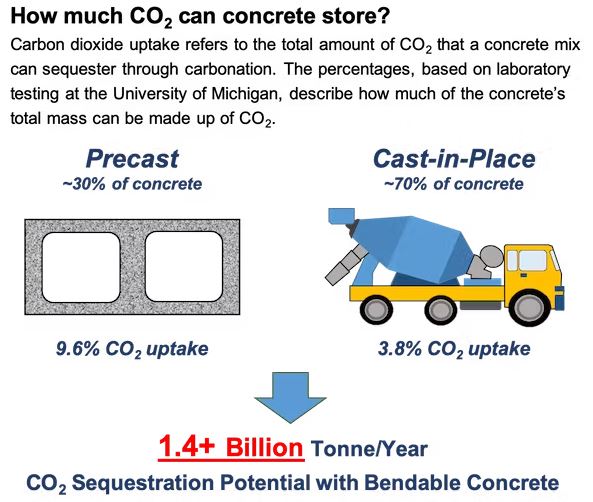
- Usage of CO2 – CO2 makes up a significant percentage of concrete mass.
- It can be added in the form of aggregates or injected during mixing.
- Carbonation curing – It can also be used after concrete has been cast.
- These processes turn CO2 from a gas to a mineral, creating solid carbonates that may also improve the strength of concrete.
- Bendable Concrete Material – It allows thinner, less brittle structure that require less steel reinforcement, further reducing related carbon emissions.
- The material can be engineered to maximize the amount of CO2 it can store by using smaller particles that readily react with CO2, turning it to mineral.
- Bendable concrete was used in the 61-story Kitahama tower in Osaka, Japan, and Roadway Bridge slabs in Ypsilanti, Michigan.
- That means structures may need less cement, reducing the amount of related emissions.
What are the challenges and how can they be addressed?
- CO2 curing - CO2 curing can improve concrete's strength and durability.
- Research can improve the conditions and the timing of steps in the curing process to increase concrete's performance.
- Electricity use – It is the largest emissions source during curing.
- It can be reduced by streamlining the process, by using waste heat.
- Advanced concrete mixes, bendable concrete in particular, already begin to address these issues by increasing durability.
Why infrastructure should be merged with climate policy?
- Government investment and procurement policies are still needed to transform the construction industry.
- In New York and New Jersey, lawmakers have proposed state-level policies that would provide price discounts in the bidding process to proposals with the lowest emissions from concrete.
- These policies could serve as a blueprint for reducing carbon emissions from concrete production and other building materials.
References
- The Hindu │ Bendable concrete and other CO2-infused cement mixes
- The Washington Post │ Bendable concrete, other CO2-infused cement mixes



