Why in news?
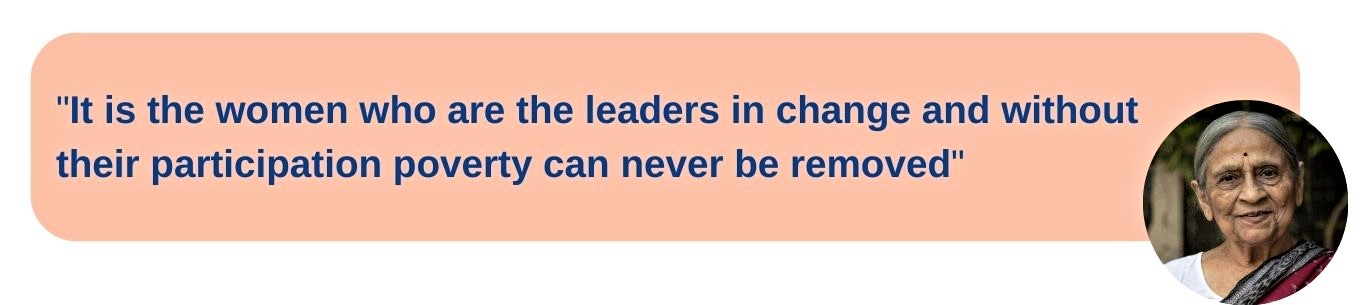
Elaben Bhatt, noted Gandhian, leading women’s empowerment activist, and renowned founder of the Self-Employed Women’s Association (SEWA) has passed away.
Who is Ela Bhatt?
- Elaben was born on September 7, 1933, in Ahmedabad, in a family that engaged in social causes.
- In 1972, she founded SEWA, one of the largest cooperatives working for women.
- She was a Member of the Rajya Sabha and of the Planning Commission of India in the 1980s.
- Ela Bhatt was a co-founder and had served as Chairperson of Women’s World Banking.
- She also served as an advisor to the World Bank, and addressed the United Nations General Assembly.
- She became the part of a group of world leaders called the Elders, founded by Nelson Mandela to promote human rights and peace across the world.
- Elaben was the Chairperson of Sabarmati Ashram and recently resigned as the Chancellor of Mahatma Gandhi-founded Gujarat Vidhyapith.
- She was the recipient of national and international awards, including the Padma Bhushan, the Ramon Magsaysay Award and the Indira Gandhi Peace Prize.
What is SEWA?
- SEWA (Self Employed Women’s Association) is the single largest Central trade union registered in 1972 with a base of over 2.1 million members from India and in neighbouring nations.
- It grew out of the Textile Labour Association (TLA) — founded by Anasuya Sarabhai and Mahatma Gandhi in 1920.
- Principle – The poor do not need charity, they need an enabling mechanism to come out of the vicious circle of poverty and vulnerability.
- It incorporates Gandhian principles of Satya (truth), Ahimsa (non-violence), Sarvadharma (integrating all faiths, all people) and Khadi (local employment and self-reliance).
- Twin goals
- Full employment – Achieve work security, food security and social security
- Self-reliance – At individual and community levels in terms of economic as well as decision making abilities.
- With an annual membership fee of Rs 10, SEWA allows anyone (women) who is self-employed to become a member.
What is so siginificant about SEWA?
- Women empowerment - It has helped rehabilitate women in personal, and even political or social crises, by empowering them through skilling and training.
- Women from diverse social and community backgrounds work together in the organisation.
- Women employment - It provided employment to women and promoted cooperative production, consumption and marketing of textiles which constituted the core of India’s industrialisation.
- Labour movement - It also decisively influenced the course of trade unionism and labour movement in India.
- Microfinance - In 1974, SEWA Bank was established to provide small loans to poor women which was recognised by the International Labour Organisation as a microfinance movement.
- Influence in policy making - The Unorganised Workers Social Security Act (2008), National Rural Livelihoods Mission (2011), and Street Vendors Act (2014) are seen as successes of SEWA’s struggle.
- The PM Street Vendors Atmanirbhar Nidhi (PM-SVANidhi) scheme is seen as being inspired by SEWA’s microfinance model.
What are the major initiatives of SEWA?
- Hansiba - SEWA launched a clothing line called Hansiba, which has collaborated with international designers to take the ethnic embroidery of Gujarat to the world, through its own women.
- Anubandh - During the pandemic, SEWA launched Anubandh, an e-commerce platform to connect sellers with buyers.
- Digital Beti - Started by SEWA Bharat in 2019 and funded by Facebook, Digital Beti aims to overcome the digital gender gap in India by training women from rural areas to become entrepreneurs.
- In Ahmedabad SEWA runs a cafe that serves affordable hot Gujarati and South Indian meals, sells vegetables grown in its farms, pulses, and spices.
References
- The Indian Express│ The story of Ela Bhatt’s SEWA
- The Hindu│ Elaben Bhatt, Gandhian, SEWA founder, and women’s empowerment activist, dies
- The Hindu│ SEWA pioneered by Elaben Bhatt was an innovative experiment
- SEWA│About Self Employed Women’s Association



