Why in news?
A new study projects that climate change will significantly impact El Niño-La Niña weather patterns approximately by 2030.
What are the findings of the study?
- Study published in Nature journal – It has projected that climate change will impact El Niño-La Niña weather patterns approximately by 2030, a decade before what was earlier predicted.
- If Central Pacific and Equatorial Pacific are not separated, sea surface temperature (SST) variability from ENSO will occur almost four decades earlier than previously suggested.
- WMO prediction – In 2022, the World Meteorological Organisation (WMO) predicted the first “Triple dip” La Niña of the century.
- This is only the third time since 1950 that a triple dip La Nina has been observed.
At present, India is witnessing an extended triple dip La Niña.
What is El Niño?
- El Niño is a loose translation of “little boy” or “Christ child” in Spanish.
- Earlier, it was also called “El Niño de Navidad” since it peaks around December.
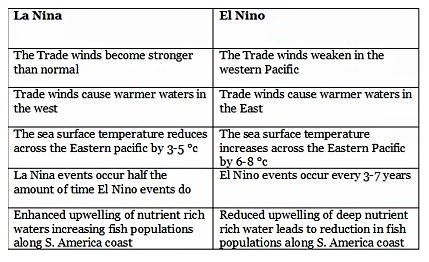
- El Niño is the warming of sea waters in Central-east Equatorial Pacific that occurs every few years (Warm phase off the coast of Peru).
- During El Niño, surface temperatures in the equatorial Pacific rise
- This weakens the trade winds — east-west winds that blow near the Equator.
- Due to El Niño, easterly trade winds that blow from the Americas towards Asia change direction to turn into westerlies.
- It thus brings warm water from the western Pacific towards America.
Effects of El Niño Phenomenon
- Weather - El Niño causes dry, warm winter in Northern U.S. and Canada and increased flooding risk on the U.S. gulf coast and southeastern U.S.
- It brings drought to Indonesia and Australia.
- In India, an El Nino event is strongly linked to suppressed rainfall in the monsoon season.
- Marine resource - Under El Niño, upwelling (deeper waters rise towards the surface) of deeper waters is reduced, thus reducing phytoplankton off the coast.
- Fish that eat phytoplankton are affected, followed by other organisms higher up the food chain.
- Warm water - Warmer water carries tropical species towards colder areas, disrupting multiple ecosystems.
- Airflow above the ocean - Heat redistribution on the surface impacts airflows above the ocean.
What is La Niña?
- La Niña or “Little girl” is the opposite of El Niño.
- La Niña sees cooler than average sea surface temperatures in the equatorial Pacific region.
- It is the “Cool phase”.
- Trade winds are stronger than usual, pushing warmer water towards Asia.
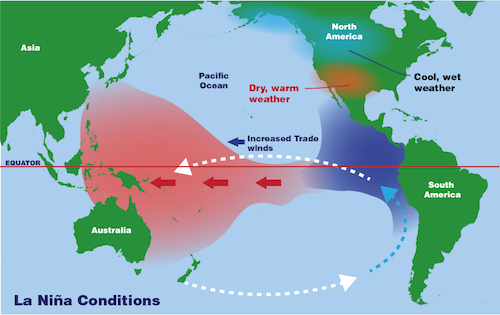
Effects of La Niña Phenomenon
- Weather - Pacific cold waters close to the Americas push jet streams (narrow bands of strong winds in the upper atmosphere) northwards.
- La Niña leads to drier conditions in Southern U.S.
- La Niña has been associated with heavy floods in Australia.
- In the Indian context, La Niña is associated with good rainfall during the monsoon season.
- Ocean water - On the American west coast, upwelling increases, bringing nutrient-rich water to the surface.
What about El Niño Southern Oscillation (ENSO)?
- The combination of El Niño, La Niña, and the neutral state between the two opposite effects is called the El Niño Southern Oscillation (ENSO).
- The phenomenon was discovered by Sir Gilbert Walker.
Quick facts
Triple dip La Nina - The extended spell of La Nina lasting across three winter seasons in the northern hemisphere is called ‘Triple dip La Nina’.
Walker circulation - The air circulation as a result of difference in surface pressure and temperature over the western and eastern tropical Pacific Ocean is known as Walker circulation.
References
- The Hindu│ El Niño, La Niña and changing weather patterns
- The Indian Express│ The ‘triple dip’ La Niña
- National Ocean Service│ What are El Niño and La Niña?



