0.1079
7667766266
x

Earthquake Swarms

iasparliament Logo
August 19, 2026

Mains: GS III – Disaster Management

Why in News?

Maharashtra has recently witnessed an earthquake storm particularly around Nashik and Palghar.

What is an Earthquake?

  • Definition – An earthquake occurs when accumulated stress in the Earth's crust causes rocks to suddenly slip along a fault or zone of weakness.
  • Tectonic forces continuously act on rocks, but friction may prevent movement along existing fractures.
  • Seismic waves – As stress builds beyond the strength of the rocks and frictional resistance, the rocks suddenly rupture or slip, releasing stored energy as seismic waves.

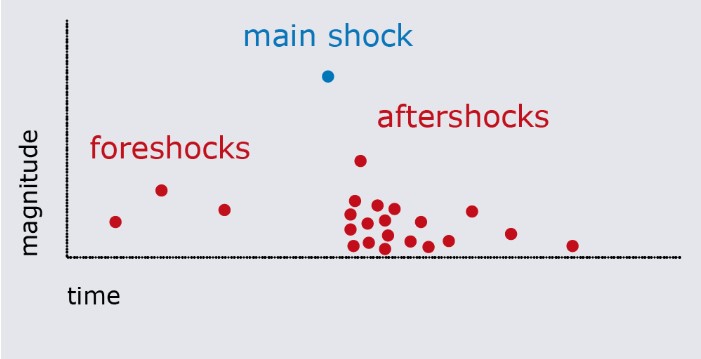
Earth quake swarm 1

  • Types of waves – These waves are primarily of three types.
    • P-waves compress and expand rocks in the direction of propagation,
    • S-waves move rocks perpendicular to the direction of travel.
    • Surface waves travel along the Earth's surface and generally contribute significantly to the shaking experienced at the surface.
  • Thus, earthquakes represent the sudden release of accumulated crustal stress.

What is an Earthquake Swarm?

  • In a conventional earthquake sequence, a relatively large mainshock is followed by smaller aftershocks.
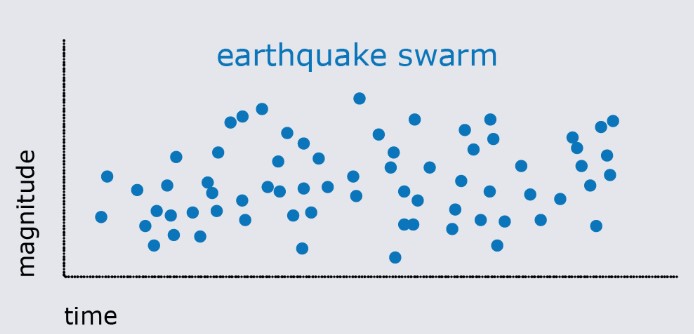
  • An earthquake swarm differs because there is no obvious dominant mainshock.
  • Instead, numerous earthquakes of broadly comparable magnitude occur over days, weeks or even months, with their magnitude and frequency fluctuating over time.

Earth quake swarm 2

  • Importantly, an earthquake swarm does not necessarily indicate that a larger earthquake is imminent.
  • Swarms have different causes depending on their geological setting.
  • Maharashtra's Palghar region provides a prominent example. Beginning in November 2018, thousands of earthquakes were recorded over more than a year.
  • Although subsequent swarms have generally been shorter, the region continues to experience intermittent seismic activity.

Why does Maharashtra experience earthquake swarms?

  • Intraplate earthquakes – Maharashtra is located well away from a major tectonic plate boundary.
  • Nevertheless, it experiences intraplate earthquakes, which occur within the interior of a tectonic plate rather than at its boundaries.
  • Deccan trap – A major geological feature of Maharashtra is the Deccan Plateau, underlain extensively by the Deccan Traps.
  • These basaltic lava formations were produced by enormous volcanic eruptions around 66 million years ago.
  • Thousands of individual lava flows accumulated over time, creating thick layers of basalt.
  • Although the Deccan Traps are ancient, their rocks contain fractures, joints and other zones of weakness.
  • Such structures can act as pathways through which stresses are transmitted and released.
  • Geological investigations around Nashik have also identified shear zones, fractures and other structural weaknesses capable of facilitating local seismic activity.
  • Plate movements – Another factor is the continuing movement of the Indian tectonic plate.
  • Although the most dramatic deformation occurs near plate boundaries, stresses can also accumulate within the plate.
  • When these stresses interact with pre-existing fractures and zones of weakness, intraplate earthquakes can occur.
  • Therefore, the absence of a major plate boundary does not mean Maharashtra is immune to earthquakes.

What is the role of rainfall and groundwater?

  • Water can also influence seismic activity under suitable geological conditions.
  • Heavy rainfall allows water to infiltrate the ground through soil, permeable rocks and fractures.
  • If this water reaches a fault or interconnected network of cracks, it can increase pore-fluid pressure.
  • Higher pore pressure can reduce the effective frictional resistance holding rocks together.
  • If the accumulated tectonic stress is already close to the failure threshold, this may trigger movement along existing fractures and produce earthquakes.
  • This phenomenon is commonly referred to as rainfall-triggered seismicity.
  • Studies of the Palghar earthquake swarm have provided evidence supporting a possible connection between rainfall and seismic activity.
  • Satellite observations have indicated land subsidence, while studies of thousands of earthquakes recorded between 2019 and 2020 found an increase in seismic activity following rainfall.
  • Researchers suggested that infiltrating water migrated into subsurface cracks and increased pore pressure.
  • However, rainfall should not be treated as the sole explanation.
  • Other studies have highlighted normal faulting, aseismic deformation, tectonic stresses and pre-existing geological structures as important contributors.
  • The precise relationship between rainfall and seismicity therefore varies with local geological conditions.

Koyna: A Case of Reservoir-Induced Seismicity

  • Maharashtra also provides one of the world's most studied examples of reservoir-triggered seismicity at Koyna.
  • After the Koyna Dam was constructed and its reservoir was filled, seismic activity began to be detected in the region.
  • This activity culminated in the devastating magnitude 6.3 Koyna earthquake of December 10, 1967, which caused extensive damage and resulted in more than 200 deaths.
  • The Koyna experience demonstrated that changes in the hydrological conditions of a region can influence seismicity.
  • The filling and periodic fluctuations of a reservoir can increase the load on the crust and allow water to penetrate fractures, potentially altering pore pressure and facilitating movement along pre-existing faults.
  • This phenomenon is known as reservoir-induced or reservoir-triggered seismicity.
  • It illustrates the complex interaction between human activities, groundwater conditions, geological structures and tectonic stresses.

What is the significance for disaster management?

  • The recent earthquake swarm highlights the need for Maharashtra to strengthen its seismic monitoring and disaster preparedness.
  • Since earthquake swarms do not necessarily precede larger earthquakes, they should neither be ignored nor treated as definitive warnings of an impending major event.
  • Measures should focus on:
    • Strengthening dense seismic monitoring networks,
    • Improving microzonation and seismic hazard mapping,
    • Enforcing earthquake-resistant building standards,
    • Assessing vulnerable infrastructure such as dams, bridges and hospitals,
    • Studying the relationship between rainfall, groundwater and seismicity, and
    • Improving public awareness and emergency preparedness.
  • Scientific communication is equally important because shallow earthquakes, even when moderate in magnitude, can generate noticeable shaking and public anxiety.

What lies ahead?

  • Maharashtra's recent earthquake swarm is a reminder that significant seismic activity can occur even far from conventional tectonic plate boundaries.
  • Understanding these swarms can help India improve its broader capacity to manage intraplate seismic hazards, which often remain difficult to predict but can be effectively mitigated through preparedness and resilient development.

Reference

The Hindu| Earthquake Swarms

Login or Register to Post Comments
There are no reviews yet. Be the first one to review.

ARCHIVES

sidetext