Prelims: Current events of national and international importance | Species
Why in News?
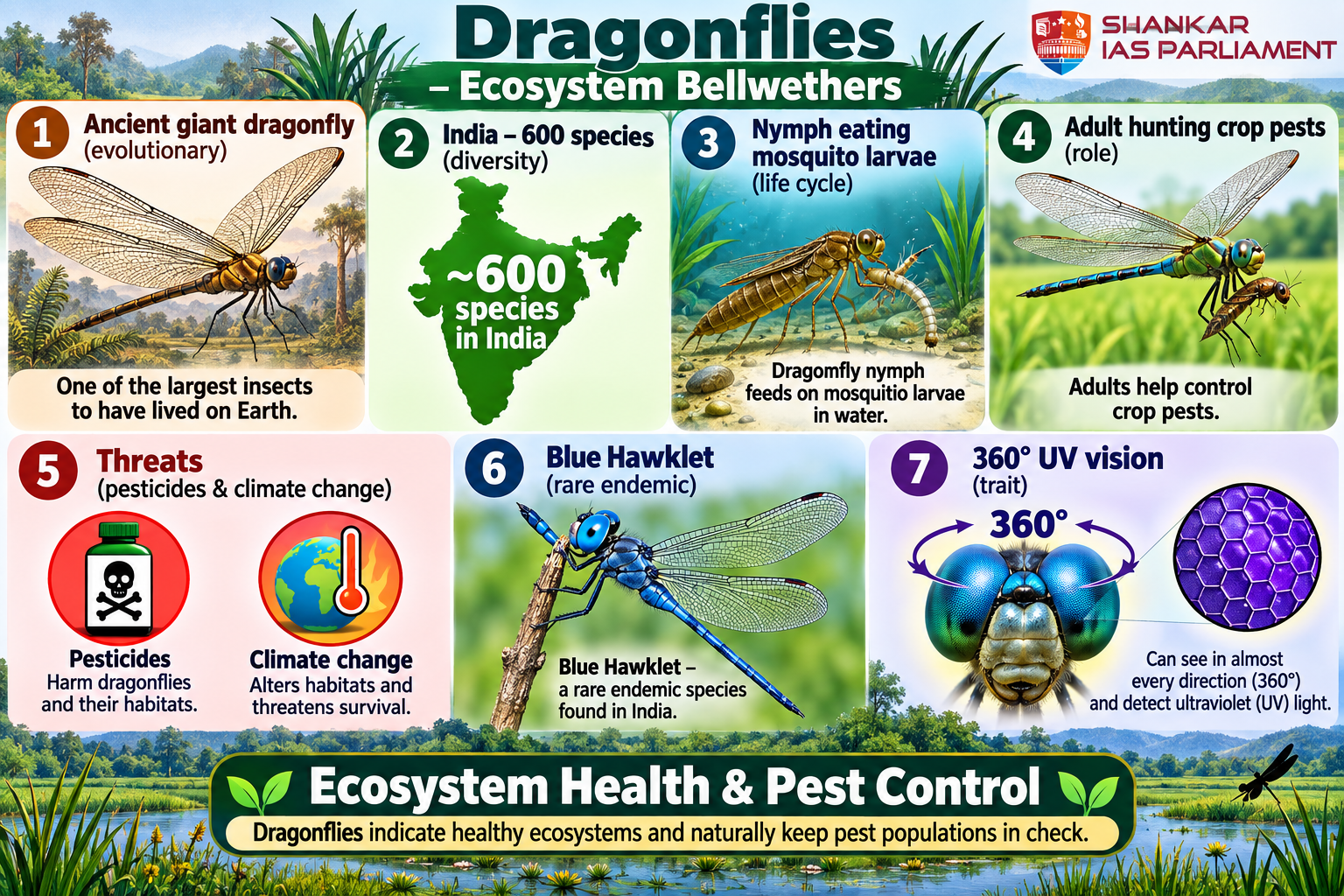
Recent studies on dragonflies highlight their distinctive 360-degree ultraviolet-sensitive vision.
Evolutionary Background – These insects are among the earliest known flying organisms, originating approximately 300 million years ago.
India is home to approximately 600 species belonging to the order Odonata, which includes both dragonflies and damselflies.
Distribution –There is significant species diversity in the Northeast and Western Ghats regions.
Recent ecological surveys indicate declining populations and the disappearance of certain species.
For example, the Blue Hawklet (Hylaeothemis apicalis), which is endemic to the Western Ghats, is now rarely observed.
Life Cycle and Ecological Role – Aquatic nymphs inhabit wetlands, ponds, and streams.
Adult individuals function as aerial predators and possess four independently moving wings.
Nymphs consume mosquito larvae and crop pests, particularly in paddy fields.
Adults prey on leafhoppers and other harmful insects.
These species serve as indicators of healthy ecosystems and sustainable agricultural practices.
Threats –The use of pesticides, particularly systemic compounds such as fipronil, has contributed to a decline in population numbers.
Climate change has resulted in increased droughts and unpredictable rainfall patterns, which negatively impact endemic species.
Additionally, these species are subject to predation by various other organisms.
Distinctive Biological Characteristics –The species possesses panoramic vision (360 degree) facilitated by more than 16 opsin genes, in contrast to the four found in humans.
It is capable of detecting ultraviolet light and exhibits a highly sensitive visual system.
Ongoing research continues to uncover additional biological insights regarding this species.
Significance
They serve as indicators of ecosystem health, as their presence reflects the overall ecological condition.
They contribute to pest management, particularly through the regulation of mosquito populations.