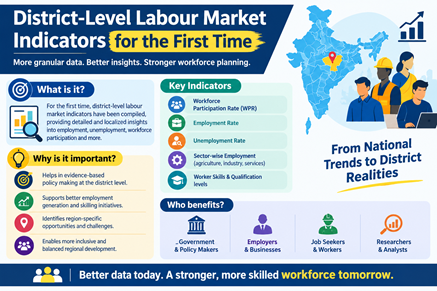
District-Level Labour Market Indicators for the First Time
iasparliament
September 22, 2026
Prelims: Current events of National and International Importance | Econ0my
Why is in news?
Statistics and Programme Implementation Ministry released a labour market snapshot of selected districts.
In detail
The district-level key labour market indicators were released by the National Statistical Office for the first time.
Around 57.8% of districts recorded a female Labour Force Participation Rate (LFPR) of 40% or above.
The Worker Population Ratio (WPR) of the top 50% populous districts ranges between 37.3 to 76.7%.
Among the 100 most populous districts, Surat in Gujarat recorded the highest levels of LFPR and WPR, while Darbhanga in Bihar recorded the lowest levels of LFPR and WPR.
More than 75% of districts have Not in Employment, Education or Training (NEET) rates under 30%.
Basics
Labour Force Participation Rate (LFPR): LFPR is defined as the percentage of persons in the labour force (i.e., working or seeking or available for work) in the population.
Worker Population Ratio (WPR): WPR is defined as the percentage of employed persons (i.e., persons who were engaged in any economic activity) in the population.
Unemployment Rate (UR): UR is defined as the percentage of persons unemployed (i.e., persons who, owing to lack of work, had not worked but either sought work through different channels or expressed their willingness or availability to work) among the persons in the labour force.
Not in Employment, Education or Training (NEET): NEET is defined as the percentage of persons who are not in employment, education or training during the reference period in the population.
Activity Status - Usual Status: The activity status of a person is determined on the basis of the activities pursued by the person during the specified reference period. When the activity status is determinedon the basis of the reference period of last 365 days preceding the date of survey, it is known as the usual activity status of the person
Principal activity status (ps): The activity status on which a person spent a relatively long time (major time criterion) during last 365 days preceding the date of survey was considered the usual principal activity status of the person.
Subsidiary economic activity status (ss): The activity status in which a person, in addition to his/her usual principal status, performs some economic activity for 30 days or more for the reference period of last 365 days preceding the date of survey, was considered the subsidiary economic activity status of the person.
Activity Status - Current Weekly Status (CWS): The activity status determined on the basis of a reference period of last 7 days preceding the date of survey is known as the current weekly status (CWS) of the person.