Prelims: Current events of national and international importance | Environment
Why in News?
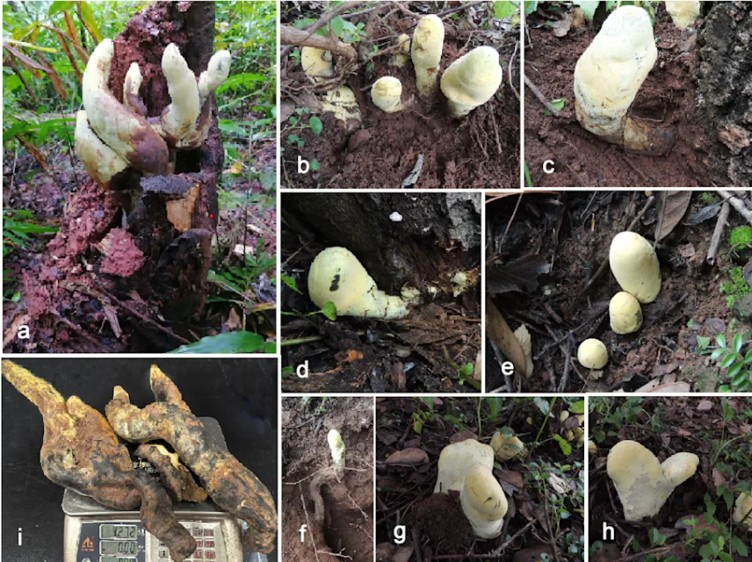
Recently, researchers from the Kunming Institute of Botany alongside international collaborators, announcing the discovery of a giant, previously unknown fungus species in the forests of Yunnan Province, China.
- Named as- Dianjunus rex (popularly dubbed 'D-Rex').
- This organism establishes an entirely new genus and family (Dianjunaceae) within the order Xylariales, with an evolutionary lineage dating back approximately 65 million years.
- Physical Morphology
- Specimens collected from temperate coniferous and tropical rainforests in Yunnan stand between 20 and 50 centimetres tall.
- While most specimens weigh between 250 and 600 grams, an exceptionally large specimen weighed 2.2 kilograms.
- It possesses the largest spore-producing structure (stromata) ever recorded among fungi belonging to Ascomycota (one of the major phyla in the fungal kingdom, comprising over 64,000 species).
- Etymology - Dianjunus combines a reference to the ancient Dian Kingdom in Yunnan with the Chinese word for fungus (jun).
- Rex means "king" in Latin, signifying its exceptional size within its phylum.
- Evolutionary Origin
- Molecular clock analyses trace the divergence of the Dianjunaceae family to roughly 65 million years ago.
- This timeline places its emergence immediately following the Cretaceous-Paleogene (K-Pg) mass extinction event (which wiped out non-avian dinosaurs).
- It suggests that it evolved as part of the fungal explosion during Earth's post-cataclysmic ecosystem recovery.
- Ecological Significance
- The fungi were found emerging from the roots of recently dead trees and surrounding soil.
- It leads scientists to hypothesize a quiet "double life"residing endophytically inside healthy trees before shifting to saprotrophic feeding upon host death to fuel its massive fruiting bodies.
Reference
Frontiers | D-rex



