Mains: GSIII – Environment
Why in News?
Delhi’s AQI rose from 179 to 244 on October 21, 2026, entering the ‘poor’ category due to fireworks, vehicular emissions, stubble burning and unfavourable weather conditions.
What are the Major Reasons for Delhi’s Air Pollution in October?
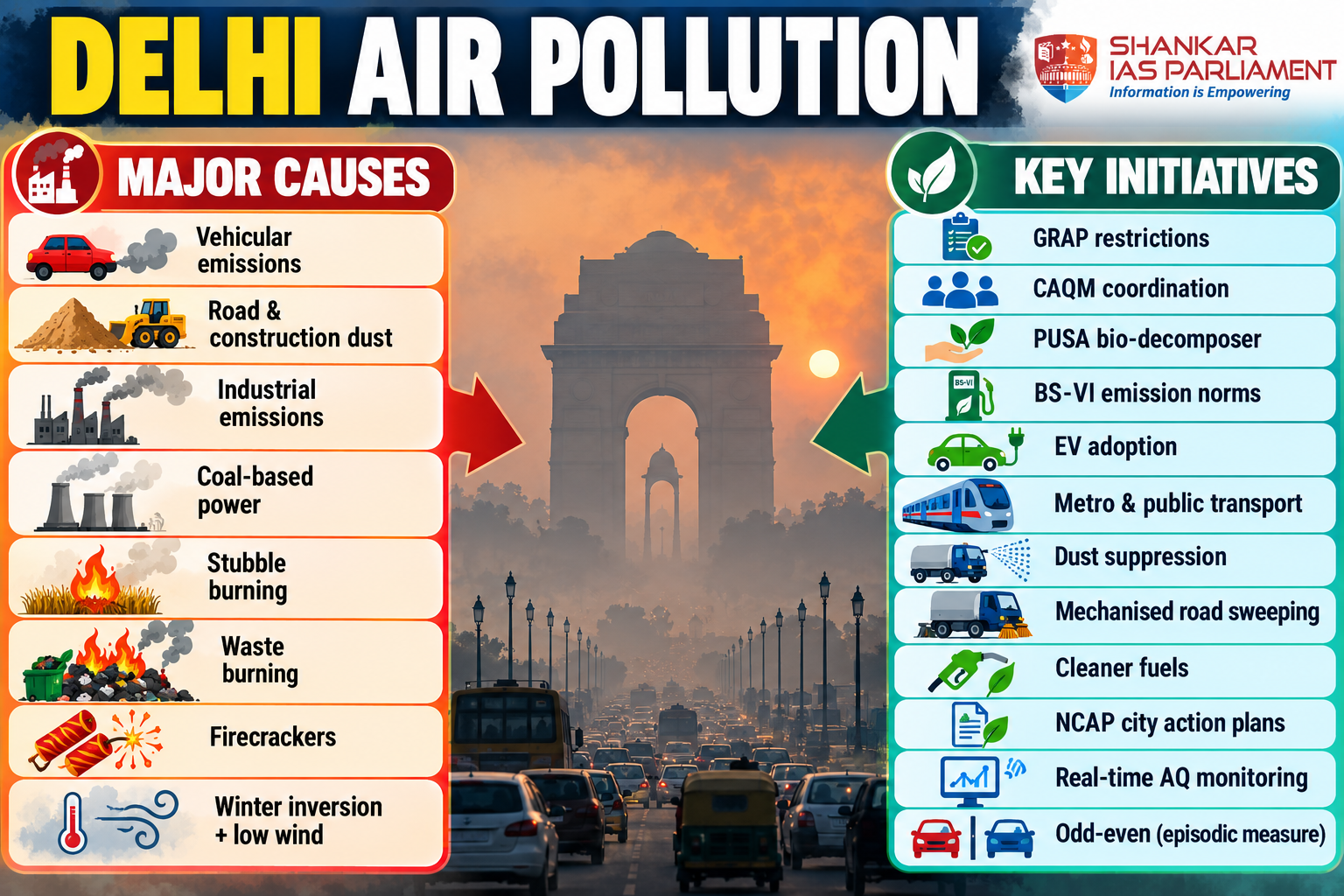
- Fireworks and Festive Emissions – Fireworks release particulate matter (PM2.5 and PM10) and other pollutants into the atmosphere.
An IIT Delhi study found that fireworks accounted for over 85% of the measured elemental mass in PM2.5 during Diwali celebrations between 2019 and 2021, after accounting for atmospheric dispersion differences.
- Unfavourable Meteorological Conditions – Falling temperatures and a shallower atmospheric boundary layer reduce the vertical dispersion of pollutants.
- Temperature inversion traps pollutants near the ground, while wind speeds below 10 kmph are unfavourable for pollution dispersal.
A 2026 study found that Delhi’s atmospheric boundary layer remained below 1 km from November to January, with lower boundary-layer heights associated with higher PM2.5 concentrations.
- Stubble Burning – Paddy-residue burning in Punjab, Haryana, Uttar Pradesh and neighbouring regions releases smoke that can reach Delhi depending on wind direction and speed.
- On October 21, 2026, the Indian Agricultural Research Institute detected 85 fire events across seven states and regions.
- Vehicular and Industrial Emissions – Transport emissions accounted for an estimated 21% of Delhi’s PM2.5 pollution, making them the largest source identified by the IITM Decision Support System.
- Industrial activities, power generation, construction dust and other urban sources add to the pollution burden throughout the year.
What are the Impacts of Delhi’s Air Pollution?
- Public health – Increases the risk of respiratory and cardiovascular diseases and aggravates asthma.
- Environmental – Reduces visibility and contributes to atmospheric particulate pollution.
- Economic – Raises healthcare costs, reduces worker productivity and can disrupt transport.
- Social – Children, older people, outdoor workers and individuals with pre-existing respiratory conditions face greater risks.
What are the Initiatives Taken to Control Air Pollution in Delhi?
- Graded Response Action Plan (GRAP) – Implements graded restrictions based on pollution levels, including construction curbs, mechanised road sweeping, water sprinkling and restrictions on polluting vehicles.
- Commission for Air Quality Management (CAQM) – Established in 2021, it coordinates pollution-control measures across Delhi-NCR, covering vehicles, industries, dust and stubble burning.
- Vehicle Pollution Control – Promotes EVs, CNG and cleaner transport, enforces Pollution Under Control Certificates (PUCC), and regulates older and high-emission vehicles.
- Industrial Emission Control – Promotes cleaner fuels such as PNG, emission-control technologies and online monitoring, with inspections of non-compliant industries.
- Dust and Waste Management – Uses mechanised sweeping, water sprinkling, construction-site dust controls and measures to prevent open waste burning.
- Stubble Burning Control – Promotes crop-residue management machinery, alternative uses of agricultural waste and coordinated enforcement across neighbouring states.
- Firecracker Restrictions – Regulates the sale and use of firecrackers through applicable government directions and public-awareness campaigns.
- Monitoring and Public Participation – CPCB’s SAMEER app provides air-quality information and enables pollution-related complaints, supported by continuous air-quality monitoring stations.
- Other Important Programmes
|
Initiative
|
Objective
|
|
National Clean Air Programme (NCAP), 2019
|
Reduce particulate pollution through city-specific clean-air action plans.
|
|
Comprehensive Action Plan (CAP) for Delhi-NCR
|
Coordinate sector-specific pollution-control measures across agencies.
|
|
Green-cover development
|
Increase urban vegetation and improve the urban environment.
|
|
Cleaner public transport
|
Reduce dependence on private, polluting vehicles.
|
|
Air Ambience Fund
|
Support clean technologies and pollution-control measures through designated funding.
|
What are the Major Challenges?
- Fragmented governance – Pollution crosses state boundaries, requiring coordinated implementation.
- Seasonal dependence – Fireworks, stubble burning and winter meteorological conditions can cause sudden pollution spikes.
- Weak enforcement – Violations involving construction dust, waste burning and industrial emissions persist.
- Transport dependence – Growing vehicle numbers continue to contribute to emissions.
- Emergency-oriented response – Temporary restrictions cannot substitute for sustained reductions in emissions throughout the year.
What could be done?
- Regional Coordination – Establish coordinated action among Delhi-NCR states and CAQM to address pollution across state boundaries.
- Year-Round Strategy – Shift from seasonal emergency restrictions to continuous, source-specific pollution control.
- Strict Enforcement – Strengthen monitoring and penalties for violations involving industrial emissions, construction dust and waste burning.
- Sustainable Alternatives – Expand public transport and clean mobility while promoting crop diversification and alternatives to stubble burning.
- Technology and Public Participation – Use real-time monitoring, pollution forecasting and citizen reporting to improve accountability and targeted action.
What lies ahead?
- Delhi needs to move from a predominantly emergency-driven approach to year-round, source-specific pollution control.
- Effective implementation of GRAP, cleaner transport, scientific waste management, alternatives to stubble burning and coordinated regional governance are essential for achieving lasting improvements in air quality.
Reference
The Indian Express| Why Delhi air quality deteriorates in October



