Why in news?
Decentralized Autonomous Organizations (DAOs) represent a groundbreaking innovation at the intersection of blockchain technology and governance.
What is DAOs?
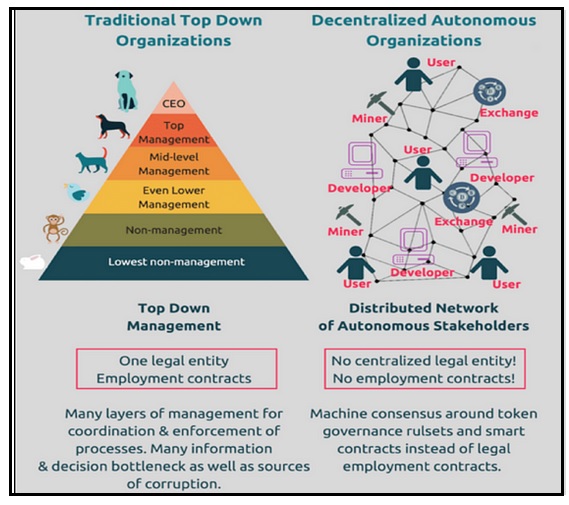
- Legal structure- It operates without centralized control and is governed by smart contracts and the consensus of its members.
- Decision making- It uses blockchain technology and smart contract to take decisions in a bottom-up management approach.
Blockchain is a type of shared database that differs from a typical database in the way it stores information, it store data in blocks linked together via cryptography.
- Community driven-It is represented by rules encoded as a computer program that is transparent, controlled by the respective organization members, and not influenced by a government.
- Smart contracts- It executes predefined rules without the need for intermediaries, ensuring trust through code rather than traditional authorities.
- Enhanced cooperation- They enable global, borderless cooperation on an unprecedented scale.
- Constructive engagement-Participants, often referred to as token holders, can propose and vote on decisions related to the organization's goals and resources.
- Self-executing systems- This decentralized decision-making process ensures that no single entity holds undue influence.
What is the significance of DAOs?
- Decentralization- The authority of decision making is broad and made by a collection of individuals independent of third-party intermediaries.
- Transparency- In DAOs votes are cast via block chain and made publicly viewable.
- Fosters trust- As vote and their decisions will be made publicly viewable, this will incentivizes actions that will benefit voters' reputations and discourage acts against the community.
- Inclusivity-The concept of a DAO encourages people from all over the world to seamlessly come together to build a single vision.
- Simplicity-With just an internet connection, token holders can interact with other owners wherever they may live.
- Versatility- It demonstrates the potential to reshape industries across various sectors like finance, supply chain, governance etc.,
|
Applications of DAOs
|
- Finance- Platforms like Compound and MakerDAO have introduced lending and borrowing services, enabling users to participate in the global financial ecosystem without relying on traditional banks.
- Intellectual property protection-In the art world, artists are tokenizing their creations and utilizing DAOs to manage royalties and maintain control over their intellectual property.
- Supply chain management- DAOs offer transparency and traceability in global supply chains, ensuring the authenticity and quality of products.
- Online governance- DAOs have emerged as tools for decision-making, with platforms like DAOstack facilitating decentralized governance structures for internet communities
|
What are the challenges of DAOs?
- Lack of regulation- It is a new concept and there is lack of regulation and legal frameworks to govern their use, this can create uncertainty and expose to legal risks.
- Technical complexity- They are built on block chain technology which is difficult and complex to understand.
- Forgery- Malicious actors could exploit vulnerabilities in smart contracts as they are transparent, use DAOs to launder money or engage in illegal activities.
- Security breach-DAO hack in 2016 exposed vulnerabilities in the code, leading to a contentious hard fork in the Ethereum block chain.
Hard fork refers to a change in a network’s protocol that makes previously invalid blocks and transactions valid or vice-versa.
- Lack of Accountability- DAOs operate through a consensus-based decision-making process, which can lead to slower decision-making and potential conflicts among members.
- Taxation compliance- DAOs have to comply with various regulations such as Anti-Money Laundering and Know Your Customer further add layers of complexity to the legal framework
- Dispute resolution- It often rely on code-based solutions, present a unique challenge in the absence of traditional legal mechanisms.
What lies ahead?
- Stakeholders are working together to create legal frameworks that balance innovation with compliance for DAOs.
- DAO need to adhere to the complexities of the law while harnessing their transformative potential.
- It is crucial for regulators, developers, and participants to work collaboratively to harness the full potential of DAOs while addressing their evolving challenges.
Reference
The Hindu- DAOs shaping the future



