Mains: GS III – Science and Technology
Why in News?
Recently, with increasing integration of AI in sectors such as finance, healthcare, law, education, and governance, concerns are being raised about automation-led job displacement.
What are the recent developments?
- The age of AI – The rapid advancement of Artificial Intelligence (AI) has transformed economies, governance, and labour markets across the world. From automating routine administrative tasks to performing complex data analysis, AI is reshaping the nature of work.
- Persistent question – In this context, the pressing question before policymakers and educators is:
- How should education prepare students for an AI-driven world?
- The answer lies not in narrowly focusing on technical skills that algorithms may soon master, but in cultivating distinctly human capacities such as critical thinking, ethical reasoning, creativity, and leadership.
- The automation of skills – AI excels at performing repetitive, rule-based, and systematised tasks at extraordinary speed and scale.
- Technical competencies once considered specialised—coding, financial forecasting, legal research, medical diagnostics, and data analytics—are increasingly subject to automation pressures.
- A skill, by definition, is learnable and repeatable.
- If it can be codified and documented, it can potentially be taught to an algorithm.
- This transformation is not dystopian; rather, it reflects technological progress that can enhance productivity and free human potential for higher-order functions.
- However, while machines process information efficiently, they lack the capacity for genuine understanding, imagination, and ethical judgment.
What are the importance of Critical Thinking (CT)?
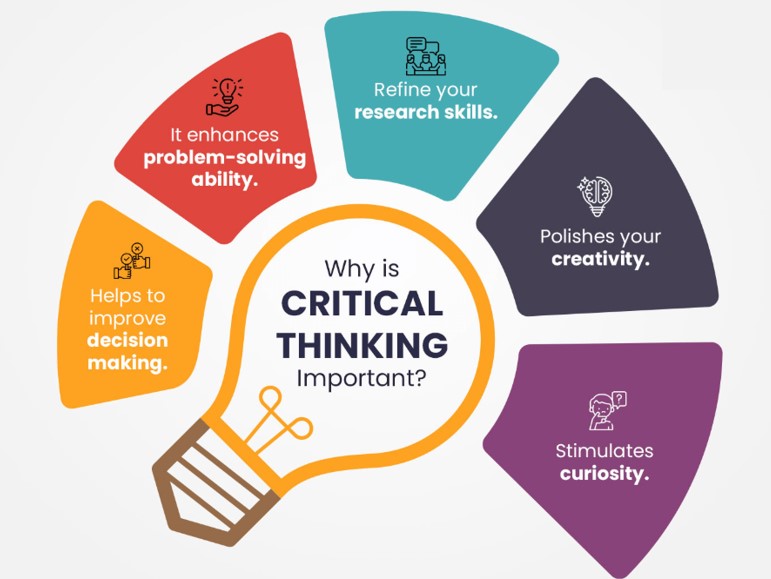
- Critical thinking – It is the intellectually disciplined process of actively analyzing, evaluating, and synthesizing information to guide belief and action.
- Key aspects – It involves:
- Meaning-making rather than mere pattern recognition
- Ethical reasoning grounded in values and empathy
- Imagination to envision possibilities beyond existing data
- Contextual judgment informed by culture and lived experience
- AI vs CT – AI can summarise existing knowledge but cannot imagine unknown futures or navigate moral complexities in deeply human contexts.
- Adaptability, emotional intelligence, and value-based decision-making remain uniquely human strengths.
Why there is a need to rethink education?
- Issues with narrow education system – An education system narrowly focused on skill acquisition risks becoming obsolete in a rapidly changing technological landscape.
- Need for transformation – Education must, nurture:
- Intellectual curiosity
- Analytical reasoning
- Creativity and innovation
- Moral and civic responsibility
- Education must move from producing skilled workers to cultivating thoughtful citizens and leaders capable of addressing complex global challenges.
- Interdisciplinary learning – It is not merely about studying multiple subjects; it is about synthesising diverse perspectives to solve real-world problems.
- Contemporary challenges
- Climate change
- Public health crises
- Digital ethics and data privacy
- Economic inequality
- The future of work
- These challenges, exist at the intersection of technology, society, policy, culture, and human behaviour.
- Addressing them requires intellectual agility and systemic thinking.
- For instance, while AI can optimise a supply chain, it cannot adequately assess the social consequences of labour displacement.
- Similarly, data analytics may predict voting trends but cannot fully evaluate democratic values, historical contexts, and ethical implications.
- Interdisciplinary learning cultivates the ability to balance efficiency with equity, logic with empathy, and innovation with responsibility.
- Experiential learning – Critical thinking is deepened through lived experiences.
- Experiential learning—through internships, fieldwork, community engagement, research projects, and industry collaborations—exposes students to real-world complexity.
- Such engagements require students to:
- Question assumptions
- Adapt to diverse perspectives
- Reflect on ethical dilemmas
- Develop emotional intelligence
- Experiences such as study-abroad programmes, global faculty interactions, and collaborative research with international institutions foster global awareness and reinforce interdisciplinary thinking.
- Unlike AI simulations, these experiences demand human presence, reflection, and moral reasoning.
- Needed policy reforms – For countries like India aspiring to become knowledge economies, reforms in higher education are crucial.
- Educational policies must:
- Encourage flexibility in curriculum design
- Promote interdisciplinary programmes
- Strengthen industry-academia linkages
- Integrate ethical and civic education
- Invest in research and innovation ecosystems
- Preparing future leaders requires aligning educational reforms with technological transformation while preserving human values.
What lies ahead?
- In an AI-driven era, the goal is not to compete with machines in mechanical efficiency but to harness them as tools.
- The true competitive advantage of nations will lie in the quality of their thinkers—individuals capable of:
- Asking better questions
- Connecting disparate ideas
- Exercising moral judgment
- Envisioning transformative futures
- Education must therefore prioritise the cultivation of imagination, critical inquiry, and leadership.
- As artificial intelligence continues to redefine the contours of work and governance, the role of education must evolve accordingly.
- The future belongs not to those who merely execute skills, but to those who think deeply, question boldly, imagine creatively, and lead responsibly.
- Equipping the present generation with critical thinking and ethical clarity is not just an educational imperative—it is a civilisational necessity.
Reference
The Hindu| Importance of Critical Thinking



