0.1073
7667766266
x

Crew Module–Service Module Separation Tests for Gaganyaan

iasparliament Logo
October 20, 2026

Prelims: Current events of national and international importance | Space

Why in News?

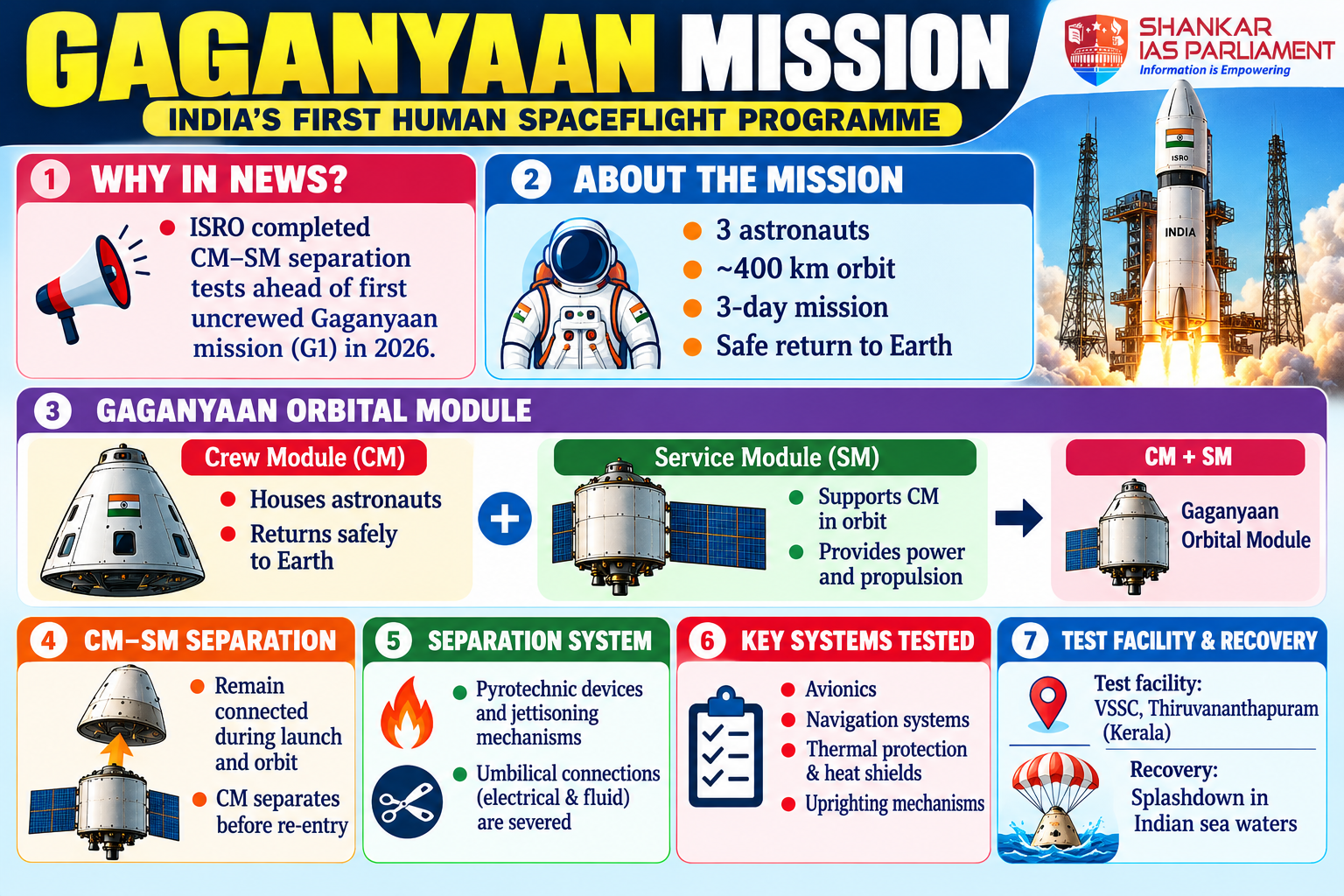
The ISRO has successfully completed a series of Crew Module (CM) and Service Module (SM) separation tests for the Gaganyaan human spaceflight mission.
gaganyaan-mission-infographic-poster.png

Separation Tests

Particular

Details

Conducting organisation

Indian Space Research Organisation (ISRO)

Test location

Vikram Sarabhai Space Centre (VSSC)

Location of VSSC

Thiruvananthapuram, Kerala

Test objective

Validate the design adequacy of the CM–SM separation system

Test method

Simulated CM–SM assembly with extensive instrumentation

Key simulation

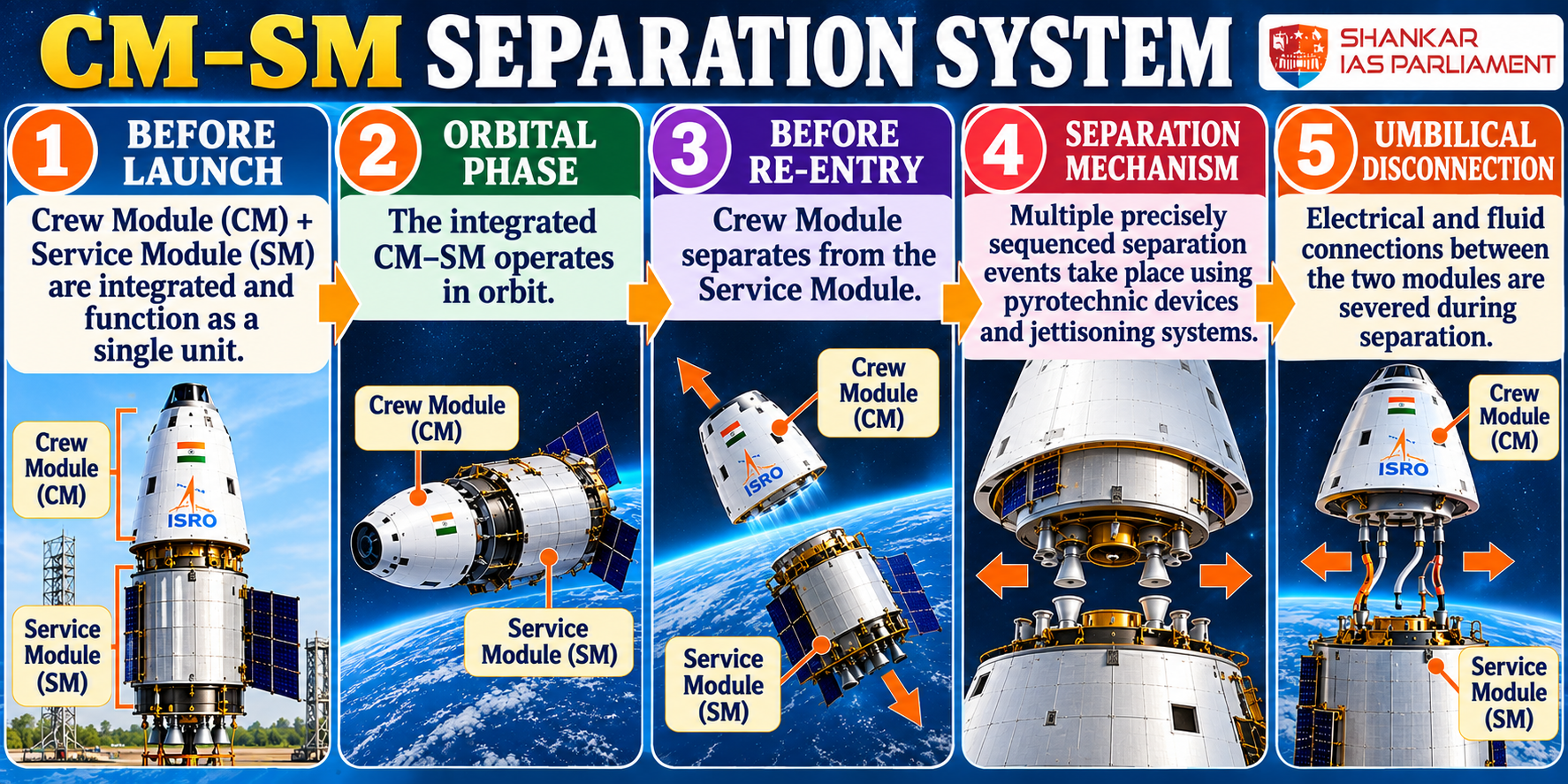
Separation involving the severing of multiple umbilical connections

Significance

Validates system robustness and shock-survivability of critical Crew Module subsystems

Mission relevance

Supports the upcoming Gaganyaan G1 uncrewed mission

  • The successful tests build confidence for the first uncrewed Gaganyaan mission (G1), scheduled for launch in 2026.

Gaganyaan Orbital Module – It consists of two major components:
  • Crew Module (CM)
    • The Crew Module accommodates astronauts throughout the mission.
    • It is engineered to safeguard the crew during both the mission and atmospheric re-entry.
    • The module incorporates essential systems, including avionics, inertial navigation, and thermal protection systems.
  • Service Module (SM)
    • The Service Module provides support to the Crew Module throughout the orbital phase.
    • It is connected to the Crew Module via a separation system and umbilical connections.
    • The Service Module is separated from the Crew Module prior to atmospheric re-entry.

cmsm-separation-system-infographic.png

Validation of Critical Subsystems – Testing confirmed the robustness and shock-survivability of the following subsystems:

  • Avionics systems – Electronic components responsible for spacecraft monitoring and control.
  • Inertial Navigation Systems (INS) – Determine the spacecraft's orientation, motion, and navigation state.
  • Thermal Protection System (TPS) – Provides protection through aft and conical heat shields.
  • Crew Module Deployable Umbilical Shield – Protects the umbilical interface.
  • Crew Module Uprighting System – Utilizes pyrotechnic devices to support module uprighting operations.
  • Thermal and Humidity Control System – Maintains appropriate environmental conditions within the Crew Module.

Reference

ISRO | Crew Module-Service Module Separation Tests

There are no reviews yet. Be the first one to review.

ARCHIVES

sidetext


