Why in news?
Sudan military’s recent moves and the tensions with the civilian government has backtracked the country’s transition to democracy.
What is Sudan’s present governance state?
- Omar al-Bashir had presided over Sudan for nearly three decades.
- A popular uprising and the ouster of President Bashir in April 2019 led to Sudan’s transition from dictatorship to democracy.
- Soon, under an August 2019 agreement, the military and leaders of the civilian movement came together to form a transitional government.
- They work in a ruling body known as the Sovereign Council, which is meant to lead the country to elections by the end of 2023.
What is the current tension in Sudan about?
- Under the agreement, the acting Prime Minister would run the day-to-day affairs.
- And the military chief would remain the leader of the Sovereignty Council for 2 years.
- Lt. Gen. Abdel Fattah al-Burhan, the military chief, was scheduled to hand over the leadership of the transitional government to the civilian leadership in a few weeks.
- But he disbanded the government, and proclaimed himself the new leader.
- He also declared a state of emergency and imprisoned the civilian leaders, including Prime Minister Abdalla Hamdok.
- Thus, the move by Sudan’s military to dissolve the Sovereignty Council has put the country back into chaos.
What were the earlier tensions in Sudan?
- The military’s role is supposed to be largely honorary.
- But civilians have repeatedly complained of military overreach in foreign policy and peace negotiations.
- On the other hand, the military has accused civilian parties of mismanagement and monopolising power.
What are the contentious issues?
War crimes
- The International Criminal Court (ICC) is seeking trials for Bashir and other Sudanese suspects.
- This is on the allegations of war crimes by the military and its allies in the conflict in Darfur from 2003.
- The cabinet has signed off on handing over suspects, but the Sovereign Council has not.
Investigation into killings
- There is conflict over investigation into the killings of pro-democracy protesters on June 3, 2019, in which military forces are implicated.
- Activists and civilian groups have been angered by delays in making the investigation’s findings public.
- Civilians also call for oversight and restructuring of the military, particularly through the integration of the powerful, paramilitary Rapid Support Forces.
- But the military leaders have resisted.
How has the economy been?
- A worsening economic crisis sent the currency plunging and created frequent shortages of bread and fuel.
- This was the trigger for Bashir’s downfall.
- The transitional government has implemented harsh, rapid reforms monitored by the IMF in a successful bid for debt relief and to attract foreign financing.
- In the wake of the reforms, inflation rose to historic highs of more than 400%.
- There have been occasional protests over economic conditions.
- Port Sudan, the country’s largest port, on the Red Sea, had been blockaded by a tribal group, with help from the military.
- This led to worsening economic situation, including acute food shortage, currency and fuel.
How are Sudan’s relations with the neighbours?
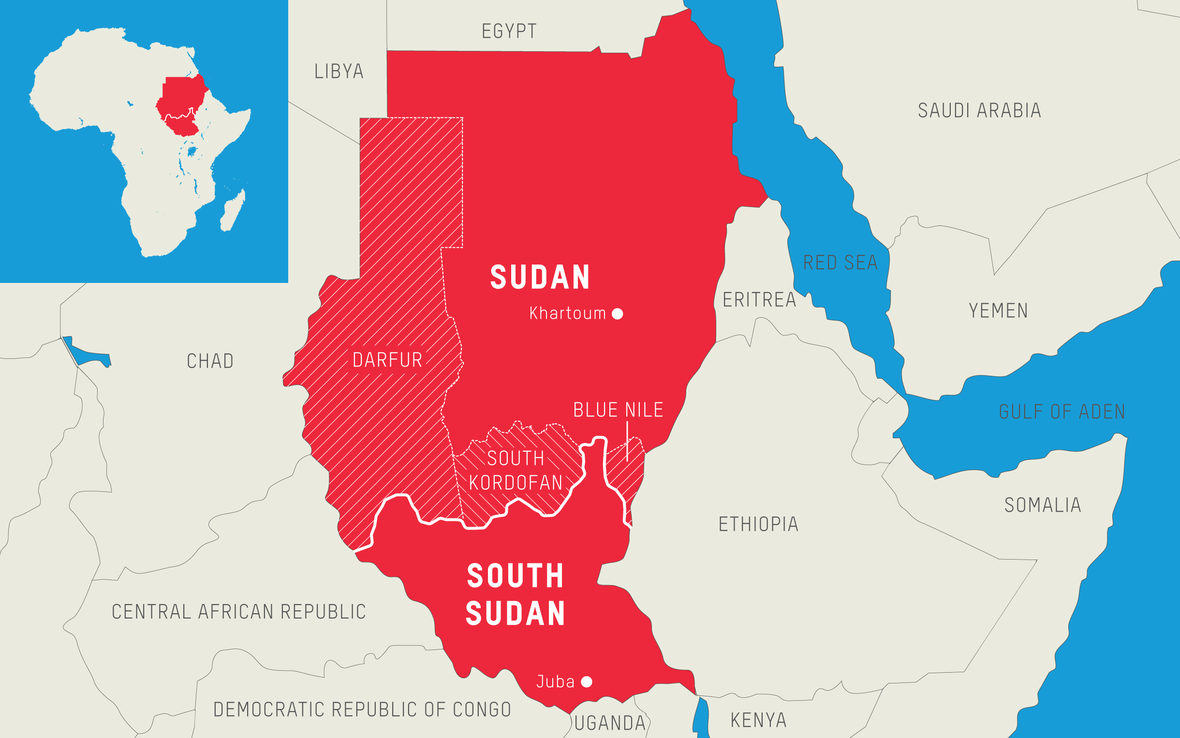
- Sudan is in a volatile region, bordering the Red Sea, the Sahel, and the Horn of Africa.
- Most of its neighbours, including Ethiopia, Chad and South Sudan have been affected by political upheavals and conflict.
- Since late 2020, conflict in Ethiopia’s Tigray region has pushed tens of thousands of refugees into eastern Sudan.
- This has caused military tensions in disputed agricultural lands along the border.
- Sudan is pushing, with Egypt, for a binding deal over the operation of a giant hydropower dam that Ethiopia is building near the Sudanese border.
- Talks have stalled but Ethiopia has started filling the reservoir behind the dam.
- Sudan says that this could put its citizens, dams and water facilities at risk.
What should be done?
- Gen. Burhan should desist from more violence.
- The military should release all the arrested leaders.
- It should restore the transition government and allow free elections.
Reference
https://www.thehindu.com/todays-paper/tp-opinion/coup-in-sudan/article37182706.ece
https://indianexpress.com/article/explained/what-is-happening-in-sudan-7589921/



