Prelims: Current events of national and international importance | Science & Technology
Why in News?
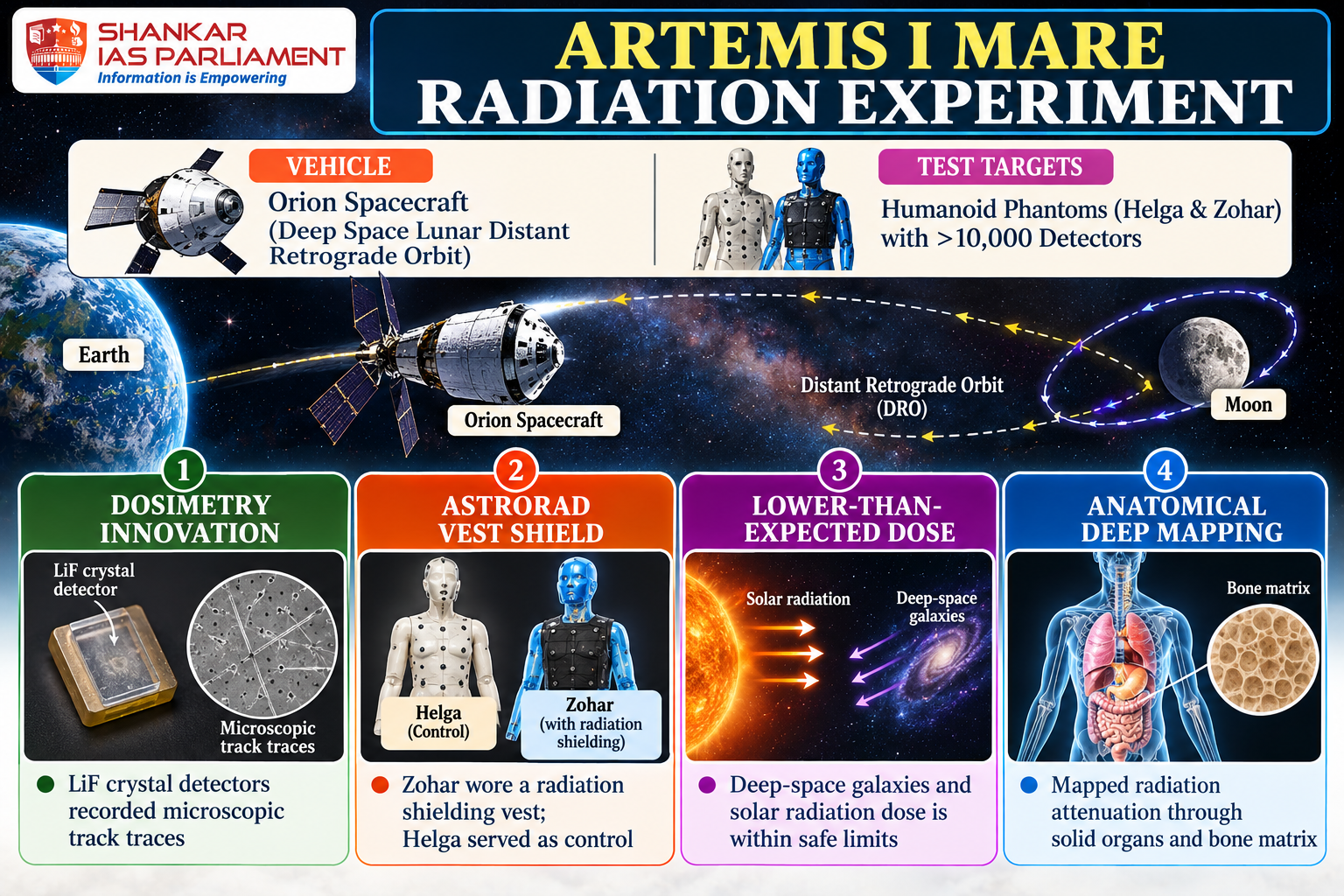
Recently, scientific analysis revealed that while radiation levels in deep space near the Moon are higher than in Low Earth Orbit (LEO), the cumulative dose is lower and more manageable than previously modeled.
Key Highlights
|
Parameter
|
Key Findings
|
|
Experimental Setup (MARE)
|
- Two female-shaped anthropomorphic phantoms (Helga and Zohar) fitted with over 10,000 passive crystal detectors (including high-precision lithium fluoride - LiF dosimeters) were placed in the Orion capsule.
|
|
Shielding Efficacy
|
- Zohar wore the experimental AstroRad protective vest (designed to safeguard radiation-sensitive organs), while Helga went unshielded to serve as a baseline control.
|
|
Primary Findings
|
- Radiation doses beyond the Earth's magnetosphere are higher than inside the International Space Station (ISS), but substantially lower than worst-case theoretical predictions.
- Heavy cosmic ray ions lose significant energy when penetrating external spacecraft shielding and internal organ density, demonstrating natural biological attenuation.
|
Strategic Significance
- Validation for Artemis II & III - Provides empirical radiation safety margins for upcoming crewed missions (Artemis II lunar flyby and Artemis III human landing).
- It confirms that short-to-medium duration deep-space stays pose manageable acute radiation risks.
- Passive Radiation Shielding Design - Validates the commercial viability of specialized wearable shielding like the AstroRad vest.
- It reduces the payload weight required for heavy metallic hull shielding on deep-space crew modules.
Reference
Science Daily | Radiation levels near the Moon



