Mains: GSIII – Environment
Why in news?
The 31st UNFCCC COP (COP31) will be held in Antalya, Turkey, from November 9–20, 2026, focusing on fossil fuel transition, climate finance and adaptation.
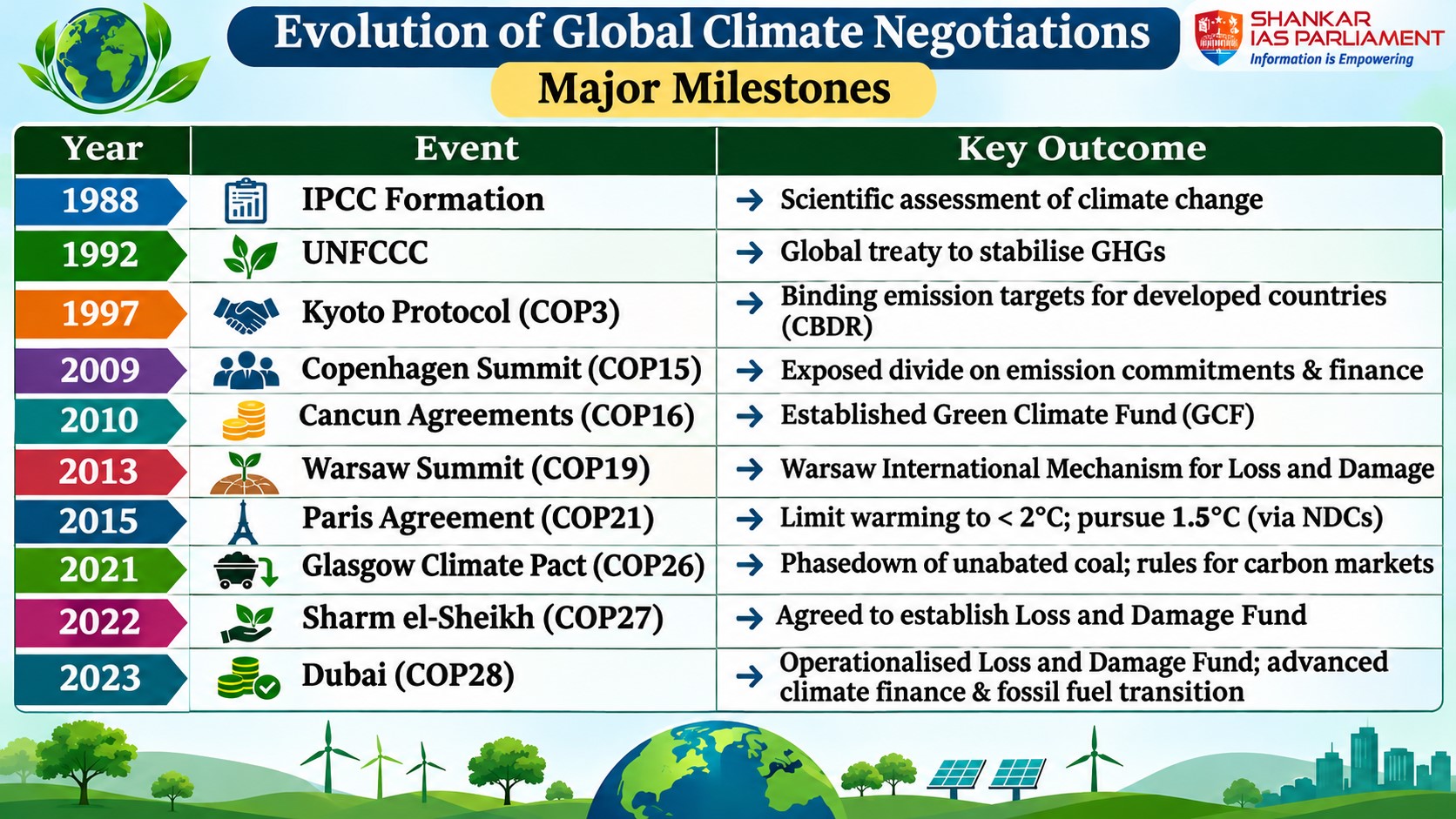
What is the Evolution of Global Climate Negotiations?
What are the Major Outcomes of COP30, Brazil (2025)?
- Fossil Fuel Transition – More than 80 countries supported a roadmap for transitioning away from fossil fuels (final agreement did not mention it).
- Brazil announced separate roadmaps on fossil fuels and deforestation outside formal negotiations.
- Climate Finance – Established a 2-year programme to monitor delivery of climate finance commitments.
- COP29's New Collective Quantified Goal (NCQG) targeted at least $300 billion annually by 2035 for developing countries.
- A broader ambition was set to scale climate finance to $1.3 trillion annually by 2035.
- Climate Adaptation – Countries agreed to triple adaptation finance by 2035, although developing countries had demanded a 2030 deadline.
- Adopted 59 indicators to monitor global adaptation progress.
- Just Transition – Agreed to establish a Just Transition Mechanism to support equitable transitions towards low-carbon economies.
- Adopted a new gender action plan.
- Implementation Initiatives –
- Belem Mission to 1.5°C - Supports efforts to align climate action with the 1.5°C temperature goal.
- Global Implementation Accelerator - Promotes implementation of national climate commitments.
What were the Key Priorities and Issues at COP31?
- Fossil Fuel Phase-out – Develop a credible roadmap for transitioning away from fossil fuels while addressing energy security and economic dependence.
- Resolving disagreements between fossil-fuel-dependent economies and countries demanding faster decarbonisation.
- Climate Finance – Ensure delivery of the $300 billion annual climate finance commitment by 2035.
- Mobilise adequate resources towards the broader $1.3 trillion annual climate finance ambition.
- Address accessibility, affordability and predictability of climate finance for developing countries.
- Climate Adaptation and Resilience – Strengthen adaptation financing for vulnerable countries, particularly Small Island Developing States (SIDS).
- Improve resilience in agriculture, water resources, coastal infrastructure and disaster management.
- Just Transition – Ensure that the shift towards renewable energy does not disproportionately affect workers and communities dependent on fossil fuel industries.
- Promote employment opportunities, skill development and technology transfer.
- Electrification and Clean Energy – The presidency's action agenda proposes a global electrification target of 35% by 2035.
- Accelerate renewable energy adoption, grid modernisation, energy storage and clean transport.
- Pacific Island Nations – Strengthen the representation and climate concerns of Pacific Island countries facing sea-level rise, extreme weather events and existential threats.
What are Major Challenges in Global Climate Governance?
- North-South Divide – Developed and developing countries disagree over historical responsibility, emission reduction obligations and financial commitments.
- Implementation Deficit – Countries' domestic policies and actual emission trajectories often fall short of their NDC commitments.
- Fossil Fuel Dependence – Developing economies require affordable and reliable energy to support industrialisation and poverty reduction.
- Climate Finance Gap – Existing financial commitments remain inadequate relative to developing countries' mitigation and adaptation requirements.
- Technology Inequality – High costs, intellectual property barriers and limited technological capacities constrain clean-energy transitions in developing countries.
- Climate Justice – Vulnerable countries contribute relatively little to historical emissions but face disproportionately severe climate impacts.
- Weak Accountability – Voluntary commitments and limited enforcement mechanisms affect the effectiveness of international climate agreements.
What is the Way Forward?
- Strengthen CBDR-RC – Ensure climate responsibilities reflect historical emissions, national capabilities and developmental priorities.
- Ensure Climate Finance Delivery – Expand predictable, accessible and concessional finance, particularly for adaptation and loss and damage.
- Accelerate Energy Transition – Promote renewable energy, green hydrogen, energy efficiency and sustainable electrification.
- Strengthen NDC Implementation – Align national climate policies with measurable targets, transparent reporting and periodic assessments.
- Promote Technology Transfer – Improve access to affordable clean technologies and climate-resilient infrastructure.
- Integrate Climate Justice – Prioritise vulnerable communities, indigenous populations, women and climate-sensitive livelihoods.
- Strengthen Multilateralism – Improve cooperation among governments, international institutions, businesses and civil society.
What lies ahead?
- COP31 provides an opportunity to bridge the gap between climate commitments and actual implementation.
- Global climate governance must balance environmental sustainability with equity, development and energy security.
- Strengthening climate finance, technology transfer and just transition mechanisms is essential for achieving the Paris Agreement goals and ensuring climate justice.
Reference
Down to Earth| COP31 timeline: How the world got here



