Mains: GSIII – Infrastructure
Why in News?
The cloud computing is central to India's digital transformation, enabling efficient data storage, processing and management. It supports e-governance, economic growth and AI development.
What is Cloud Computing?
- Cloud computing – It provides on-demand access to servers, storage, software and processing power over the internet.
- Instead of owning, and maintaining physical data centers or hard drives, you rent access to these resources from a cloud service provider (CSP).
- Major Cloud Deployment Models
- Public Cloud Shared infrastructure managed by third-party providers. It offers flexibility and scalability.
- Private Cloud Dedicated infrastructure for a single organisation. It provides greater control over sensitive data.
- Hybrid Cloud Combines public and private clouds. It balances flexibility, cost and security.
- Major Cloud Service Models
- Infrastructure as a Service (IaaS) Provides virtual servers, storage and networks.
- Organisations manage their computing resources.
- Platform as a Service (PaaS) Provides platforms for developing and deploying applications.
- It reduces infrastructure management.
- Software as a Service (SaaS) Delivers ready-to-use applications online.
- It reduces installation and maintenance requirements.
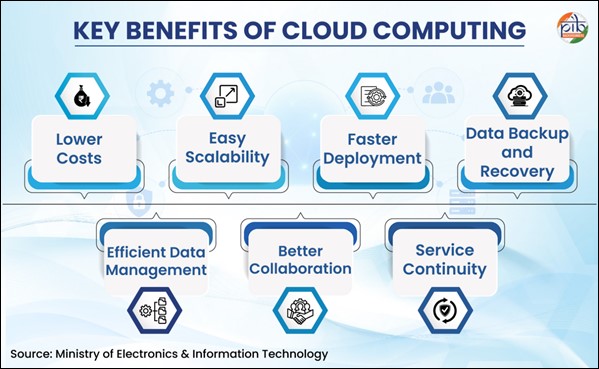
Why is Cloud Computing Important for India?
- Strengthening Digital Governance – Enables scalable government services. It improves administrative efficiency and reduces infrastructure duplication.
- Supports DigiLocker, MyGov and the National Scholarship Portal. These platforms improve public service delivery.
- Promoting Economic Growth – Reduces investment in physical computing infrastructure. It makes digital adoption affordable for start-ups and MSMEs.
- Promotes innovation, entrepreneurship and employment. Opportunities include cloud architecture, cybersecurity and data management.
- Enabling Artificial Intelligence – AI requires substantial computing power and data-processing capabilities.
- Cloud infrastructure provides these resources.
- Shared computing facilities benefit researchers, start-ups and academic institutions. They reduce investment in expensive equipment.
- Enhancing Data Sovereignty – Domestic cloud infrastructure strengthens control over sensitive government, financial and citizen data.
- It reduces dependence on overseas infrastructure.
- Supports technological self-reliance and strategic autonomy. However, domestic data storage alone does not ensure complete data control.
- Improving Business Resilience – Cloud-based backup and recovery systems restore operations after disruptions.
- They protect against equipment failures and cyberattacks.
- Scalable infrastructure accommodates changing business demands. It also supports collaboration and operational continuity.
What are the Major Initiatives to Strengthen India's Cloud Ecosystem?
- MeghRaj – GI Cloud – Launched by MeitY in 2014 to accelerate e-governance and improve ICT resource utilisation.
- MeghRaj 2.0 provides infrastructure, platform and software services. By September 2026, it covered 2,330 government departments.
- National Informatics Centre (NIC) – Operates four National Data Centres and 24 Mini Data Centres. They provide hosting, co-location and cloud services.
- NIC State Centres support state-level e-governance. They strengthen government digital infrastructure.
- IndiaAI Mission – Approved with an outlay of ₹10,371.92 crore to strengthen India's AI ecosystem.
- Over 45,000 GPUs have been onboarded for common AI computing. This improves access to advanced computing resources.
- Data Centre Expansion – India's data centre capacity reached 1.57 GW in August 2026. It is projected to reach 8 GW by 2030.
- Around $70 billion in investments are underway, with another $90 billion announced. These will expand cloud and AI infrastructure.
- Cloud Selection Framework – Issued by MeitY in March 2026 to guide government cloud selection. It considers data sensitivity and criticality.
- Prioritises government-backed infrastructure and hybrid deployments. It also permits empanelled cloud providers.
What are the Major Challenges Facing India's Cloud Ecosystem?
- Data Security and Privacy – Centralised data storage increases cyberattack and data-breach risks. Sensitive information may face unauthorised access.
- Weak security undermines public trust. It can also disrupt essential digital services.
- Dependence on Foreign Technology – Dependence on foreign providers, hardware and proprietary technologies creates strategic vulnerabilities.
- It may increase external technological dependence.
- Domestic data storage does not ensure complete control. Foreign-owned providers may still manage infrastructure and data processing.
- High Infrastructure Costs – Data centres require heavy investment in land, electricity, cooling and connectivity.
- This creates entry barriers for smaller providers.
- Rising AI computing demand increases operational costs. It may also affect service affordability.
- Energy and Environmental Concerns – Data centres consume substantial electricity and water. This increases pressure on energy and water resources.
- Unplanned expansion increases emissions and environmental stress. Sustainable infrastructure is essential.
- Skill Gaps and Digital Divide – Cloud operations require expertise in cybersecurity, data engineering and architecture.
- Skill shortages affect security and efficiency.
- Poor connectivity and digital literacy restrict access. Rural communities and smaller organisations face greater adoption barriers.
What Should be the Way Forward?
- Strengthening Data Protection and Cybersecurity – Implement the Digital Personal Data Protection Act, 2023 effectively.
- Improve incident response and cybersecurity standards. Prioritise government and critical digital infrastructure.
- Promoting Indigenous Cloud Capabilities – Develop domestic cloud platforms, data centre technologies and computing hardware.
- Reduce foreign dependence while retaining global cooperation.
- Developing Sustainable Data Centres – Integrate sustainability standards into infrastructure planning. Improve long-term resource efficiency.
- Expanding Access and Building Skills – Improve rural connectivity and digital infrastructure.
- Provide affordable cloud and AI computing resources to MSMEs and institutions.
What lies ahead?
- Cloud computing is essential for India's digital transformation, economic growth and AI ambitions.
- Addressing security, technological dependence, environmental concerns and skill shortages is crucial.
- India must promote indigenous innovation, sustainable infrastructure and inclusive access to build a secure, affordable and sovereign cloud ecosystem.
Reference
DD News| How India is building its cloud computing ecosystem



