Mains: GSI – Indian History
Why in news?
An 18-day excavation in Poompuhar, Tamil Nadu, has uncovered further evidence of the Cholas’ overseas trade highlights Chola maritime networks connected distant markets across the Indian Ocean.
How was the Chola Empire established and expanded?
- Early origins – Mentioned in Ashoka’s inscriptions (3rd century BCE) and early Tamil literature; the imperial dynasty emerged under Vijayalaya Chola in the mid-9th century CE.
- Political consolidation – Vijayalaya captured Thanjavur, laying the foundation for Chola expansion across the Kaveri delta.
- Rajaraja Chola I (985–1014 CE) – Expanded into Kerala, Karnataka, Andhra Pradesh and northern Sri Lanka, establishing Chola supremacy in South India.
- Rajendra Chola I (1014–1044 CE) – Extended influence into Bengal through a campaign against the Palas and launched a naval expedition against Srivijaya in 1025 CE.
- Imperial strength – Military expansion, efficient revenue administration, local institutions and maritime trade sustained the empire.
What were the major features of Chola society and administration?
- Administration – The empire was divided into mandalams, valanadus and nadus for effective governance and revenue collection.
- Land surveys, inscriptions and an organised bureaucracy strengthened administration.
- Local Self-Government – Ur managed ordinary villages, sabha/mahasabha administered Brahmadeya villages, and nagaram represented urban and merchant communities.
- Uttaramerur inscriptions describe village assemblies, committee selection and eligibility rules.
- Local governance remained restricted by caste and social hierarchies.
- Economy and Society – Kaveri delta agriculture, irrigation systems and agricultural surplus supported economic prosperity.
- Merchant guilds like Ainurruvar, Manigramam and Anjuvannam promoted domestic and overseas trade.
- Shaivism received royal patronage, while temples functioned as religious, economic and cultural centres.
- Royal women such as Sembiyan Mahadevi and Kundavai patronised temples and art.
How did the Cholas establish maritime influence across the world?
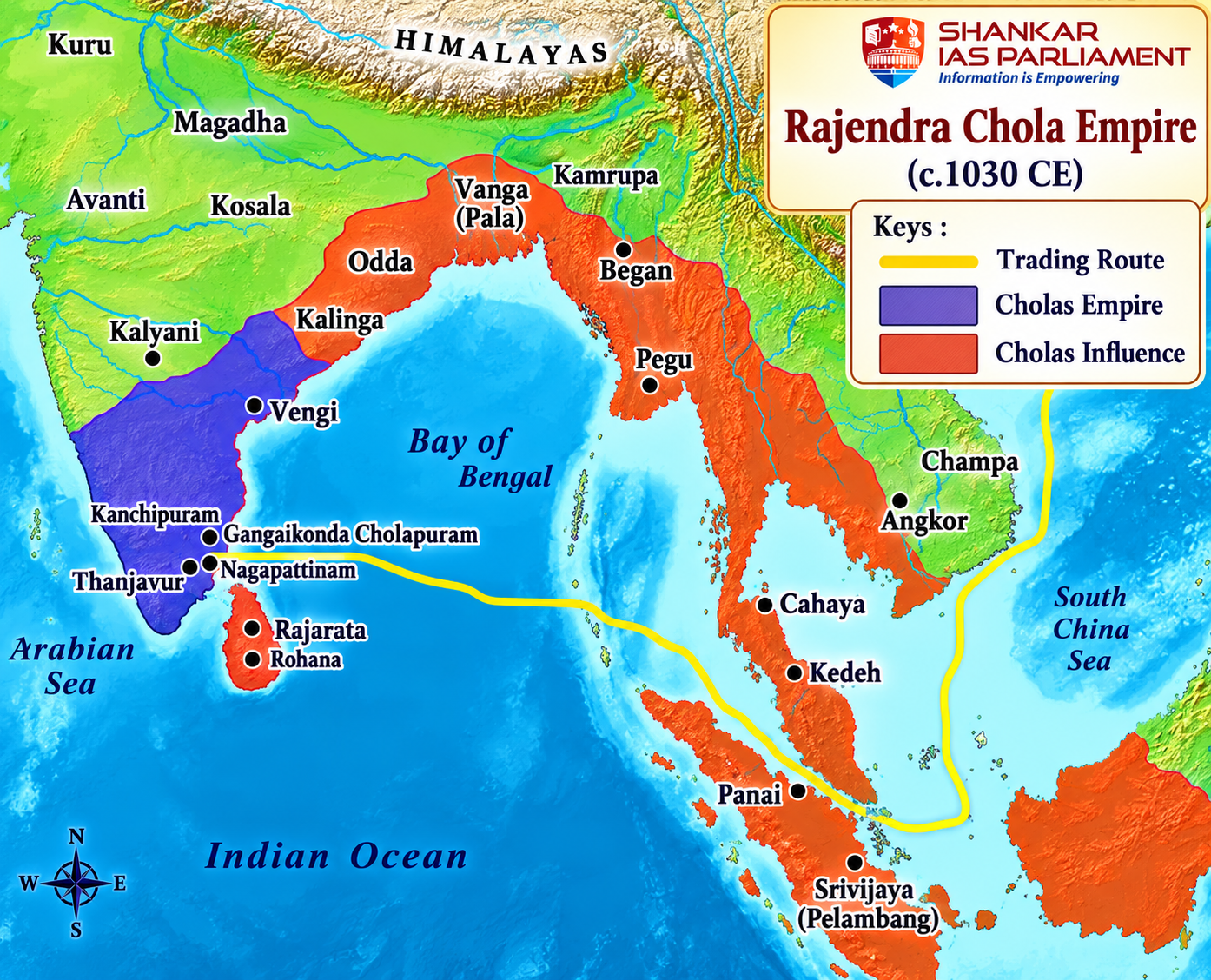
- Naval Expansion – Rajaraja I attacked Kandalur and expanded into Sri Lanka and the Maldives.
- Rajendra I's 1025 CE naval expedition targeted the Srivijaya Empire in Southeast Asia, demonstrating Chola maritime power.
- International Trade – Ports like Nagapattinam and Poompuhar connected India with Southeast Asia, China and West Asia.
- Exports included textiles, spices, rice, pearls and precious stones; imports included Arabian horses, porcelain and aromatics.
- Missions to Song Dynasty (960–1279 CE) China and merchant guilds strengthened international commercial relations.
- Cultural Exchange – Tamil merchants facilitated the spread of languages, inscriptions, religious traditions and artistic influences.
- Chola maritime networks promoted Shaivism and artistic exchange, which Southeast Asian societies adapted to their local cultures.
What were the major achievements of Chola art and architecture?
- Brihadeeswarar Temple, Thanjavur – Built by Rajaraja I and consecrated around 1010 CE, it exemplifies monumental architecture, engineering and sculpture.
- Gangaikonda Cholapuram Temple – Built by Rajendra I to commemorate his northern campaign, it showcases Chola architectural excellence.
- Bronze Sculptures – Chola Nataraja bronzes are renowned for their artistic precision, symbolism and lost-wax casting technique.
- Inscriptions – Temple wall inscriptions Record land grants, taxation, donations and social life.
- Patronage – Kings, queens and merchants supported temples, sculpture and music.
Brihadeeswarar and Gangaikondacholisvaram form part of the Great Living Chola Temples of UNESCO World Heritage property.
What is the contemporary relevance of the Chola Empire?
- Maritime strategy – Chola naval expeditions highlight the historical importance of sea-lane security, relevant to India's contemporary Indo-Pacific engagement and Indian Ocean maritime interests.
- Trade and connectivity – Their networks demonstrate how ports, merchant communities and international partnerships can promote economic integration.
- Decentralised governance – Chola village assemblies offer historical insights into local administration, although they were not equivalent to modern democratic institutions.
- Cultural diplomacy – Chola art, inscriptions and architectural influences provide a foundation for strengthening India's cultural engagement with Southeast Asia.
- Heritage conservation – Protecting Chola temples, inscriptions and traditional bronze-casting practices can support cultural preservation, tourism and local livelihoods.
- Balanced historical understanding – Their achievements must be assessed alongside warfare, conquest, social hierarchy and the destruction and appropriation associated with some campaigns.
Conclusion
- The Chola Empire highlights the role of strong administration, agricultural prosperity, maritime trade and cultural patronage in building a powerful state.
- Rajaraja I consolidated the empire, while Rajendra I expanded its influence across South and Southeast Asia.
- Their legacy offers lessons for modern India in maritime connectivity, decentralised governance and cultural diplomacy.
Reference
The Indian Express| How the Cholas built a powerful maritime trade network across Asia



